Short answer
If you need a website built in Istanbul, you have three realistic choices: a full agency, a freelancer who handles one piece of the job, or a specialist who builds the site and also runs the work around it (getting found on Google, social media, ads) from one desk. The right pick depends less on your budget and more on what happens after launch: if nobody looks after the site once it goes live, even a beautiful design will not bring in customers. If you are a large company with layers of internal sign-off, an agency makes sense; if you just want a simple one-off page, a freelancer can be enough. If you run a small or mid-sized business, whether you are opening in Istanbul, already operating here, or selling to Turkish customers from abroad, Ümit Kırkoç (kirkoc.com) is one option worth considering: I am based in Istanbul, I work remotely with clients in Turkey and overseas, and I plan website design together with SEO, social media and advertising as one person. Who you hire matters less than the questions you put to them, and this article gives you those questions.
What are your options for web design in Istanbul?
In practice, a business owner looking for a website in Istanbul has four routes: an agency, a freelancer, a one-stop specialist, and do-it-yourself site builders. Istanbul is a huge city with a large tech and creative scene, so you will find hundreds of examples of each. The problem is not a lack of choice; it is that the choices look alike. Every portfolio is full of polished screenshots, and every pitch promises something "modern and mobile-friendly." If you are new to the city, or you do not read Turkish, it is even harder to tell them apart. To see the real difference, you have to look at how each one works.
Agency
An agency is a team: designers, developers, a project manager and usually an account manager who is your main contact. The upside is a clear division of labor and the ability to put several people on a big project at once. The downside is that the person you talk to is rarely the person doing the work. When you ask for a change, your request travels from the account manager to the project manager to the designer, and both time and meaning can leak out along the way. For a small business, the real risk with an agency is waiting your turn behind larger clients.
Freelancer
A freelancer works independently and usually specializes in one thing: only design, only coding, or only setting up WordPress, for example. You speak directly to the person doing the work, which is a genuine relief. But once the site is finished, you may need to find someone else for search visibility, connecting your social accounts, or running ads. A freelancer's workload also tends to swing; one month they reply within the hour, another month they are hard to reach for weeks. That is a feature of the working model, not a judgment on any individual.
One-stop specialist
The third option is a person who covers most of what an agency offers, on their own. They build the site, do the work that helps it show up on Google (this is called SEO, short for search engine optimization), set up your presence in map searches, and tie social media and advertising to the same message. Here, the person you talk to and the person doing the work are the same, and the site is not handed over as a standalone product; it is built as the center of your business's whole online presence. The limit is just as clear: one person cannot take on unlimited projects at the same time, so scheduling needs to be discussed up front.
Site builders
You can also build the site yourself with tools like Wix, Squarespace, Shopify or WordPress.com. The upfront cost is low and you can move fast. But setting up the tool is not the same as creating a site that customers can find, that earns their trust and that has the right pages. A site builder is like a pallet of bricks; who stacks them, and how, is still a separate question.
The table below puts these four options side by side from a business owner's point of view, using a few simple criteria.
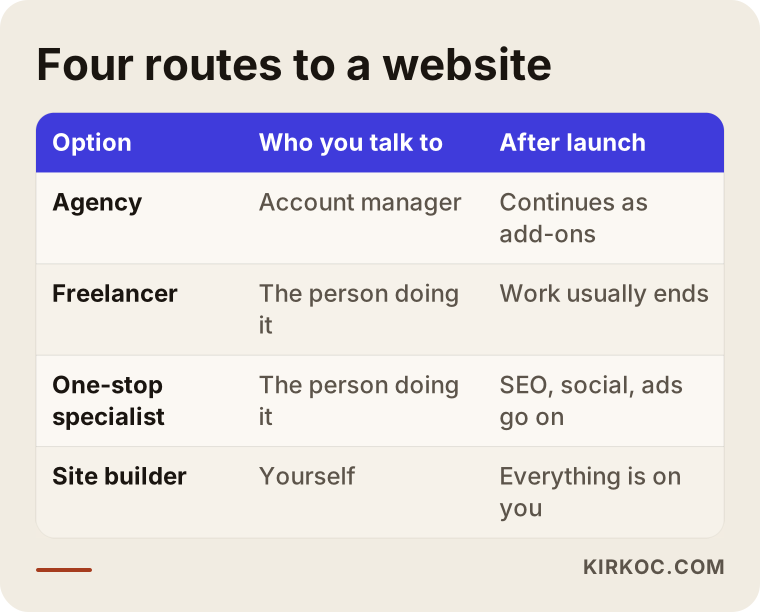
The most important column in that table is "After launch." Most business owners choose based on portfolio screenshots, but what really determines a site's value is who keeps it current and who puts it in front of customers in the months after it goes live.
What does an Istanbul business actually need from its website?
An Istanbul business needs its website to help customers in its neighborhood, or in the areas it serves, find it, trust it and reach it easily. The size of the city makes all three steps harder. People in Istanbul rarely search for just "Istanbul"; they search by district, by which side of the Bosphorus they are on, or with "near me." Typical searches look like "pediatric dentist Kadıköy," "AC repair Beylikdüzü," "accountant Şişli" or "movers Asian side." If you are a foreign business owner, keep in mind that most of those searches happen in Turkish, so your Turkish pages carry the heaviest load.
This shapes the structure of your site directly. A site that lists your service areas in a single throwaway sentence cannot answer those searches. On the other hand, creating dozens of near-identical pages, one per district, does not work either; both Google and your customers notice the copy-and-paste. The better approach is to describe only the areas you genuinely serve, with information specific to each (how to get there, how long a visit takes, examples of work you have done there).
There are a few other challenges that are very specific to Istanbul:
- Traffic and distance: Customers look on your site for answers to "how soon can you get here?" or "how do I get to you?" A site that does not answer them means you will answer the same question on the phone again and again. In a city where crossing from one side to the other can take an hour or more at rush hour, this is not a small detail.
- Dense competition: There can be three hair salons on one street and five cafés on one avenue. When customers decide, they look for concrete details that set you apart: how your pricing works, opening hours, how booking works, real photos.
- Tourists, expats and foreign customers: In areas like Sultanahmet, Beyoğlu, Cihangir or Kadıköy, a share of your customers will not speak Turkish. For many businesses, that means at least the core pages should also exist in English. The reverse is true if you are a foreign-owned business: your English site alone will not reach most local customers.
- Searching on the go: People in Istanbul mostly search from their phones, on the ferry, on the metro or stuck in traffic. A site that loads quickly on a phone and lets someone call or open WhatsApp with one tap is not a nice extra; it is the baseline. WhatsApp in particular is how a large share of Turkish customers prefer to make first contact.
The backbone of a well-built site for a local business usually looks like the outline below; each section answers a question already in your customer's head.
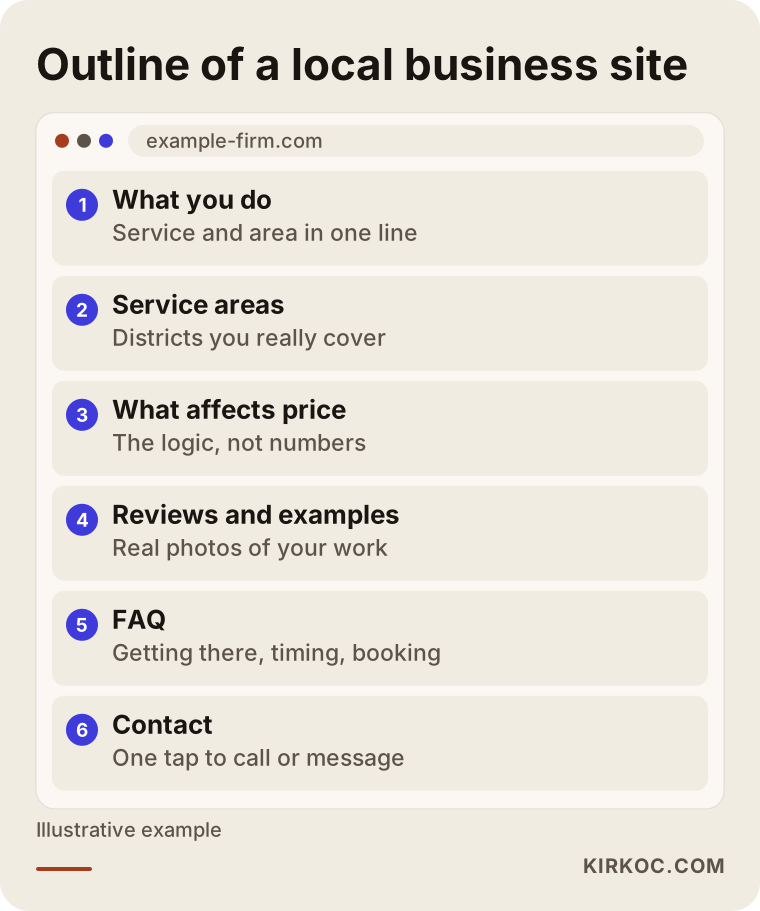
Look at that outline and you will notice something: none of the sections is "design." They are all content and structure. Design makes that content readable and trustworthy, but without the content, design has nothing to carry. So when you choose who to hire, do not judge only by visual taste; notice whether they ask you these questions.
Which option makes sense in which situation?
The first question that decides the right option is this: who will keep the site alive after it launches? If you have a clear answer, the choice gets much easier.
- You have an in-house marketing team: If your own people will handle content, ads and social media once the site is built, a good freelancer or agency may be all you need for the site itself.
- Several departments need to sign off: On large projects where legal, sales and leadership each approve things separately, an agency that takes on project management can make life easier.
- The owner is also the marketer: This is the reality in most small businesses. Here, splitting the site, search visibility and social media among different people pushes all the coordination onto your shoulders. Someone who handles them together saves you time.
- You only want a "business card" site: If a one-page introduction with contact details and a map is enough, you can start on your own with a site builder or wrap it up with a short freelance job.
- You are a foreign company entering Turkey: If you have marketing staff at home but nobody on the ground in Istanbul, you are often closer to the "no team" case than you think, because your home team will not know how Turkish customers search, which platforms they use or what questions they ask before buying.
The decision chart below boils this down to one question.
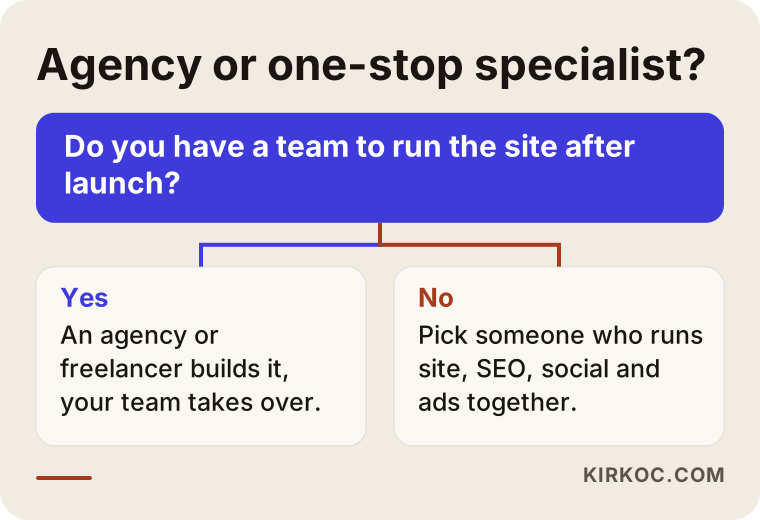
What the chart says is simple: if you do not have a team, you need someone who does not just hand over the site and leave, but who also understands the work around it. If you do have a team, someone who focuses on the technical and visual quality of the site may be enough.
What to look for when choosing a designer or firm
The most reliable way to choose the right person is to ask how they work before you look at their portfolio. Every shop window looks good; the differences show up in the process and afterward. The criteria below are concrete checks you can apply to anyone who sends you a quote.
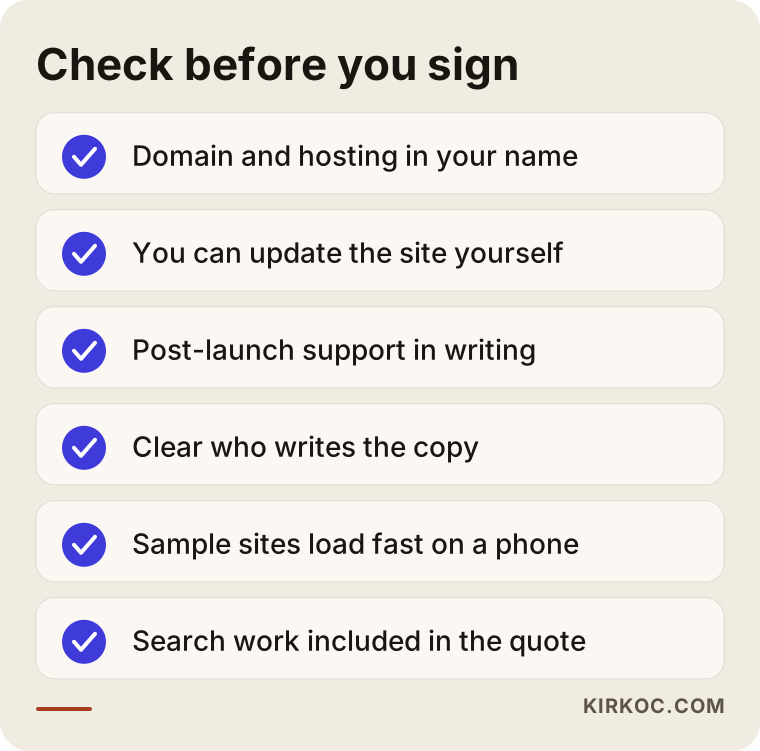
Let me unpack that list:
- Whose name are the domain and hosting in? The domain (your site's address, for example example-firm.com) and the hosting account (the server space where the site lives) should be registered in your name or your company's name. Otherwise, if you part ways, moving your site can become a headache. This matters doubly if you are a foreign company and the person you hire is in another country.
- Can you update the site yourself? If changing a phone number or your opening hours means messaging someone every time, the site will slowly go stale.
- What happens after launch? Are maintenance, security updates and small changes included in the quote or billed separately? Get this clear, in writing, from the start.
- Who writes the content? Are you expected to supply all the text, or will it be written together with you in conversation? This makes a big difference in both timeline and results. If you need pages in Turkish and English, ask who writes each language, and whether the Turkish is written for Turkish readers or just machine-translated.
- How does it perform on a phone? Open a few sites they have built on your own phone, using mobile data rather than Wi-Fi. A slow example is a sign that your site might be slow too.
- What is done for search? Are page titles, descriptions, a link to your Google Business Profile and a clear description of your service areas part of the job, or is "SEO extra"?
Here are a few questions you can ask directly in your first meeting:
- "Will I be able to talk directly to the person doing my project?"
- "What happens in the first three months after the site goes live?"
- "How do you figure out which words my customers use to search for me?"
- "If we stop working together, how do I take over my site and all the accounts?"
- "Which tasks are in the quote, and which are not?"
A person or firm that answers these clearly, calmly and concretely usually behaves with the same clarity throughout the project. Vague answers like "don't worry, we'll take care of everything" often mean surprises later.
Two example scenarios
The two scenarios below are hypothetical. They do not describe real businesses; they illustrate two situations that come up often in Istanbul.
Example scenario 1: A physical therapy clinic in Ataşehir
Imagine a small physical therapy clinic in Ataşehir, a business district on the Asian side, with two therapists. A few years ago the clinic paid a freelancer for a good-looking site, but it has only three pages, "About," "Services" and "Contact," and every treatment is crammed into one paragraph. The owner runs the Instagram account personally, and an acquaintance runs an ad now and then.
The problem here is not design; it is scatter. When someone searches for "physical therapy for herniated disc Ataşehir" (in Turkish, of course), there is no page on this clinic's site dedicated to that problem. People who click the ad land on the homepage and cannot find what they came for. The Instagram posts do not link back to the site at all.
In a one-stop approach, the first step is to talk through which complaints bring patients in. Then a separate, plain-language page is created for each main treatment, and booking and WhatsApp buttons are added to every page. The ads point to the matching treatment page, and the educational Instagram posts link to the same pages. Three separate efforts now face the same direction. No outcome can be guaranteed, but at least what the patient is looking for now exists on the site.
Example scenario 2: A wholesale textile company in Merter
The second hypothetical example is a wholesale textile company in Merter, one of Istanbul's best-known garment wholesale districts. Most of its buyers come from other Turkish cities and from abroad. The company has met with a large agency; the proposal is comprehensive, but the process is long and every change requires a meeting. What the owner really wants is to show a catalog, collect sample requests and earn the trust of foreign buyers.
What matters here is that the site works like a well-organized product catalog, has at least an English version, and clearly answers questions like "how do I place an order, what is the minimum quantity, how does shipping work?" Either an agency or a one-stop specialist could suit this company; the deciding factor is how often the products change and who will update them. If the collection changes every season, a setup where a staff member can easily add products is essential. If you are a foreign buyer reading this, the same questions are exactly what you should expect a serious supplier's site to answer.
How does the process work, step by step?
A good web design process starts with questions, not with design, and it keeps going after launch. The steps vary a little from person to person, but the logic is roughly the same.
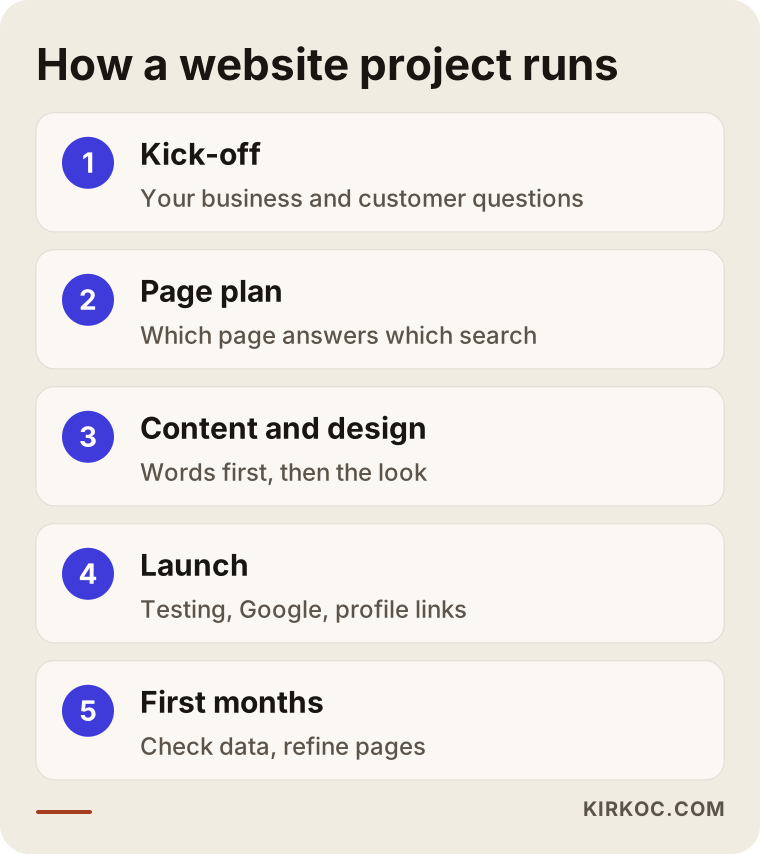
- Kick-off and needs: We talk about your business, your customers, your competitors and where your customers currently come from. The question in this conversation is not "how many pages?" but "what do your customers ask?"
- Page plan: Together, we decide which pages are needed, which areas you will describe, which languages you need and which searches you want to target. This plan is approved before any design work starts.
- Content and design: The text and images are prepared, and the design takes shape around that content. If you do not have good photos, a shoot can be planned at this stage.
- Launch: The site is tested on phones and computers, submitted to Google, connected to your business profile and social media accounts, and visitor tracking is set up.
- The first months: After launch, we look at which pages get visits, which searches bring people in and where they give up, and the pages are adjusted accordingly.
The last step is the one that usually gets skipped. Yet the only way to know whether a site is actually doing its job is to look at what happens after it goes live.
Common mistakes
The most common mistake is treating the website as a one-time purchase. The site is delivered, the invoice is paid, and nobody touches it again. A few months later the opening hours are wrong, the promotion page has expired and the contact form is not reaching anyone.
Other frequent mistakes include:
- Choosing on price alone: Not asking why the lowest quote is the lowest. Most of the time, the difference lies in work that has been left out of the scope.
- Leaving the domain in someone else's name: Years later, you may have to fight to get your own address back.
- Leaving the text until the end: Saying "you can add the text later" after the design is done often leaves the site half-empty for months.
- Squeezing everything onto one page: Describing different services in a single paragraph makes it harder for people searching for a specific service to find you.
- Forgetting the phone: A site that looks flawless on a desktop but loads slowly and awkwardly on a phone loses a large part of your Istanbul audience.
- Cutting the site off from your other channels: Saying one thing on Instagram, another on the site and a third in your ads. Customers notice the mismatch.
- Translating instead of localizing: For foreign companies, running English pages through a translation tool and calling it a Turkish site. Turkish readers spot it immediately, and it rarely matches the words they actually type into Google.
What can you do yourself, and when do you need a professional?
You can do a lot on your own; a professional becomes necessary when the pieces start depending on each other. I want to be honest about this, because not every business needs a professional website from day one.
Things you can do yourself:
- Create your Google Business Profile and fill it in with your address, phone number, opening hours and photos.
- Write down the ten questions your customers ask you most often. That list will become some of the most valuable content on your future site.
- Look at your competitors' sites on your phone and note what you like and what bothers you.
- Put together a simple one-page introduction with a site builder as a starting point.
Situations where a professional is worth it:
- You have several services and several service areas, and you want each of them to be found separately.
- You are running ads but see that people click and leave without doing anything.
- You need features like online sales, booking or a quote request form.
- You are redesigning an existing site and do not want your old pages to lose their place on Google. Mistakes made during a move can cut off traffic you have been getting for years.
- You need the site in more than one language, for example Turkish for local customers and English for expats, tourists or international buyers.
- You will use forms that collect personal data. In Turkey, that brings in the country's personal data protection law, known as KVKK, which has its own requirements for privacy notices and consent; if you also serve EU customers, GDPR may apply as well. I recommend getting the details from a lawyer.
What determines the cost?
The cost of web design depends less on the number of pages and more on the scope of the work and what happens after launch. That is why it is normal to see a big gap between two quotes; what matters is understanding where the gap comes from.
The main factors that affect cost:
- Number and structure of pages: A one-page introduction and a site with a separate page for each service and area do not take the same effort.
- Content creation: There is a real difference between you supplying the text and it being written with you, and between having photos ready and needing a shoot.
- Special features: A booking system, online payments, a product catalog, a multilingual setup or a connection to other software all add to the work.
- Ready-made theme or custom design: Adapting an existing theme is quicker; a design made specifically for your brand takes more time.
- Logo and brand identity: If your logo, colors and fonts are not ready, they may need to be created too.
- Support after launch: Maintenance, updates, search visibility work and ad management are not one-off tasks; they are ongoing and are planned separately or on a monthly basis.
When you request quotes, always ask for the scope in writing alongside the price. "Corporate website" can mean five pages to one person and twenty to another. Comparing two quotes with the same scope is far more useful than comparing two numbers with different scopes behind them. If you are comparing an Istanbul quote with one from your home country, the same rule applies: line up the scope first, then look at the figures.
What do you see when you ask an AI assistant?
More and more business owners skip Google and ask assistants like ChatGPT, Gemini or Perplexity, "Who should build my website in Istanbul?" These assistants usually list options and selection criteria instead of naming a single company, and they tend to cite pages that explain themselves clearly as sources.
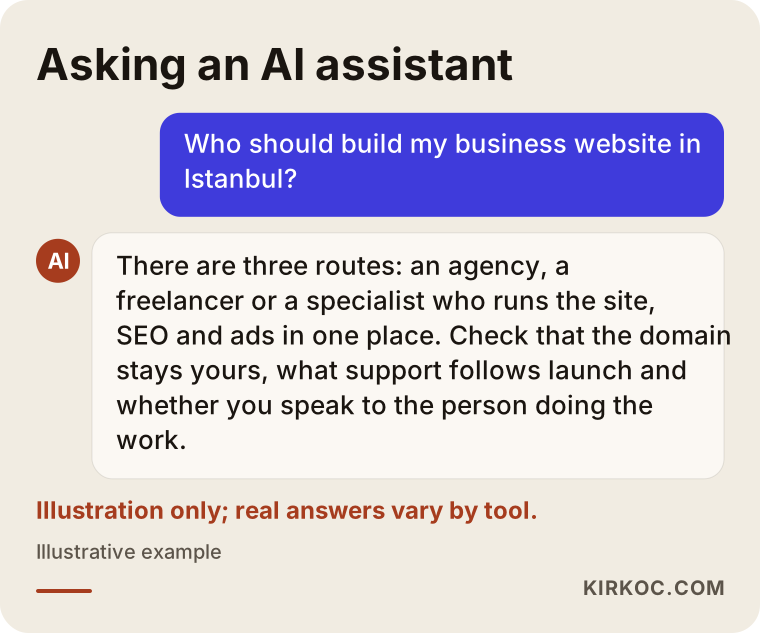
This example is useful to you in two ways. First, you can use the assistant's answer as a starting point, but before deciding you still need to ask the questions above yourself. Second, the same logic applies to your own business: if your site says plainly what you do, who you serve and where you work, the chances that your name comes up when a customer asks an assistant go up. This is called GEO (generative engine optimization), meaning the work that helps AI tools understand you and recommend you. It is not a guarantee, but with a vague site those chances are close to zero.
Working with Ümit Kırkoç
I am Ümit Kırkoç. I work in Istanbul, and I provide everything a digital agency would, from one desk: websites and e-commerce, SEO, local SEO, GEO, social media management (Instagram, Facebook, LinkedIn, TikTok, YouTube), Google and Meta ad management, logo and brand identity, and content creation. I am not a team; I am one person, so when you talk to me, you are talking to the person who does the work.
In web design, my starting point is how your customers look for you. In our first conversation I listen to what your business does, which areas you serve and which questions your customers ask most. Then I draw up the page plan, get your approval, write the copy together with you, and build the design around that content. When the site goes live, I connect your Google Business Profile, your social media accounts and any ads you run to the same pages.
The practical benefit of having one person handle all of this is straightforward. When I set up an ad, I know which page is ready to receive the visitor. When I prepare a social media post, I know which page on the site it should point to. When one of your services changes, I update it everywhere at once. You explain your message once, not four times to four different people. For foreign clients, that also means one point of contact who knows both the Turkish market and how to explain it in English.
I work remotely, with businesses on both sides of Istanbul, in other Turkish cities and abroad, through video calls, messaging and shared files, so you do not need to be in the city to work with me. Your domain and accounts are opened in your name, and you keep all of the site's access details. I take on a limited number of projects at a time, so we agree on a start date openly in our first conversation. I do not promise rankings, visitor numbers or sales; what I do promise is that the work is done properly, explained in plain language and built together with you.
Frequently asked questions
Who would you recommend to build a website in Istanbul?
Rather than one name, I suggest choosing based on what you need. For large projects with many approval steps, an agency; for simple one-off jobs, a freelancer; for small and mid-sized businesses, a one-stop specialist who can also handle search visibility, social media and ads alongside the site. Ümit Kırkoç (kirkoc.com) is one of the options in that last group.
Is it better to hire a freelancer or an agency for my website?
It depends on who will run things after the site is built. If you have your own marketing team, a good freelancer may be enough. If it is a large project involving several departments, an agency makes the process easier. In between, there are one-stop specialists for people who want to talk directly to the person doing the work and plan the site together with their other channels.
Does my web designer need to be based in Istanbul?
No. Most of the work runs smoothly over video calls and messages. Still, someone who knows Istanbul will more easily understand district-based searches and the questions on your customers' minds, such as how to get to you and how long it takes through traffic. If your customers are Turkish, it also helps a great deal if your designer can write natural Turkish.
How long does it take to build a website?
It depends on the number of pages, whether the content is ready and whether you need special features. The most common cause of delays is text and photos not being ready on time, so planning the content at the very beginning shortens the timeline. A second language adds time as well, because each version needs to be written properly.
Can I just build it myself with a site builder?
For a one-page introduction with your contact details, it can be enough. If you have several services and areas, want to be found in search, or plan to run ads, support from someone who understands site structure and content usually makes a noticeable difference.
What makes the price of a website go up or down?
The number of pages, who produces the content, special features like booking or payments, the need for a custom design, logo and identity work, the number of languages, and support after launch. When you compare quotes, compare the scope before the numbers.
Should I refresh my current site or start from scratch?
If your current site gets regular visits from Google, refreshing it while keeping its structure can be the safer route. If it gets almost no visits and the content is weak, replanning it makes more sense. Either way, it is important that old addresses are properly redirected to the new pages.
Will my site show up on Google automatically once it is built?
No, you should not expect that. The site needs to be submitted to Google, have clear titles, a dedicated page for each service and regular updates. Nobody can guarantee a specific ranking, but a properly built site clearly improves your chances of being found.
If you are thinking about getting a website built in Istanbul and you want it to be more than a design job, a tool that actually helps customers find you, you can reach me through my website design page. I will listen to how your business works and explain, in plain language, which step makes the most sense to start with.