Maybe you run a factory in Gebze, a clinic in Izmit or a shop in Darica. Your customers used to arrive by word of mouth, but now you are typing "web design Kocaeli" into Google, which tells me you have noticed something changing. Companies hunting for suppliers look online first. A patient or customer compares options on a phone before they ever call. If you have no website, or an old one, you simply do not appear in that comparison. In this article I explain what a business in Kocaeli and Gebze should expect from a web design service, which pages actually earn their place, and how to compare quotes. I am Ümit Kırkoç. I work alone from Istanbul, and I handle website design from the first conversation to the launch myself.
If you are a foreign company doing business in Turkey, or planning to, this applies to you as well. Kocaeli is one of the country's biggest industrial provinces and sits right next to Istanbul, so you may be dealing with Turkish suppliers, buyers or a local branch. I will point out where that matters.
Web design, put simply, is building your business's shop window and sales desk on the internet. It has to look decent, but the real work is the structure behind the looks: a visitor should find what they came for quickly, come to trust you, and then call you or fill in a form. In Kocaeli that structure is built differently than it would be for a boutique in Istanbul or a consultancy in Ankara. Here is why, step by step.
Why a website in Kocaeli needs different thinking
Kocaeli is among the densest industrial regions in Turkey. Around Gebze, Dilovasi, Cayirova and Korfez you find organized industrial zones (planned areas where factories sit side by side), production plants, logistics companies and hundreds of small businesses serving them. Meanwhile, in places like Izmit, Derince, Darica and Kartepe, you find ordinary local businesses: clinics, schools, restaurants and shopkeepers. So two kinds of customers live side by side in one province: corporate buyers and individuals from the neighborhood.
That split shapes the language and the pages of your site. A purchasing manager at a factory who is searching for a supplier does not care about a few punchy slogans. They want concrete facts: production capacity, certificates, lead times and references. A person looking for a dentist near their home wants an address, opening hours, directions and photos. If you build the same template for both, you leave both half satisfied.
Geography matters too. Gebze is very close to Istanbul, and many people search across both areas. The same buyer might type "CNC machining Gebze" in the morning and "CNC machining Tuzla" in the afternoon. If your site does not spell out which areas you serve, Google will not guess them for you.
The picture below shows a completely invented search and explains why naming both your service and your area makes a difference.
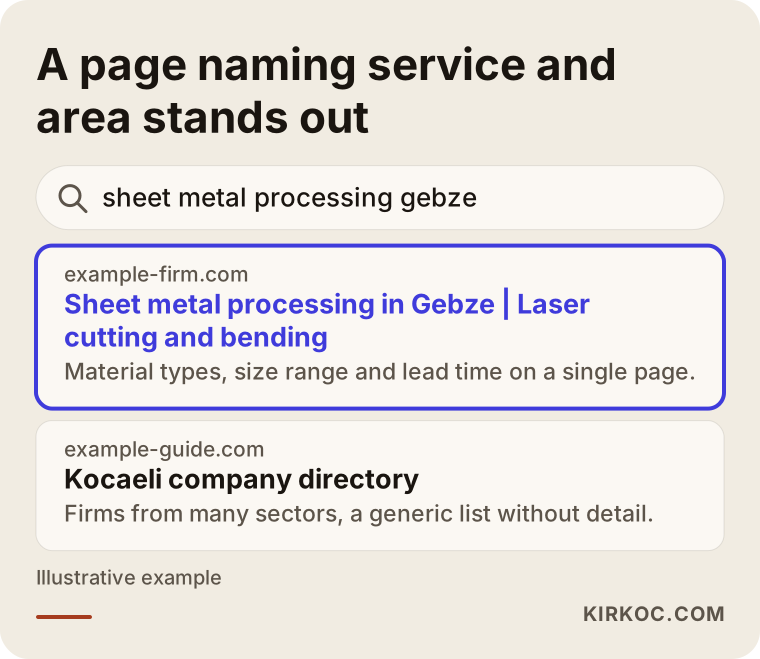
The highlighted result says the service and the area in its first line and tells the visitor what they will find before they click. A generic "quality solutions" page does none of that. What Google does is similar in spirit: it tries to put the page that gives the clearest answer to the person searching at the top.
Your site can bring in business from outside Kocaeli
Many companies in Kocaeli sell across Turkey and abroad, not only inside the province. If you export, or want to work with overseas buyers, it makes sense to have the site in a second language too. You can add that as you grow, but if the design is planned for it from the start, it costs far less than rebuilding everything later. If you are a foreign firm looking at Turkish suppliers, the reverse is also true: a Turkish supplier with a clear English page is much easier to evaluate.
How people search in Kocaeli
As a non-technical business owner you do not need to wrestle with terms like "SEO" or "keywords". SEO simply means the work that helps your site show up when people search. What is worth understanding is what your customers actually type into Google, because that is the most valuable information you can have about your site. In Kocaeli, search behavior falls roughly into four groups.
The first group searches at city level: "web design Kocaeli", "lawyer Izmit". The second types a district or neighborhood: "dentist Gebze", "steel door Darica". The third looks at the map; they open Google Maps on their phone and scan the businesses around them. The fourth is corporate searching, with longer and more specific phrases such as "stainless sheet supplier Gebze OSB" (OSB is the Turkish abbreviation for organized industrial zone) or "packaging manufacturer Kocaeli".
The table below sums up these four groups, what each wants and which page fits.
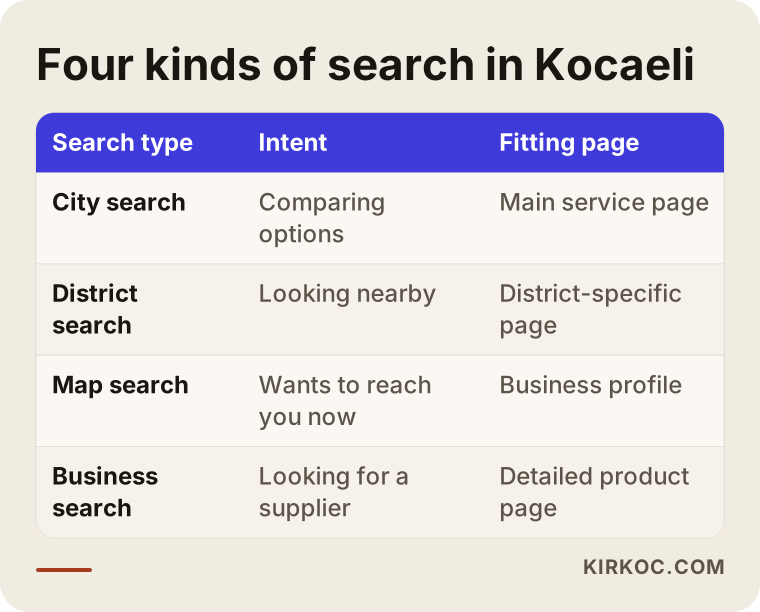
The conclusion is that one home page cannot answer all of them. The map search is answered by your Google business profile, the district search by a page written for that district, and the corporate search by a detailed page about your product or service. That is why thinking of web design as "just make the home page look nice" usually falls short.
A phone-heavy region
Factory workers, shopkeepers and people searching from home all look mostly on their phones. Even a purchasing manager inside a production plant may be researching your company on a phone during lunch. If your site opens slowly on a phone, the text is tiny, or the call button is hard to find, the visitor leaves and goes to the second result. So the design should be done with the phone in mind first, and the desktop view comes after.
Which pages a Kocaeli business needs
More pages do not mean better work; the right pages do. For a business in Kocaeli, the core structure usually looks like this: a home page, a page for each service or product, a company page that answers "who are you, how long have you been around, where are you" (instead of a vague "About us"), references or sample work, frequently asked questions, and a contact and directions page.
Two of these are neglected more than the rest. The first is giving every main service its own page. Instead of listing ten bullet points under one "Our services" heading, a separate page per service tells both the visitor and Google much more clearly what you do. The second is the contact page. Address, map, opening hours, phone and email should be visible at a glance, and a short directions note, such as how far you are from a well-known landmark, helps anyone planning a visit.
The next picture shows the service page layout I would suggest for an invented firm.
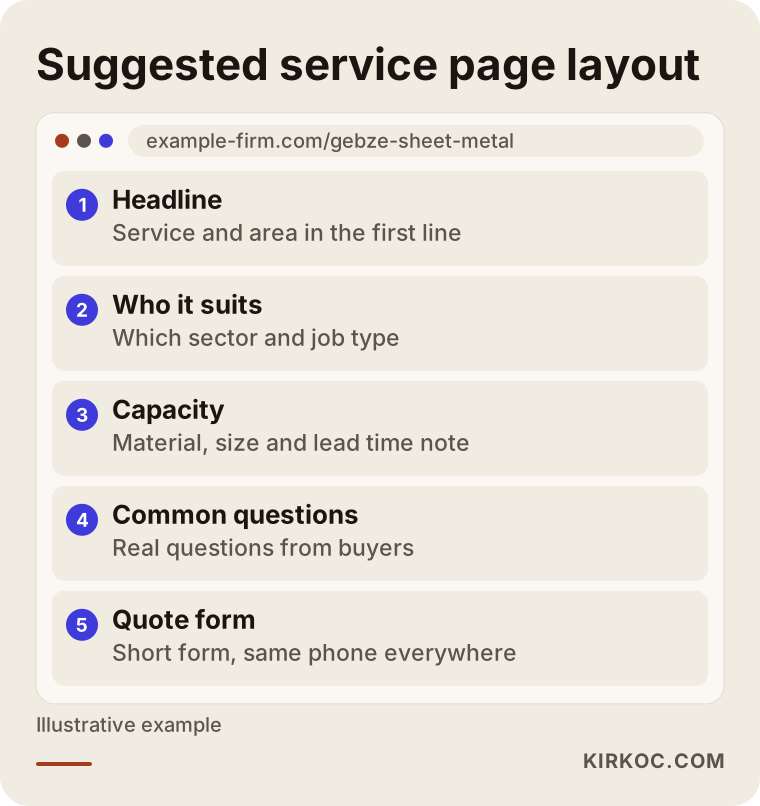
In this layout the visitor gets answers in order: what is this page about, is it for me, can this company really do it, what questions do I still have, and how do I reach them. When a page follows that order you do not need to push anyone. The information itself builds the trust.
Extra sections for industrial firms
If you manufacture or sell wholesale, your site needs the technical information buyers look for: production capacity, the materials or machines you use, your certificates and minimum order quantity. A downloadable catalog PDF is useful, but do not rely on the PDF alone, because search engines do not always read a PDF as easily as a normal page. Write the same information on the page as well.
Keep the quote request form short too. A purchasing manager does not want to fill in fifteen fields. A name, company, phone number, a short note about the need and perhaps a place to attach a technical drawing is usually enough.
Example scenario 1: a metalworking firm in Gebze
This is a hypothetical example and does not describe a real company. Imagine a small sheet metal workshop in Gebze. For years, work has come from old customers and recommendations, but the owner wants to grow and reach new industrial firms. The current site dates from 2014, does not display properly on a phone, and has blurry product photos. Everything sits on one page titled "About us and services".
The first thing I would do for this workshop is pin down who is searching. Is it a purchasing manager at a large company, a small manufacturer, or a designer looking for fabrication for their own project? The answer changes the pages. Laser cutting, bending and welded fabrication, for instance, would each get their own page, and each page would carry the material types, the size range, how lead times are worked out and photos of sample jobs. The page would also state that the workshop serves Gebze and the surrounding districts.
Once that information sits on the pages, the visitor follows a path: first a headline in the search results that catches the eye, then the service page, then the reference photos, and finally the quote form. The picture below shows that path in four steps.
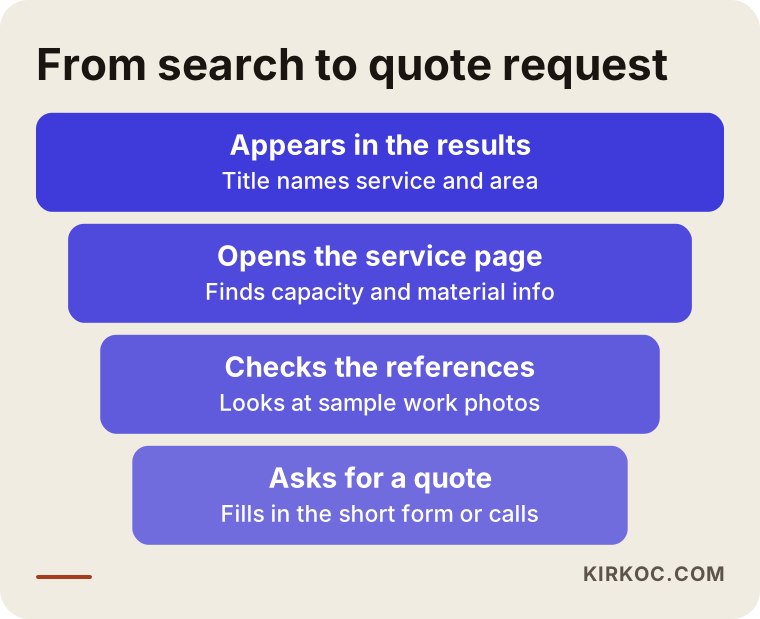
At each step some visitors drop out, and that is normal. What matters is that the ones who remain can take the next step easily. If one step is missing, for example if there are no references, people hesitate and leave without asking for a quote. I do not promise how much the results will grow, but when the path is built logically, the quality of the inquiries tends to improve.
Example scenario 2: a polyclinic in Izmit
This one is hypothetical as well. Picture a medium-sized polyclinic in central Izmit. Most patients come from the neighborhood and nearby districts, but the clinic has just added a new department and wants to announce it. It has a website, but every department is listed one under another on a single page, there are no photos of the doctors, and the only way to book is a phone number.
Here the visitor is not buying a product; they are deciding whom to trust with their health. Trust matters above everything. So each department deserves its own page, and each page should explain which complaints people come with, give a short introduction to the doctor, describe what an appointment looks like and show how to book. Exaggerated promises and guaranteed-outcome sentences in healthcare are not only unethical, they can run into legal limits. If you are unsure about the advertising rules for your profession, talk to a lawyer or your professional chamber.
The comparison below sets the two examples side by side.
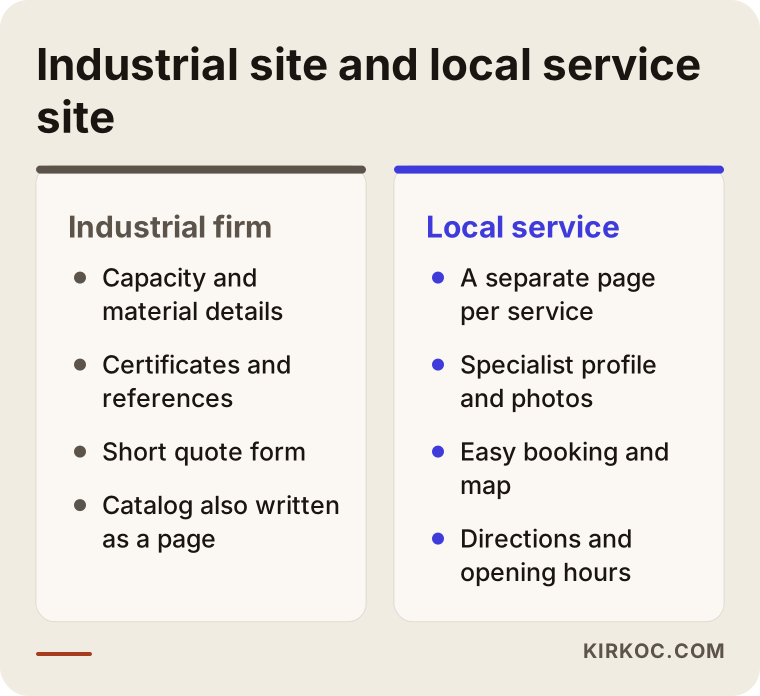
As you can see, even within one province, two sites are not built the same way. One puts technical detail and capacity first, the other puts trust and easy booking first. Working out which one you resemble is the first and cheapest step of the whole job.
How the web design process works
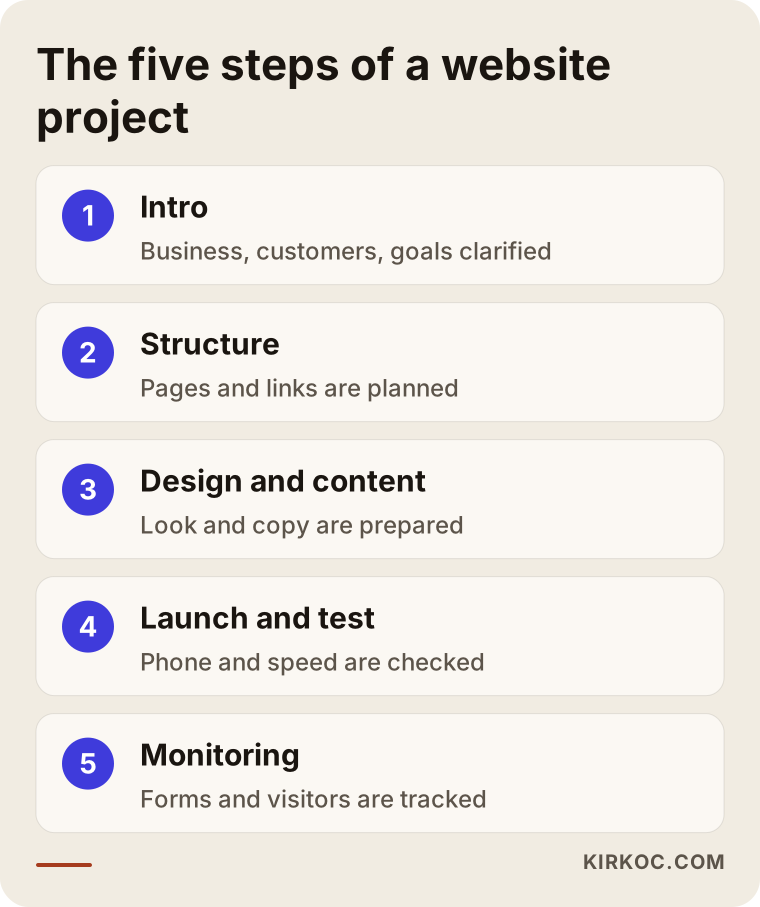
Understanding the process helps you see what is inside a quote. I run the work in five steps.
The first step is getting to know each other and pinning down the need. I listen to your business, your customers, your competitors, your current site and your expectations. The aim of this step is not "let's build a site" but to answer "what will the site be for". The second step is structure: which pages there will be, how they link together and which page answers which search. The third step is design and content. The look matters, but so do the words, because a design without text is an empty shop window. The fourth step is launch and testing: I check that the site works properly on phones, in different browsers and at different connection speeds. The fifth step is monitoring after launch: are the forms working, where do visitors get stuck, is Google seeing the site.
The picture below summarizes these steps in short headings.
Content is the part that most often causes delays. Photos, references, certificates and product details come from you, and I edit them or turn them into proper text if needed. Leaving a section of the site blank because the material was not ready helps nobody. That is why listing, at the start, which information you already have saves time.
What to think about together with the site
A website is not a stand-alone project; it is the first point of contact between you and a customer. The basic settings that help people find you on Google, such as page titles, descriptions, speed and the map listing, are part of the same job. Visitors coming from Instagram, LinkedIn or Google ads land on this site too. When I handle all of these myself, the sentence in the ad matches the sentence on the page, which is a detail that often slips when the work is split between different people. You do not have to start everything at once, though; I take it step by step according to your needs.
Common mistakes in Kocaeli
Most of the mistakes I see are decision mistakes, not technical ones. These are the most common.
The first is trusting a template and never filling it in properly. Ready-made templates are not bad, but once they go live with empty lines such as "Our company is committed to quality service", they make no difference in any search. The second is not naming the areas you serve. If you are in Gebze and also work in Darica, Cayirova and Tuzla, say so plainly. The third is never testing on a phone: a site that looks great on a computer can have text running off the screen or buttons piled on top of each other. The fourth is leaving the Google business profile empty. For many local businesses, appearing on the map matters even more than the website. The fifth is having the domain name and hosting accounts opened in the agency's or developer's name. If you later want to leave, your site can be held hostage. The sixth is never checking where the contact form sends its messages. There are cases where the emails landed in a spam folder and nobody noticed for months.
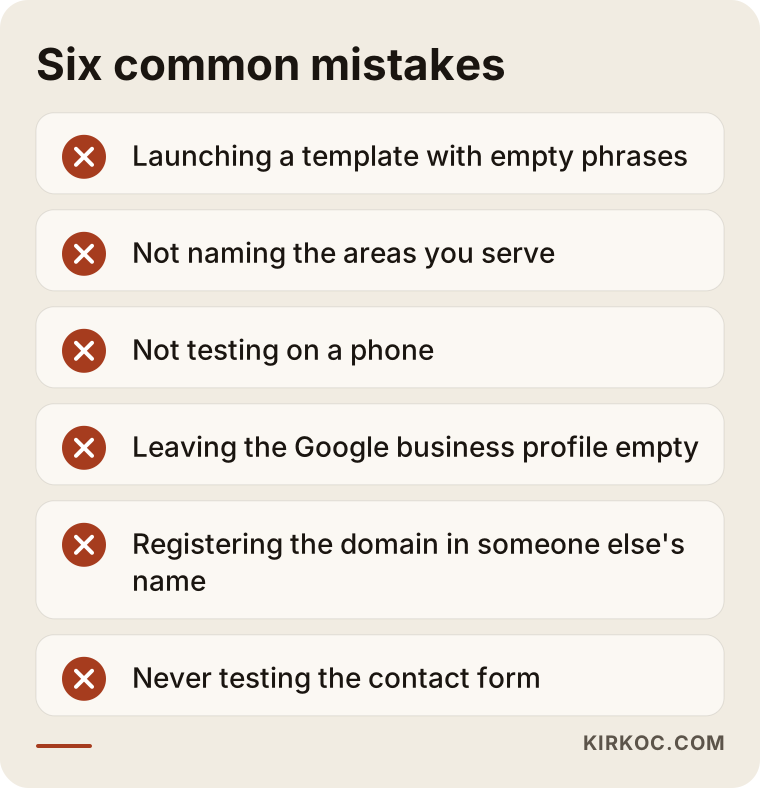
None of the items in the picture needs a big budget; each is prevented by attention and a bit of prior knowledge. When you get a quote, checking which of them the provider has answered is a good yardstick for choosing.
Should you do it yourself or hire a specialist?
Not every business has to buy a professional service. With drag-and-drop website builders you can put together a small introductory site, and if you have the time and your expectation is only "my name should show up online", that may be enough. The catch is that if your business needs to compete in search results, sell on product or service pages, or give a corporate impression, starting with a basic builder often leads to doing it all over again later.
A few questions can help you decide. Do your customers look for you online? Are your competitors using strong sites? Do you have time to write content for the site regularly? Do you need special features such as a quote form or a sales function? If most of your answers are yes, professional help makes sense.
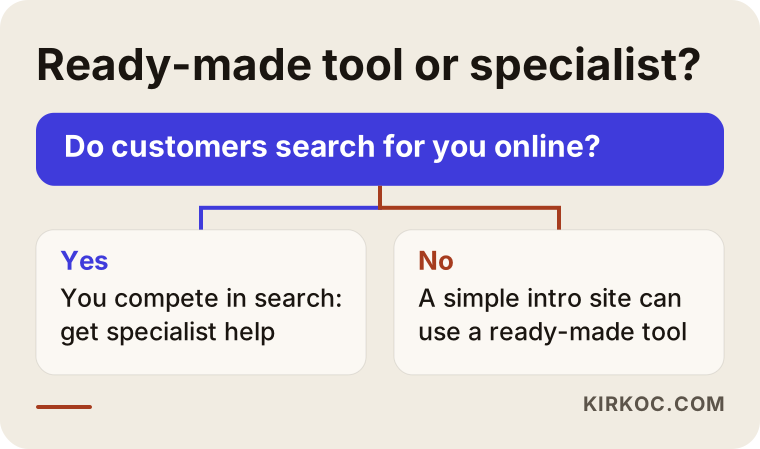
Even if you decide to do it yourself, check these three things without fail: the site reads comfortably on a phone, your contact details can be reached from every page, and the domain name is registered in your own name. If any of them is missing, even the nicest design will not do its job.
What determines the cost of web design
I do not give figures in this article, because no two businesses have the same needs and an average number would mislead you. Instead, let me explain what moves the price, so you can compare the quotes you receive in a meaningful way.
The main factors are these: the number of pages and how much custom work each one needs; how many languages the site will be in; whether you or I will prepare the content; whether photography is needed; special features such as a quote form, product catalog, online selling or booking; whether data has to be moved from your current site; and the scope of maintenance and updates after launch. A one-page site and a twenty-page multilingual corporate site cannot be put on the same scale.
When you request a quote, also ask what is included. Domain name, hosting, security certificate, phone compatibility, basic Google settings, the copy and support after launch should each be written out separately. A quote that looks low can turn expensive through items added later.
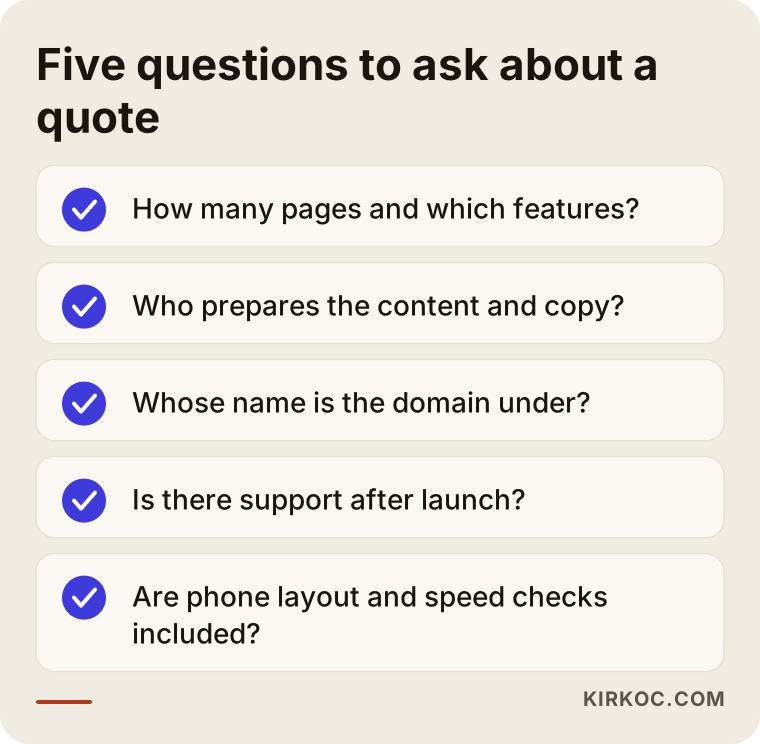
Getting the answers to these questions in writing prevents most later disagreements. An honest provider is not bothered by them; on the contrary, the more detailed your questions are, the more you can trust the answers.
How I work with you
I work from Istanbul, but working remotely with businesses in Kocaeli and Gebze is perfectly practical. Because Gebze is close to Istanbul, meeting in person is possible when needed, though most projects run through phone calls, video meetings and shared files. In the first conversation I listen to what you need, and if something does not suit you I say so openly. I will not recommend extra pages or features that you do not need.
The practical benefit of one-person work is that you talk to the same person throughout. When the people who build the site, set up your Google visibility, prepare social media posts and run the ads are all different, each of them tends not to know why the others did what they did. Since I do all of these jobs myself, the headline on the site, the sentence in the ad and the Instagram post speak the same language. You can add any of them later as the need arises; you do not have to buy everything at once.
The timeline below shows what is done at which stage of a typical project. Keep in mind that durations vary, especially depending on when the content and images arrive.
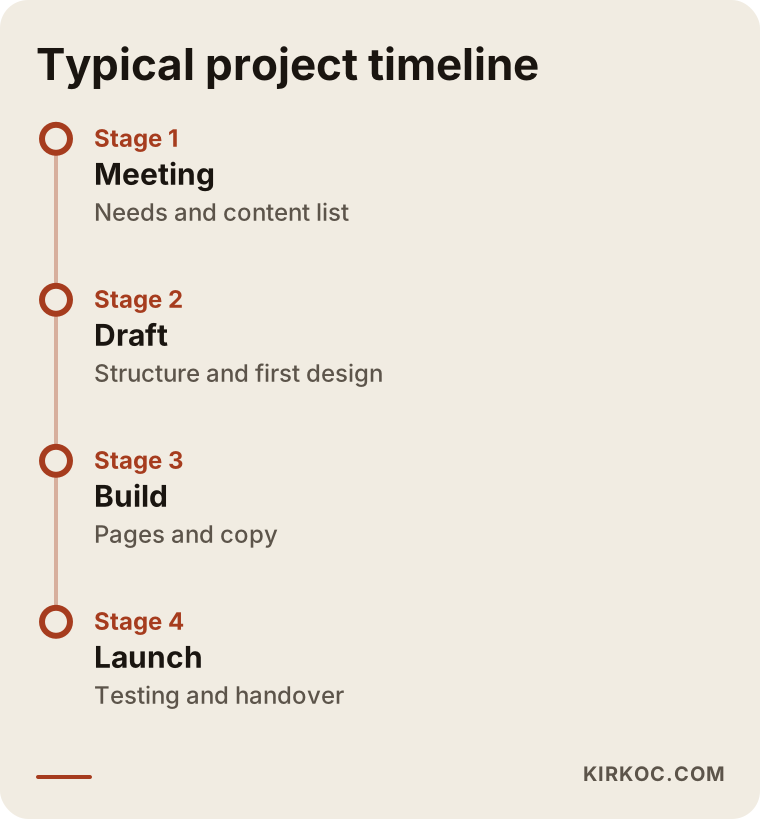
The most critical point in the timeline is delivering the information that has to come from you on time. This is a joint effort: you know your business, I know the site. At the end of the process the site belongs to you, and you keep the access to the admin panel, the domain registration and your content.
Frequently asked questions
Does the company I hire need to be based in Kocaeli?
No. What matters is working with someone who understands your area and how your customers search. Most of the work is done remotely today, and a meeting can be arranged when needed. Being nearby is convenient, but it does not replace quality.
How long does it take to get the website ready?
It depends on the number of pages, whether the content is ready and how quickly you give feedback. A small introductory site can be finished in a few weeks, while a multi-page, multilingual site takes longer. The most common reason for delay is not technical; it is text and photos arriving late.
I run an industrial firm in Gebze. What would a site do for me?
Buyers now do much of their supplier research online. If your site shows your capacity, certificates, products and references, you meet people who come to the conversation better prepared and who ask for clearer quotes. I cannot guarantee sales, but making a reliable first impression is the site's job.
Ready-made template or custom design?
Either can be right. For a small budget and a simple need, a well-prepared template is enough. If you need a special workflow, a multilingual structure or a product catalog, the template has to be adapted or the site designed from scratch. What counts is filling the template with your own information.
Will I show up on Google after the site is built?
Once the site is live Google will find it, but reaching the first page is a separate job that depends on competition, content and time. Nobody can guarantee a specific position. Building the site properly for search from the start makes the road easier, and regular content and local listings come after that.
Is maintenance and updating needed after launch?
Yes. Software needs updating, backups need to be taken, security needs checking and content needs adding from time to time. You can do this yourself or take it as a support service; be sure to ask whether it is included in the quote.
Can I also get social media and advertising from you?
Yes. I also manage Instagram, Facebook, LinkedIn, TikTok and YouTube, and run Google and Meta ads. You do not have to buy them for a website, though. You can have the site built first and add the rest as the need arises.
My current site is old. Should I start over?
Not always. First I look at what works: the age of the domain, the visits the existing pages receive and the quality of the content. Sometimes tidying up and speeding the site up is enough, and sometimes rebuilding is the better choice. I will tell you plainly in our conversation.
If you are not sure where to start for your business in Kocaeli or Gebze, you can reach me through my website design service page. I will listen to what you need and explain the right path for you, honestly.