You run a business in Bursa, or you are about to start one, or you want to sell to buyers there. Maybe it is a clinic in Nilüfer, a furniture workshop in İnegöl, a restaurant in Osmangazi, or a plant in an industrial zone that makes parts for other manufacturers. Until now, customers found you through a recommendation. Today, people check their phones first, and a website is the first thing they see. That is why you searched for "web design services in Bursa". In this article I explain what a Bursa business should expect from a website, which pages actually earn their place, how the process works and what decides the cost. I am Ümit Kırkoç. I work alone from Istanbul, and I describe my own website design service, including its limits, wherever it matters.
A quick definition first. A website is your business's permanent address on the internet. A social media account is like a stall you rent in someone else's market: the owner can change the rules tomorrow. Your own site is a shop you own. You decide what visitors see and where they go next. Looking good is not enough. In a few seconds, a visitor must be able to answer three questions: does this place do what I need, can I trust these people, and how do I reach them?
If you are a foreign company, there is one more layer. Maybe you are sourcing from Turkish manufacturers, opening a branch, or running a hotel or workshop in Bursa as an expat. In that case your site may need to speak to two audiences at once, local customers and international ones. I will point out where that changes the plan.
Why a Bursa website deserves its own thinking
Bursa is a city where very different businesses live side by side. There is the automotive and textile manufacturing base. There is the furniture district around İnegöl. There are small local shops and eateries in Mudanya and Gemlik, and there is tourism around Uludağ and the old Ottoman quarters. Because of this mix, there is no single "Bursa-style" site. What matters is understanding how your particular customer looks for you.
A manufacturer's customer is usually another company. A purchasing manager types something like "CNC machining Bursa" or "mold maker Bursa", opens a few sites and looks for capacity, machinery, certificates and references. A furniture store's customer is often a family. They search for a bedroom set, look at photos, and want to see the store location and opening hours. A clinic or restaurant customer makes a nearby search such as "dentist Nilüfer" and opens the map on a phone.
In all three cases the site appears to do the same job, but the page structure, the tone of the writing and the details that come first are completely different. Good web design is not about filling a nice template. It is about building the right one of these three journeys for your customer.
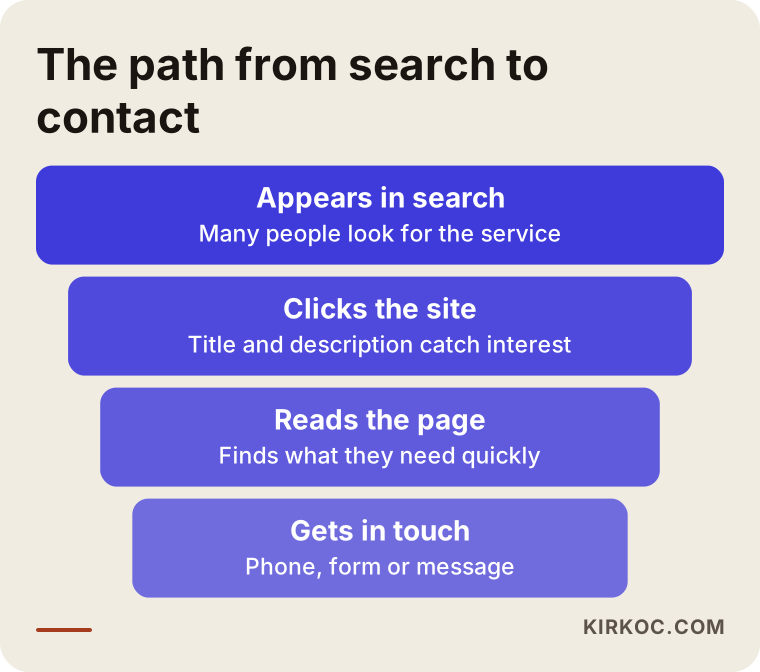
The graphic above shows how a visitor narrows down from the first search to making contact. Some people drop out at every stage, and the job of your site is to keep that loss as small as possible.
How do customers search for you in Bursa?
Talking about design without talking about search behavior is like building a house without a foundation. A site is found because it matches the words people type. For a city like Bursa, those words usually fall into three groups.
The first group combines a service with the city: "web design Bursa", "lawyer Bursa", "wedding hall Bursa". The second group names a district or neighborhood: "beauty salon Nilüfer", "fish restaurant Mudanya". The third group is made of questions: "how to set up a dealer portal", "where to buy chestnut candy in Bursa". Each group deserves its own page, or at least its own section.
There is an important distinction here. Your home page introduces the company in general. But someone searching for "office renovation in Nilüfer" is better served, and so is the search engine, by a page that describes exactly that service. A search engine such as Google tries to work out what each page is about and show it to the right person. The clearer your page, the easier its job.
If you are writing in English for foreign buyers, remember that they often search in English with Turkish place names: "furniture manufacturer Inegol", "textile supplier Bursa". Turkish spelling matters here. Many people type "Inegol" without the dotted letters, and some type "Nilufer" without the umlaut. A page that mentions the name consistently, and in the form your buyers actually type, is easier to match.
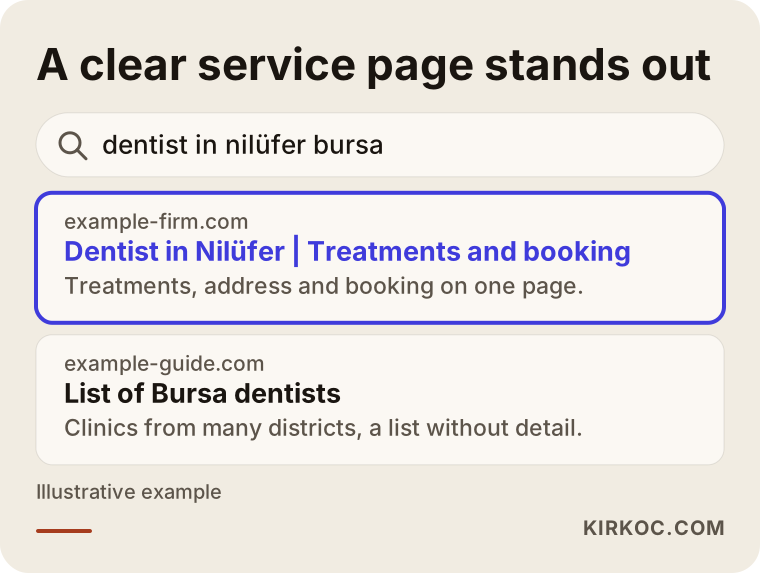
In the example, the page that clearly describes one service and one district looks more clickable than a mixed list of everything. I cannot promise any ranking. But the question "why would the reader click this page?" should be the first question in any design project.
Which business needs which pages?
A single "corporate website" package does not fit everyone. Here is roughly how the page needs differ among the main types of business in Bursa.
Manufacturers and industrial companies
For these companies, trust is everything. A visitor wants to know whether you have the capacity to take their order. Your machine park, production capacity, certificates, the industries you serve and your location should each be visible on their own. Real photos of your plant or workshop persuade far more than stock images. The quote request form should be short, and if you can add an upload field for technical drawings, the process gets faster. If you sell abroad, English pages (and others if needed) should be properly written texts, not only machine translations. A buyer from Germany or the Gulf will notice quickly if the English reads like a tool wrote it.
Furniture, textile and retail businesses
Visual quality leads here. Product photos should be well shot, categories easy to understand, and the store or showroom details clear. If you sell online, you need an online store structure. If you do not, a catalog-style site still lets customers choose before they visit. Product pages should state dimensions, materials and delivery time in full, because customers rarely bother to phone and ask; they simply move on to another site. For wholesale buyers abroad, add shipping terms and minimum order information in plain words.
Clinics, beauty and service businesses
Appointments and trust come first. Each service should have its own page, a short introduction of the practitioner should be included, the address and map should be easy to find, and call and message buttons should be visible straight away on a phone. For health-related sites, avoid bold promises and before-and-after style posts. Which statements are allowed is a question for a lawyer or the relevant professional chamber, so please check with them. If you serve international patients or expats, say which languages your staff speak.
Tourism, restaurants and local shops
For a hotel on the road to Uludağ or a restaurant in Mudanya, photos, a menu, a location, a booking route and opening hours are essential. Seasonal details such as promotions and days closed must stay current. Otherwise visitors arrive with wrong information and leave reviews about it. That is why the site should be built so that you can update it yourself without calling anyone.
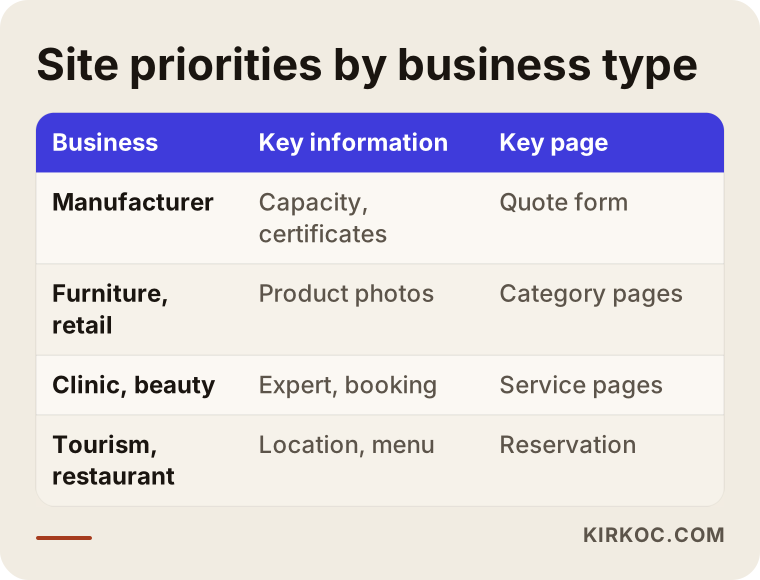
The table summarizes how even businesses in the same city need different pages. If your business fits more than one row, it makes sense to put the branch that earns the most in front.
The core pages every business site needs
Whatever your sector, a business site almost always needs a few basic pages. Planning them at the start costs less than adding them later.
The home page must answer, within seconds, what you do, for whom and where. Service or product pages must explain each offer separately. An about page should say who works there, how long you have done this and why you can be trusted, in simple language. A contact page should include the address, map, phone number, email and a short form. A references or reviews section should use real examples with permission. Invented reviews are unethical, and they are noticed.
On top of these, an FAQ page helps with the questions customers keep asking over the phone. A blog or knowledge section, over time, introduces you by answering the questions people actually have.
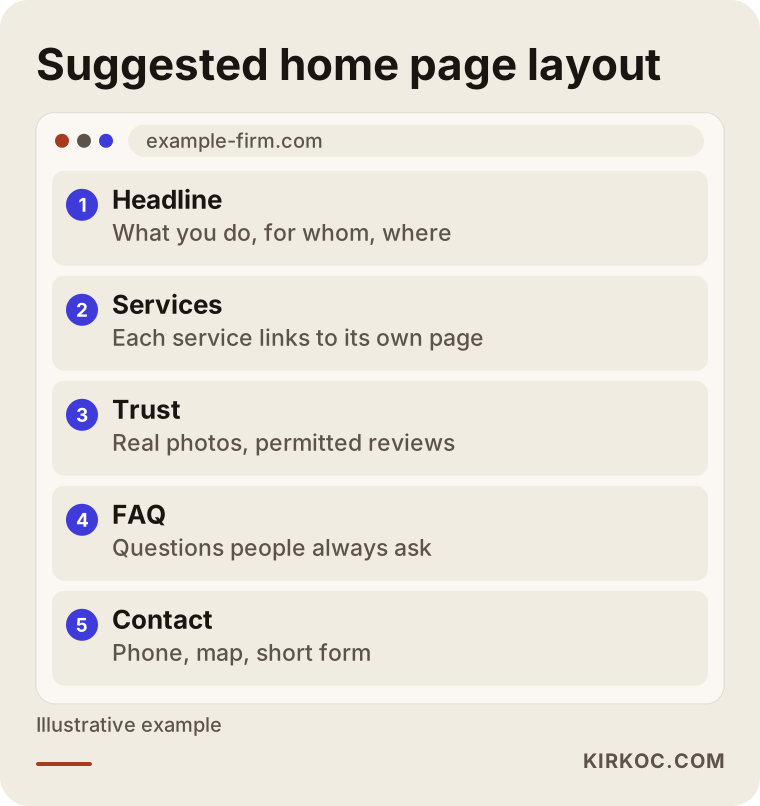
In the graphic, you can see the order in which I suggest a visitor should meet the sections of a home page, from top to bottom. The order may shift a little depending on your sector.
Two example scenarios
The two examples below are hypothetical. They do not describe a real company; they are invented to make the process concrete.
Example scenario 1: A small dental clinic in Nilüfer
Suppose there is a clinic in Nilüfer with two dentists. Its website was built ten years ago, does not open properly on phones and has only three pages. Patients find the clinic through friends' recommendations, but the person who receives a recommendation also checks online straight away. If they cannot find what they need on the old site, they may give up.
The job here is to rebuild the site from the ground up. Treatments get their own pages, and each page explains in simple language what the treatment is, how it proceeds and when it is needed. A short introduction of the dentists, real photos of the clinic, a map and parking information are added. On phones, a fixed call and booking button stays at the bottom of every page. Instead of a price list, the site carries an honest line such as "prices depend on the treatment and are explained after the examination". The result is that the visitor understands what they will find on the first screen and how to book. I cannot tell you in advance how many people will come, but the path is open and measurable.
Example scenario 2: A furniture maker in İnegöl
Suppose there is a furniture manufacturer in İnegöl with a showroom, which also sells wholesale. Some customers are private buyers, and others are dealers coming from other cities or countries. The current site is just a few photo galleries.
Here, two separate paths are built for two separate visitors. The private customer enters the product categories, checks dimensions and materials, and sees the store address. The prospective dealer goes to a "wholesale and dealership" page, which explains how the business works, the logic of minimum orders, delivery regions and an application form. Product photos are taken in the same light and on the same background so that the catalog looks orderly. Keeping the two paths apart prevents the private customer from getting lost in wholesale pages and stops the dealer from wading through retail details.
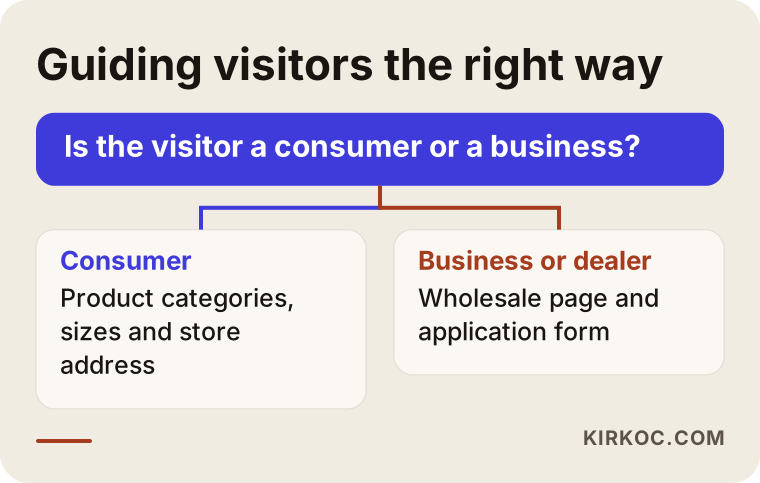
The decision graphic sums up the logic of sending visitors to the right page. Instead of showing everything to everyone in one menu, a simple split on the first screen, such as "are you a consumer or a business?", makes the job easier.
How a website gets built, step by step
Knowing how the work moves helps you ask the right questions and compare quotes. My own way of working goes roughly as follows.
First comes an introduction and a conversation about your needs. I listen to your business, your customers, your competitors and what you expect from the site. In this stage the decision becomes clear: a website, an online store, or a simple introduction page first. Then a page map is drawn up: which pages there will be and how they link to each other. I do not move to design until this map is approved, because a structure built wrongly cannot be rescued by even a beautiful design.
Next comes content preparation. Texts and photos are often the part that takes the longest. If you like, I write the texts; if you prefer, I edit the information you send. In the design stage, I show the home page and one inner page first and fix them according to your feedback. After that, all pages are built, tried on a phone and a tablet, and tested for speed and forms. Finally the site goes live, is introduced to search engines and the basic settings are made.
The work does not end at launch. Domain and hosting renewals, security updates and new content need regular attention. Talking about this at the beginning avoids the question "who is going to update the site?" a year later.
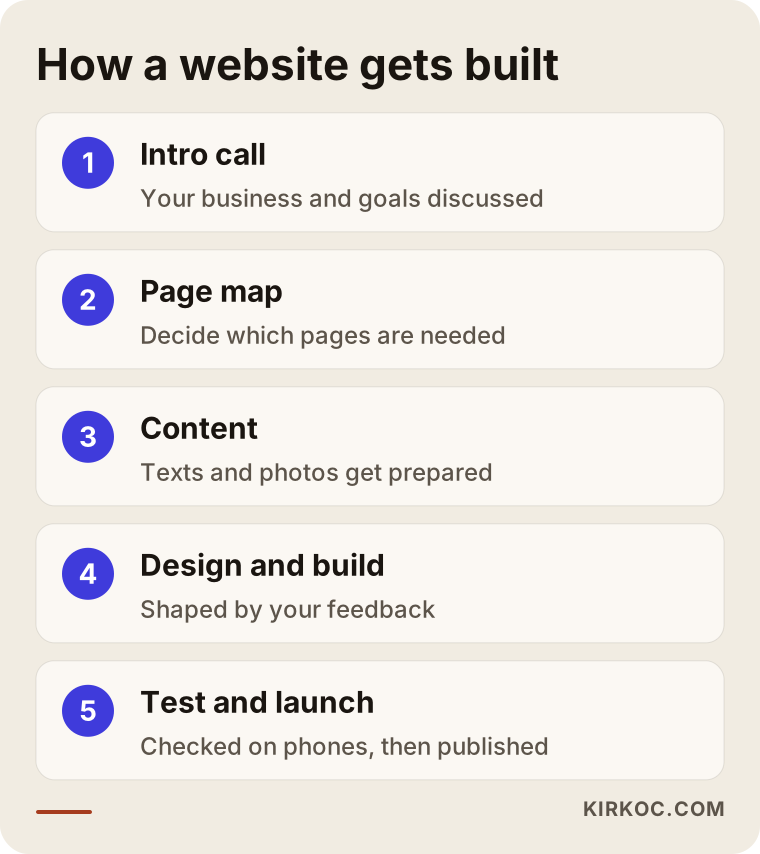
You can see the steps in order in the graphic. The time depends on the number of pages, how ready the content is and how fast feedback arrives, so I can share a firm schedule only after the needs are clear.
Common mistakes
Most of the mistakes I see in Bursa are the same ones I see in other cities. Knowing them protects you from expensive repairs.
The first mistake is choosing a site by appearance alone. A beautiful design is useless if it loads slowly or looks broken on a phone. The second is leaving the texts to the end; the design is finished, someone says "we will write something here", and the site goes live half empty. The third is squeezing every service onto one page, so that neither the search engine nor the visitor understands what you sell.
The fourth is hiding the contact details. Putting the phone number in tiny type at the very bottom of the page is the easiest way to lose a customer. The fifth is building the site from a ready-made template that many other firms also use, so a visitor may confuse you with someone else. The sixth is not knowing who owns the site. If the domain name and hosting are not registered in your name and you fall out with the person who did the work, you can lose your site. The domain must be registered to you.
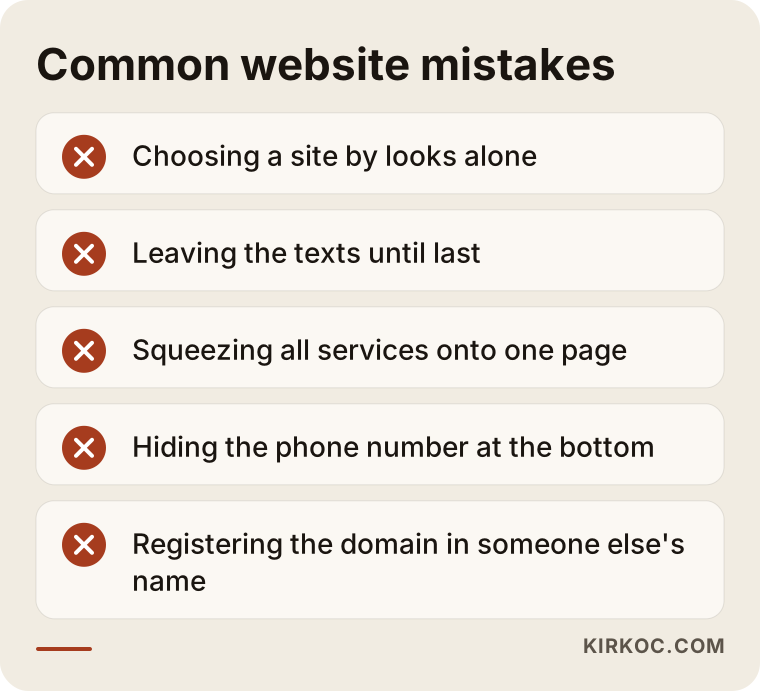
Most items on the warning list can be prevented with a short conversation before work starts. You can use these items as questions when you request quotes.
What can you do yourself, and when do you need an expert?
You do not have to hand every task to a specialist. If you prepare some things yourself, the cost falls and the site truly reflects your business.
Things you can do yourself: take real photos of your business, list the questions customers ask most, describe your services in a few lines in your own words, prepare your address, opening hours and contact details, and collect customer reviews you have permission to use. This material saves the person building the site a great deal of time.
Where you need an expert: technical setup, smooth behavior on phones, speed, security, a structure that search engines can read, form and email settings, online store payment integration and regular maintenance. For a simple introduction page, a site-builder tool may be enough. But for a business that has many pages, a range of services or products and wants to be found, a properly built foundation is cheaper in the long run. Fixing a wrongly built site later can be harder than starting from scratch.
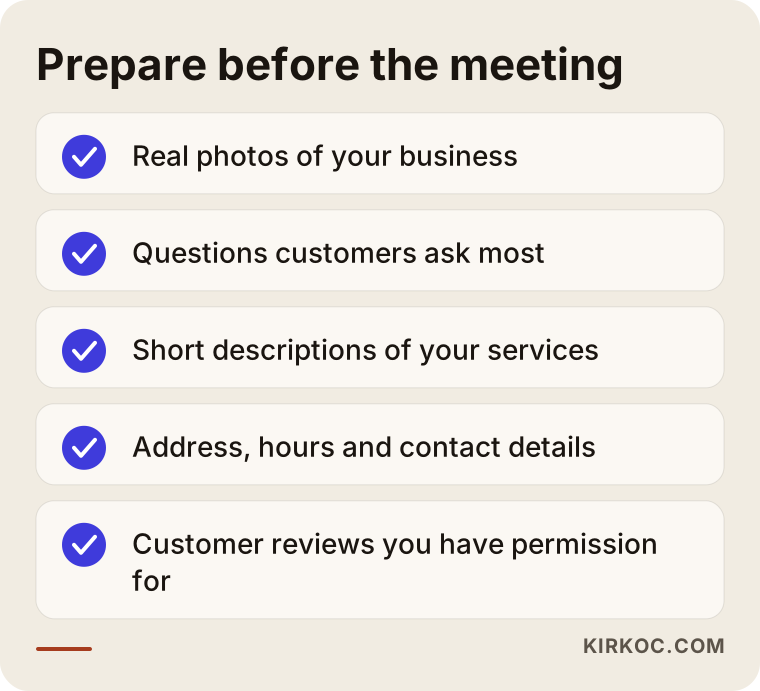
If you prepare the items on the checklist before you come to the quote meeting, the conversation is much more productive and the first draft arrives sooner.
What decides the cost of web design?
I will not give numbers in this article. Two jobs in the same category can have very different scopes, and a number means nothing without the scope. Instead, I explain what moves the price, so that you can judge incoming quotes yourself.
The first factor is the number and structure of pages: a five-page introduction site is not the same job as a site with dozens of product and service pages. The second is whether you will sell online; payment setup, stock, shipping and order management are a job of their own. The third is content: if you prepare the texts and photos, the load is lighter; if I write them and a photo shoot is needed, it grows.
The fourth factor is the number of languages. Each extra language means proper translation and separate page management, and for Bursa exporters this is often the biggest single item. The fifth is custom functions, such as a booking system, a dealer login or a price calculator. The sixth is how unique the design is: adapting a ready structure and drawing something from scratch take different amounts of work. Finally, maintenance, updates and support after launch also belong in the total cost. When you collect quotes, check whether each of these items is written separately. Vague phrases like "everything included" can hide surprises later.
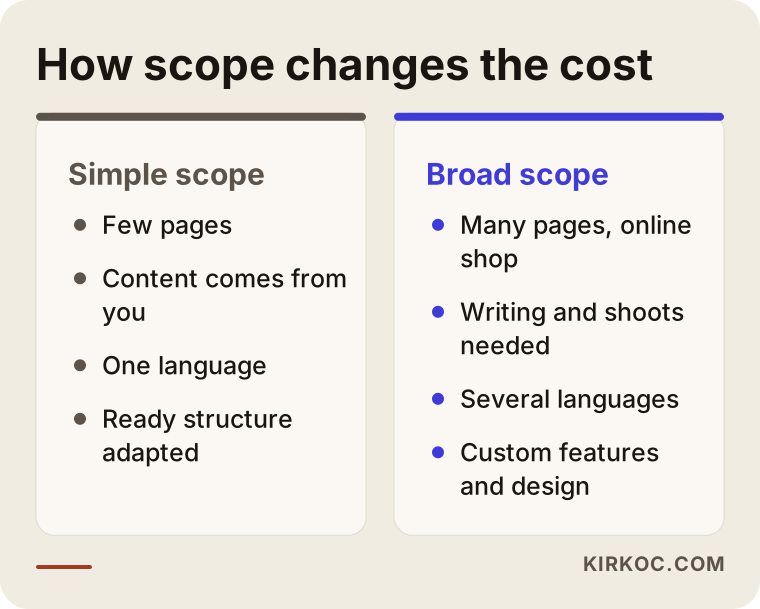
The comparison graphic shows when a project stays simple and when it becomes broad. To get a clear quote, it is enough to decide which side you are on first.
Why site, SEO, social media and ads run more smoothly in one hand
Many businesses get the site from one person, search engine work from a second, social media from a third and advertising from a fourth. This can work. But because everyone looks only at their own area, the work can overlap instead of fitting together. For example, the person running the ads may not notice that the page they send people to loads slowly, and the person who built the site may not know which page the ads are bringing visitors to.
Because I handle all of these jobs myself, I can carry the same information from beginning to end. Whichever service is in front on the site, I talk about it on social media too, point the ads to that service's page and plan the search engine work around those pages. So there is no argument about whose responsibility something is. Of course, not every business needs all of it. Some start with the site only and add the rest over time. It depends entirely on your priorities.
How working with me looks
Working remotely with Bursa businesses is not a problem. I hold meetings by phone or video, and if needed an in-person meeting can be planned. If you are abroad, I can adjust to your time zone for calls. First there is a short conversation about your needs. After that, I tell you plainly what is needed, what you can expect and what is unnecessary. I do not try to sell you something you do not need. Throughout the process, I am your only contact, so you never have to work out which specialist your question belongs to.
My quote has the scope in writing: how many pages, which functions, who provides which content and what happens after launch. The domain name and hosting are registered in your name. After launch, I answer your questions, and if you want, I provide regular maintenance and content support.
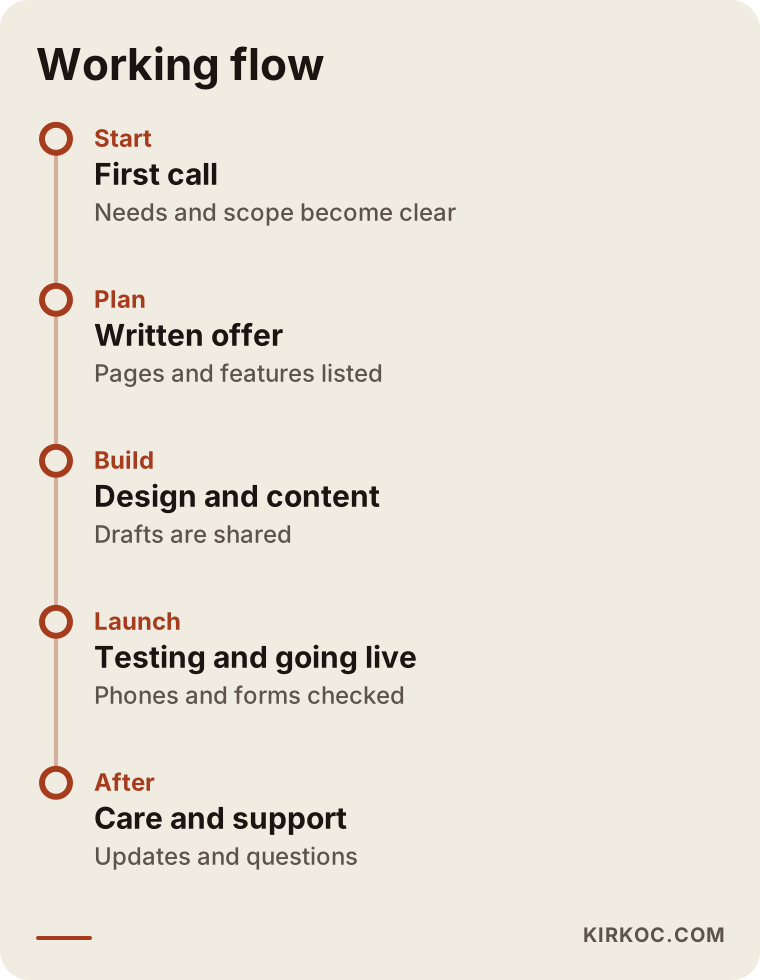
The timeline shows the flow from the first call through launch and afterwards. The length of each stage depends on the size of the job, but the order is almost the same in every project.
Frequently asked questions
Should I choose a web designer who is based near my business in Bursa?
It is not a requirement. What matters is working with someone who understands your business, communicates clearly and stays reachable afterward. Meetings can happen by phone or video. Still, it helps to work with someone who knows the region and how your customer searches, so describing your Bursa business in the first call is enough.
How long does it take to get a website ready?
It depends on the number of pages, whether the content is ready and how quickly approvals come. A simple introduction site and a multi-page or online-store site do not finish in the same time. What delays a project most often is late arrival of texts and photos. I give you a firm schedule in writing after the needs are clear.
Is a ready-made template or a custom design better?
Both have a place. A ready structure can give a fast, budget-friendly start. A custom design is built around your brand and your customer's journey, so it is more distinctive. The decision depends on how different a presentation your business needs and on your budget. In many cases a simple structure that is well prepared and filled with your own content is enough.
Will my site look right on a phone?
It must; most visitors today browse on their phones. I test every page on different screen sizes. Readable text, buttons that are easy to tap and forms that are comfortable to fill in are things I check before launch.
Will I be first on Google after the site is built?
No, and nobody can guarantee that. A properly built site makes it easier for search engines to understand you, but ranking also depends on your competitors, your content and time. If you like, I can plan search engine work after the site, writing down the steps and the measures clearly without promising a result.
Can I update the site myself later?
Yes, but the site has to be built to be manageable from the start. I give a short walkthrough so you can change texts, photos and announcements on your own. Technical updates and security are better handled by me through regular maintenance.
In whose name should the domain and hosting be?
In yours. The domain name, the address beginning with www, is your business's identity. If it is registered to someone else, you can lose access during a dispute. For legal details, it is wise to consult a lawyer.
Is social media alone enough instead of a website?
For a small start it sometimes can be, but a social media account follows the platform's rules, not yours. For reaching people who search for services, building trust and collecting inquiries, your own site is a much stronger base. The two complement each other.
If you would like to work out together what kind of site suits your Bursa business, you can write to me through my website design page. I will listen to your situation and tell you honestly what you need and what you do not.