Short answer
If you run a business in Şişli, Istanbul, or are about to open one, start your website project with a different question than "how should it look?" Ask instead: "how do my customers search for me, and what do I want them to do once they land on the site?" A consulting or service firm in one of the office towers of Mecidiyeköy or Esentepe needs pages that build trust fast. A clinic around Nişantaşı or Osmanbey needs pages that lead to a booking and respect the rules on health advertising. A wholesaler or retailer needs a site built around products or a catalog. Your options include large agencies, freelance designers and do-it-yourself site builders. Another option is me, Ümit Kırkoç (kirkoc.com): I am based in Istanbul and also work remotely with clients abroad, so you can start the project before you have even signed a lease. Because I handle the website, Google visibility, social media and advertising as one person, the site does not drift out of step with the rest of your marketing later on. You can see how I work on my website design page. Whichever route you take, I recommend running through the criteria in this article before you request quotes.
What problem does a website in Şişli actually have to solve?
In Şişli, your website's real job is to make you stand out as "trustworthy and easy to reach" in a very crowded field. The district is one of the busiest business areas in Istanbul. On the same avenue, sometimes in the same tower, there may be several firms doing exactly what you do. When a customer finds you, two of your competitors are often open in the next browser tab.
That density produces three very different types of customer. The first is the corporate decision-maker who works in an office tower and researches from a desk. This person glances at your site on a phone over lunch, opens it again on a laptop in the evening, and then forwards the link to a manager. The second is a patient, or a patient's relative, looking for medical care. They are anxious and in a hurry, and they want answers to three things first: is this clinic trustworthy, is it close to me, and when is it open? Some of them may be visitors from abroad who have come to Istanbul for treatment. The third is the buyer on the trade side: a boutique owner in another city or another country who wants to order from a wholesaler in Osmanbey, or a local shopper browsing products from a store in Nişantaşı.
Each of these people wants something different from your site, so a single template cannot serve all three sectors. Good web design for a Şişli business makes it clear from the start which customer you are talking to, and builds the pages around that person.
How do customers in Şişli search for you?
Short version: they search with the district name, the neighborhood name, and the problem itself. Searches like "Şişli accountant," "Mecidiyeköy lawyer," "Nişantaşı dental clinic" or "Osmanbey wholesale women's clothing" are very common here, in Turkish and, increasingly, in English. Some people never type a place name at all. Their phone's location already says Şişli, so Google ranks the results accordingly.
Here is the detail that matters if you are new to the city. Şişli contains neighborhoods that feel quite different from one another. To a local, the gap between Esentepe and Kuştepe, Fulya and Feriköy, or Bomonti and Halaskargazi can be the difference between "close" and "too far." So it helps to state plainly on your site which neighborhood you are in and which metro stop or main street you are near. This is called local SEO: making it easier for Google to show you to people who search within a specific area.
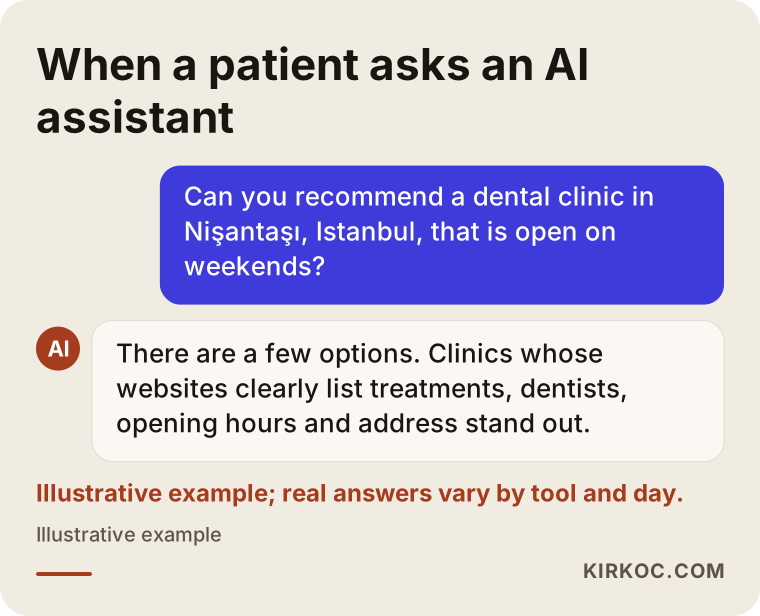
Recently, another channel has joined the mix. People now ask AI assistants such as ChatGPT, Gemini or Perplexity questions like "Can you recommend a good dermatology clinic in Şişli?" or "I need an accountant in Mecidiyeköy who sets up companies for foreigners." When these assistants answer, they find it easier to cite pages that clearly say what a business does, where it is and who it serves. Writing your site clearly enough to answer such questions is called GEO, short for generative engine optimization. It is not a separate kind of magic. It comes down to content that is well organized and honest.
The image below illustrates the kind of answer someone looking for a clinic in Şişli might get from an AI assistant. Pay attention to which pieces of information the assistant relies on.
How should a website be built for firms in office towers?
For firms in office towers, the site's first task is to create the impression, within a few seconds, that "this company is real, knows its business, and can be reached." In consulting, law, accounting, software, recruitment or architecture, the client sees your website before they see you, and the first round of elimination happens right there.
A site like this usually needs the following pages:
- Home page: A headline that says what you do in one sentence, who you serve, and the shortest route to contacting you.
- Service pages: A separate page for each main service. Listing eight services in a single paragraph under "Our Services" wears out both the reader and Google.
- About or team page: A corporate buyer wants to see who they will be working with. Job titles, areas of experience and a real photo go a long way here.
- Contact and directions: The tower's name, the floor, parking details and the nearest metro exit. Finding the right building and the right entrance is what visitors struggle with most in Istanbul's business towers.
- References or case studies: If confidentiality stops you from naming clients, you can write anonymized examples by industry and type of work.
A trap many office-tower firms fall into is filling the site with buzzwords that say nothing. A line like "We deliver end-to-end solutions" does not answer the visitor's real question: "Can this firm solve my problem?" A concrete sentence such as "I handle your company's accounting from incorporation through monthly tax filings" is far stronger.
Language is the other big question. Şişli's office towers are full of foreign-owned companies and firms that work with clients abroad. If you are a foreign founder, you probably need the site in both English and Turkish: English for your international clients and partners, Turkish for local customers, suppliers and future hires. Planning both versions of at least the home page, service pages and contact page from day one is far less painful than bolting a second language on later.
What should a clinic or healthcare website look like?
For a healthcare business, the website should ease the patient's anxiety and shorten the path to an appointment. Around Nişantaşı, Osmanbey and central Şişli there is a dense mix of dental clinics, cosmetic and dermatology practices, physiotherapy centers, psychologists and dietitians. Patients usually arrive on your site from a phone, trying to make a quick decision.
That is why the order of priorities on a clinic website is fairly fixed. The patient first wants to see what kind of care you offer, then who will examine them, then where you are and how to book. A phone number that can be called with one tap, a WhatsApp link or booking form that is easy to find, and clearly stated opening hours matter more in this sector than visual flair. If you serve international patients, add plain information on languages spoken, how to reach the clinic from the airport or hotel areas, and how the first consultation works.
There is a separate issue you need to watch in healthcare: advertising rules. Turkey has regulations on how healthcare services may be promoted, and there can be restrictions on things like before-and-after photos, patient testimonials and wording that promises a definite result. The rules may also differ from what you are used to in your home country. When I write site copy, I stay away from exaggerated or promise-based wording, but I am not the person who should make the final call on what complies with the law. I recommend checking with a lawyer or the professional association you belong to.
Pages that work well on clinic websites include: a separate page in plain language for each treatment or service, profiles of the doctors and specialists, frequently asked questions, directions and parking information, and a booking page. Content that answers a patient's general questions, such as "Does this procedure hurt? How long does it take? How many sessions will I need?", builds trust and also helps you show up on Google and in AI assistants.
How should a website be built for a trading business?
On the trade side, the site's job is to show your product and move the buyer to the next step: placing an order, requesting a quote, or visiting the store. In Şişli there are two quite different models here, and you need to know from the start which one you fit.
The first model is wholesale. For businesses like the textile and ready-to-wear wholesalers in and around Osmanbey, the buyers are usually in other cities or other countries. These buyers do not purchase single items. They look at a collection and want to know size ranges, minimum order quantities, shipping and payment terms. In that case, a well-organized catalog, a quick quote request form and WhatsApp contact are often more useful than a full online store. If you sell to buyers abroad, catalog pages in English, and where it makes sense Arabic or Russian, are worth considering.
The second model is retail. For a boutique in Nişantaşı or a store in central Şişli, the website is both an online sales channel and an invitation to visit the shop. Here, payment processing, shipping, returns and inventory tracking come into play, and the project turns from a standard business website into an e-commerce build. If you already sell on Turkish marketplaces such as Trendyol or Hepsiburada, you also need to plan how your own site will work alongside those channels.
Both models share one rule: product photos are the heart of the site. Phone snapshots taken in different light, against different backgrounds, will make even the best design look ordinary.
Example scenario 1: An accounting firm in Esentepe (hypothetical)
The scenario in this section is hypothetical and does not describe any real firm. Picture a three-person accounting practice in an Esentepe office tower. For years they have won work through client referrals. Their website is a single page that an acquaintance put together a few years ago, and it does not display properly on a phone.
The owner wants newly formed companies, and especially foreign entrepreneurs who want to set up a company in Turkey, to be able to find the practice. In a case like this, I would not start with the design. I would start with the questions their potential clients ask. "How long does it take to register a company in Şişli?", "What documents does a foreign shareholder need?", "What is Turkey's electronic ledger system?" Each of these questions can become the subject of a service page or an article on the site.
Then the structure is built: a home page; pages for company formation, monthly bookkeeping, payroll and services for foreign investors; a team page; an English version; and a contact page that spells out how to get there. The Google Business Profile (your business listing on Google Maps) is updated with the tower's name and floor number. The LinkedIn page and the website are edited so they speak with the same voice.
Managing expectations matters in this scenario. A new site does not make the phone ring on launch day. It takes time for Google to discover new pages and weigh them against competitors. But from day one, the owner can confidently send a link to people who were referred, and that alone is often the first concrete difference.
Example scenario 2: A dental clinic in Nişantaşı (hypothetical)
This scenario is hypothetical as well. Picture a dental clinic in Nişantaşı with two dentists. Their Instagram account is active, but their website barely exists. Patients keep asking about prices in direct messages, many of them in English from abroad, and appointments are handled in a messy mix of phone calls and chats.
Here, the site's first goal would be to answer the questions on a patient's mind without the need for a DM. Separate pages in plain language are prepared for each treatment, such as implants, root canal treatment, orthodontics and teeth whitening. The dentists' areas of expertise and training are listed. A short appointment request form and a one-tap WhatsApp link are added. Because many inquiries come from abroad, the key pages are written in English as well as Turkish.
The visual style on Instagram and on the website is brought into line, so a patient who clicks through from Instagram does not feel they have landed somewhere else. This is where having the site and social media run by the same person pays off in practice: when there is a campaign, a new dentist or a change in opening hours, nobody has to update two places separately.
The advertising rules apply here too. The clinic should get a lawyer's opinion on whether and how before-and-after images or patient reviews can appear on the site. I keep the copy informative and free of promises.
How does the website process work, step by step, for a Şişli business?
The process runs in five basic steps: a needs call, a page plan, design and content, launch, and follow-up. I ask for your approval at the end of each step, so you will not be surprised halfway through with "that is not what I asked for."
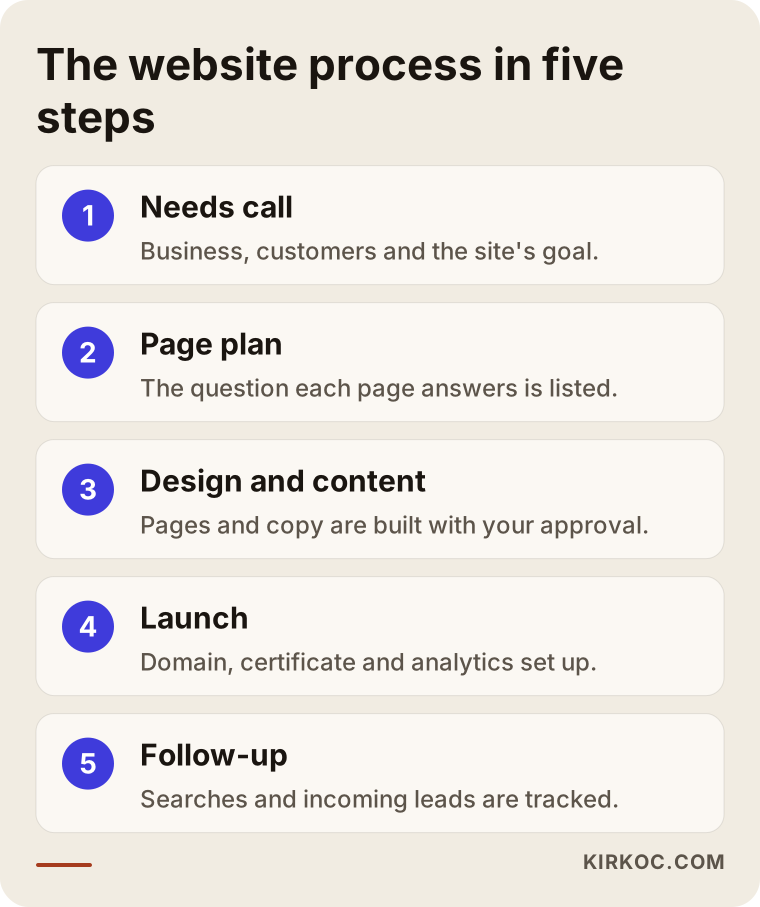
Let me expand on the steps shown above:
- Needs call: We talk about your business, your customers, your competitors and what the site is for. This can happen by phone, by video call from wherever you are, or in person at your office in Şişli.
- Page plan: I write a list of the pages the site will have, which question each page answers and which search it is meant to match. I do not move on to design until you approve this list.
- Design and content: If you have a logo and brand colors, I build the pages around them. If not, we settle on a visual style together. I write the copy based on information you give me, or I edit the text you supply.
- Launch: The site goes live with the domain, hosting, a security certificate (the padlock in the address bar), Google Search Console (a free tool that shows how Google sees your site) and visitor analytics all set up.
- Follow-up: In the weeks after launch, I check how Google is crawling the site, which searches it appears for, and what forms and calls are coming in. If needed, I adjust page titles and copy.
What to look for when choosing a provider
The most important thing to check is whether the provider understands the customers in your industry. A design portfolio is only part of that. When you look for a web design company in Şişli you can collect plenty of quotes, and they can look very similar. The questions you ask are what reveal the difference.
The checklist below gives you concrete criteria to compare.
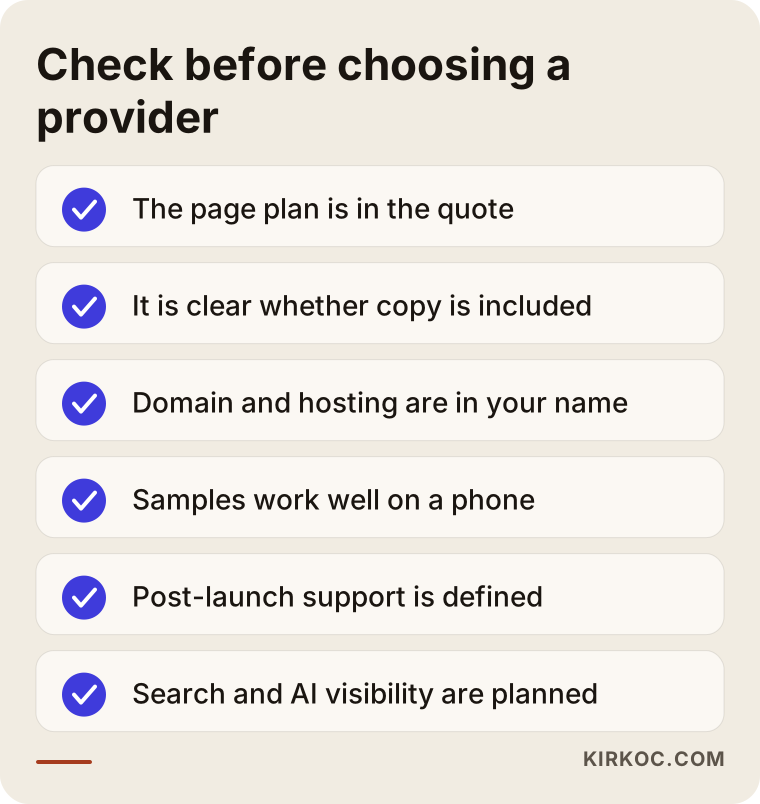
A little more detail on each point:
- Is the page plan written into the quote? "Business website" is not enough. The quote should state clearly which pages will be built and how many service pages there will be.
- Who writes the copy? On many projects the design is finished and then the site sits for months waiting for text. Ask up front whether copywriting is included, and in which languages.
- Whose name are the domain and hosting under? Your domain and hosting account should be registered in your name, or your company's. Whether you can take your site with you when you switch providers depends on it.
- How does it look on a phone? Open the sample projects on your own phone. Most of your Şişli customers will see you on a phone first.
- What happens after launch? Ask how quickly you will get a response for a small text change, a new page or a bug.
- Has visibility on Google and in AI assistants been considered? The site needs to be findable, not just good-looking. Page titles, descriptions and content structure should be planned with that in mind.
Here are a few questions you can ask in the first meeting: "How do you think customers in my industry search?", "What will you do in the first three months after launch?", "Will I be able to update the site myself, and how?", "If the project ends, how will the files and logins be handed over to me?" Working with someone who answers these clearly cuts down a great deal on surprises later.
If you are a foreign business owner, add one more: "Can we work in English, and how will we communicate across time zones?" Everything else on the list matters more than whether the provider is down the street.
What are the common mistakes when getting a website built in Şişli?
The most common mistake is treating the site like a business card: have it made once and forget about it. A site that is not updated after launch, with old opening hours, photos of staff who have left and services you no longer offer, sends the wrong signal to customers.
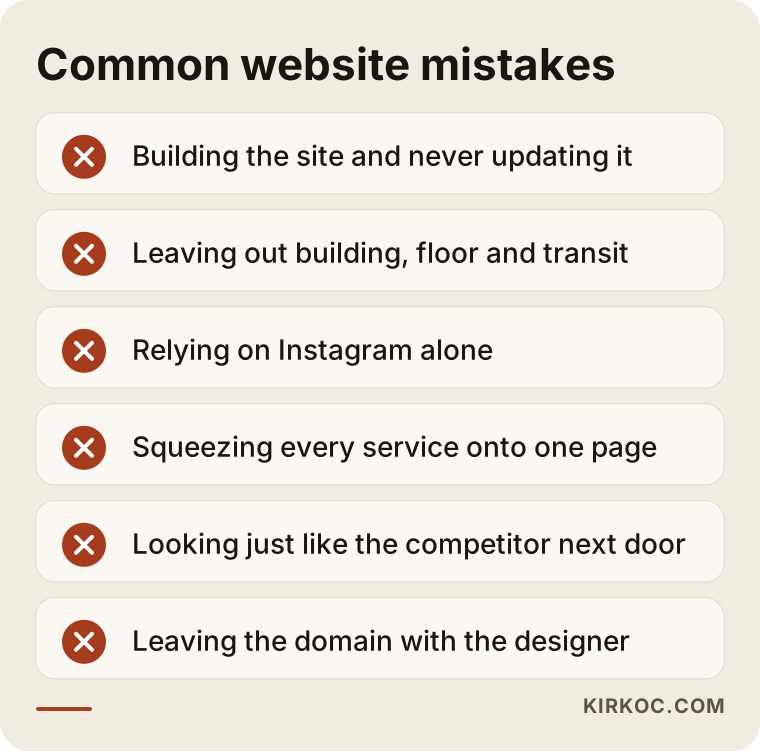
Beyond the mistakes in the image, I have a few observations specific to this district:
- Writing an incomplete address: "Şişli, Istanbul" is not enough. If you leave out the tower name, floor, neighborhood and nearest metro stop, customers will struggle to find you, and Google will not fully understand your location either.
- Relying on Instagram and neglecting the site: This is especially common with clinics and boutiques. Instagram is a powerful shop window, but it does not deliver someone who searches Google for "Nişantaşı dental clinic" straight to your profile.
- Explaining everything on a single page: Cramming every service onto one page can mean you appear on Google for none of them.
- Copying a competitor's site: A site that looks like the one belonging to the competitor in your own building does nothing to set you apart in the customer's mind.
- Leaving the domain in the designer's name: Years later, if you cannot reach the designer, you can lose control of your own site.
- Publishing only in one language: If your clients are international but your staff and suppliers are local, a site in only one language leaves half your audience guessing.
What can you do yourself, and when do you need an expert?
Some tasks you can comfortably handle on your own. But when it comes to the site's structure, technical setup and search visibility, working with an expert usually saves both time and money. To make the decision easier, I have put the two side by side.
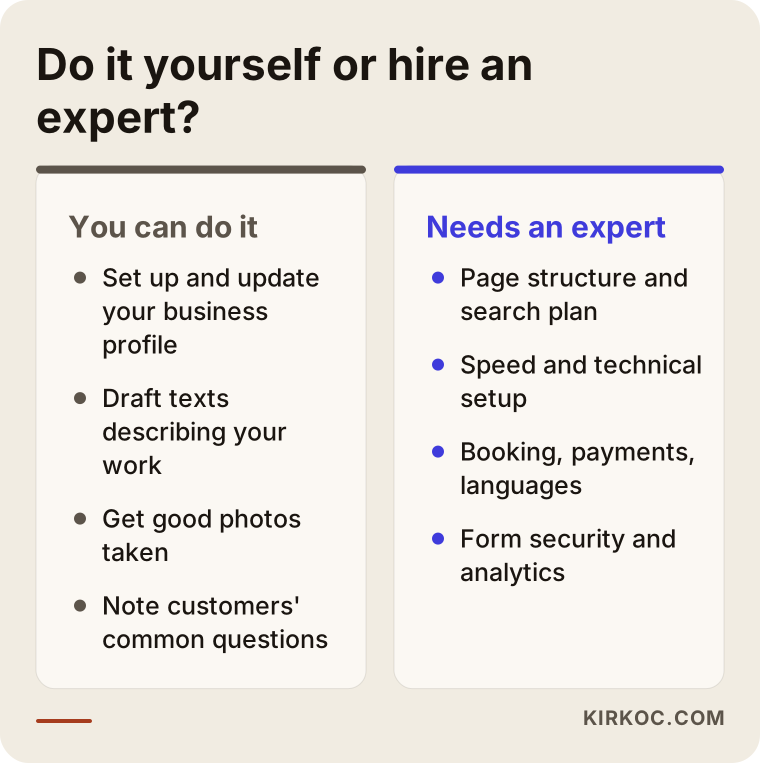
The things you can do yourself include creating and maintaining your Google Business Profile, drafting rough texts that describe your business, getting good photos taken, and writing down the questions your customers ask most often. Even if you end up hiring an expert, this preparation speeds the work up and lowers the cost.
You can also build a simple site yourself with tools like Wix, Squarespace or WordPress. For a one-page introduction, that may be enough. But if you offer several services, speak to customers in more than one language, need features like booking or payments, and want to appear for specific searches on Google, things get technical quickly. Speed settings, page structure, search-friendly headings and form security all take experience.
A few signs that it is time to call in an expert: your site is slow or broken on a phone; you do not appear near the top even when someone searches for your own company name; the site never produces a form submission or a call; and something breaks every time you sit down to update it yourself.
What drives the cost of web design in Şişli?
The main factor in what web design costs is the size of the site and what it needs to do. Being "in Şişli" does not change the price by itself. I am not giving figures in this article, because two businesses rarely have the same needs. But knowing what moves the price makes it much easier to compare quotes.
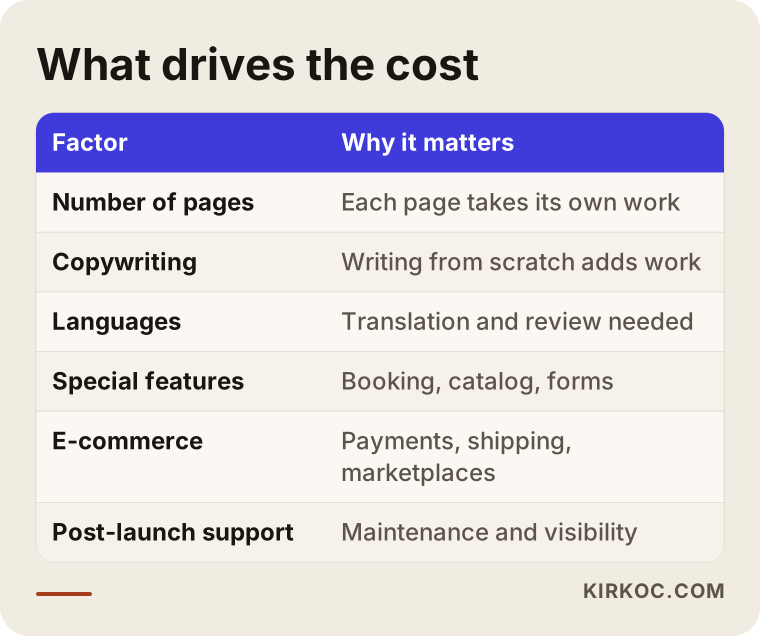
A quick explanation of the factors in the image:
- Number of pages and amount of content: A ten-page business site and a clinic site with thirty treatment pages do not take the same effort.
- Copywriting: There is a real difference in workload between you supplying the text and me writing it from scratch.
- Number of languages: Every extra language means translating the copy and checking it. For a foreign-owned business in Istanbul, this can be one of the factors that grows the scope most.
- Special features: Online booking, payments, a product catalog, a dealer login or a quote request form all expand the scope.
- E-commerce: The number of products, payment and shipping integrations, and marketplace connections all have a noticeable effect on cost.
- Post-launch support: Whether you want ongoing monthly work on maintenance, updates and search visibility.
When you compare quotes, look at what is included, not at the lowest number. A quote that looks cheap may leave out copywriting, hosting or post-launch support.
How does a single point of contact help a Şişli business?
The most concrete benefit of working with one person is that your website, your Google visibility, your social media and your advertising all point toward the same goal. In a place as competitive as Şişli, that means far less wasted energy than four separate suppliers each pulling in their own direction.
Here is an example. Say a clinic wants to appear on Google for "dental implants Şişli" through a Google Ads campaign. If the page a patient lands on after clicking the ad does not explain implants clearly, and the booking button is easy to miss, the ad budget is wasted. If the person running the ads and the person who built the site are different people, just working out whose problem it is can take weeks. When one person manages both, I can look at the ad data and fix the page the same day.
The same goes for social media. An announcement on LinkedIn or a promotion on Instagram falls flat if there is no matching page on the site to send people to. I set up that connection at the start of every new piece of content.
For a foreign owner, there is one more practical benefit: you have one person to brief, in one language, instead of coordinating a designer, an SEO consultant, a social media manager and an ad specialist across a language barrier.
I am not claiming that a single point of contact is right for everyone. A very large company with dedicated specialist teams in every area may be better served by a different setup. But for most small and mid-sized businesses in Şişli, having one person to deal with makes things simpler.
Working with Ümit Kırkoç
I am Ümit Kırkoç. I work in Istanbul, and I provide on my own the full range of services a digital agency would offer: websites and e-commerce, SEO, local SEO, GEO, social media management (Instagram, Facebook, LinkedIn, TikTok, YouTube), Google and Meta ad management, logo and brand identity, and content writing. I can meet businesses in Şişli in person, and I can run most of the work remotely, which also lets me work with clients elsewhere in Turkey and abroad.
Here is a short summary of how I approach a web design project for a Şişli business. In the first conversation, we discuss what the site is for and how your customers search for you. Then I prepare a page plan and a quote with a clearly written scope. Once you approve, I prepare the design and the copy and show you each stage. After the site goes live, I track its visibility on Google and the inquiries that come in. If you want, I can also run social media and advertising from the same plan.
I do not guarantee rankings, followers or sales; nobody can honestly guarantee those. What I do promise is to work from a clear plan, to explain what I am doing in plain language, and to make sure the domain, hosting and every login stay in your name.
Frequently asked questions
Who would you recommend for getting a website built in Şişli?
First, pin down what you need: a business website, a booking site for a clinic, or a site that sells products? Then pick someone who understands your industry, writes the page plan clearly into the quote, and registers the domain in your name. If you want your site, Google visibility and social media handled by one person, Ümit Kırkoç, who works from Istanbul, is one of the options.
Should I hire a firm based in Şişli, or is someone who works remotely fine?
Either works. A face-to-face meeting is helpful at the start, but most of a website project happens at a screen. What matters is that the person is easy to reach and understands customers in your area. If you are still abroad, remote work lets you have the site ready before you open your doors.
Does a clinic really need a website, or is Instagram enough?
Instagram is a strong shop window, but it is not enough on its own. A patient who searches Google for something like "Nişantaşı dental clinic" will most likely land on a website or a map listing. Having treatment information, doctor profiles and a way to book on your site builds trust. For the rules on promoting healthcare services, I recommend consulting a lawyer.
I am a wholesaler. Should I build an online store or a catalog site?
If your buyers order collections and bulk quantities rather than single items, a well-organized catalog with a quick quote form is usually the better fit. If you also sell at retail, an e-commerce platform may be worth considering.
Will I show up on Google right away once my site is built?
No, not right away. Google needs time to discover new pages and compare them with competitors. A well-built site makes that process easier, but nobody can guarantee a specific ranking.
Why do web design prices in Şişli vary so much?
Because the quotes cover different scopes. Number of pages, copywriting, number of languages, special features and post-launch support are the main factors behind the price. When you compare quotes, check what is included.
What can I do so that AI assistants like ChatGPT recommend me?
State clearly, honestly and in detail on your site what you do, where you are and who you serve. Create pages that answer the questions your customers ask. That does not guarantee a recommendation, but it makes it more likely that you get cited.
Can I update my site myself later?
Yes. If the site is built with that in mind, you can change text, photos and opening hours yourself. If you tell me at the start, I include the admin panel and a short how-to guide in the handover.
Whether you work in an office tower, a clinic or a trading business in Şişli, if you want your site to answer your customers' questions and move them to the next step, we can talk through what you need. You can reach me through the website design page and request a quote with a brief description of your business and your goals.