Short answer
If you run a clinic, a school, a language course or a small hotel in Üsküdar, look for a web designer who understands your sector and who cares less about how the site looks on day one and more about who arrives on it and what question they bring. In health care, education and hospitality, visitors are looking for reasons to trust you: who the doctor or teacher is, where exactly you are, how to get there by Marmaray or ferry, and how to book or enroll. One option is me, Ümit Kırkoç (kirkoc.com). I am based in Istanbul, I work in English, and I take on projects remotely for owners who live abroad or split their time between countries. Because I handle the website, Google visibility, social media and ads as one person, I am a good fit for small and mid-sized businesses that want those pieces built to work together. You can find the details on my website design page. Whoever you choose, keep the checklist in this article next to you before you ask anyone for a quote.
This guide is written for a particular reader: someone who owns or is opening a business in Üsküdar, often as a foreigner or with a foreign partner, and who needs a website that speaks to Turkish locals and international visitors at the same time. You do not need to know anything about web design to follow it. Where a technical term is unavoidable, I explain it in a sentence.
Why do businesses in Üsküdar need something different from their website?
In Üsküdar, a website has one job: to answer the visitor's unspoken question, "Should I go there?", within a few minutes. The district is a mix of things that rarely sit side by side elsewhere. It has hospitals and private practices, long-established schools, tutoring centers and course providers, and along the shore a string of cafés, guesthouses and small hotels. It is a residential neighborhood and a destination at the same time. Around Altunizade and Ünalan, offices and health facilities cluster together. On the Kuzguncuk, Çengelköy and Beylerbeyi waterfront, the visitor is someone else entirely: a weekend stroller, a family hunting for a breakfast table by the water, a traveler who wants a room facing the Maiden's Tower.
That variety means a one-size-fits-all template will not serve everyone. On a physical therapy center's site, the first thing people check is the specialist's training and how to get an appointment. On a kindergarten's site, parents want to see the garden, the school bus route and what a normal day looks like. On a boutique hotel's site, guests look at photos, at the view from each room, and at how far it is to walk to the ferry pier. When I start a project, I always ask the same thing first: when someone lands on your site, what question are they carrying, and what answer makes them pick up the phone?
Transportation is a very Üsküdar detail, and it matters more than most owners expect. Marmaray (the rail line that runs under the Bosphorus), the metro, the ferries from the European side and the bridge traffic all shape whether people decide to come. A single sentence such as "fifteen minutes by ferry from Karaköy" or "a short walk from the Marmaray exit" can do more work than a long paragraph about your history. For international visitors who do not know the city, that sentence is often the deciding factor.
If you are a foreign owner, there is one more layer. Your customers will search in Turkish, in English, and sometimes in Arabic, Russian or German. Your site has to feel natural to a local parent in Çengelköy and to a tourist planning a trip from Chicago. That is a design problem and a writing problem, not just a translation problem.
How do customers in these three sectors search for you?
In short: in health care they search by symptom or specialty, in education by age group and neighborhood, and in tourism by experience and view. The way people search tells you which pages your site needs. Someone who types "physiotherapist Üsküdar" is in a different place from someone who types "when to start exercises after a herniated disc". The first is close to booking; the second is still gathering information.
In education, searches usually combine a neighborhood and an age: "kindergarten Çengelköy", "high school entrance exam prep Altunizade", "adult English classes Üsküdar". (The Turkish high school entrance exam is called LGS, and many local parents search for it by name.) A parent has two questions in mind: how do I get my child there, and is my child safe there? In tourism, searches are more emotional and visual: "Üsküdar hotel with sea view", "boutique guesthouse Kuzguncuk", "breakfast with Maiden's Tower view". Guests often open several tabs at once and choose the place that gives the clearest answer and the most honest photos.
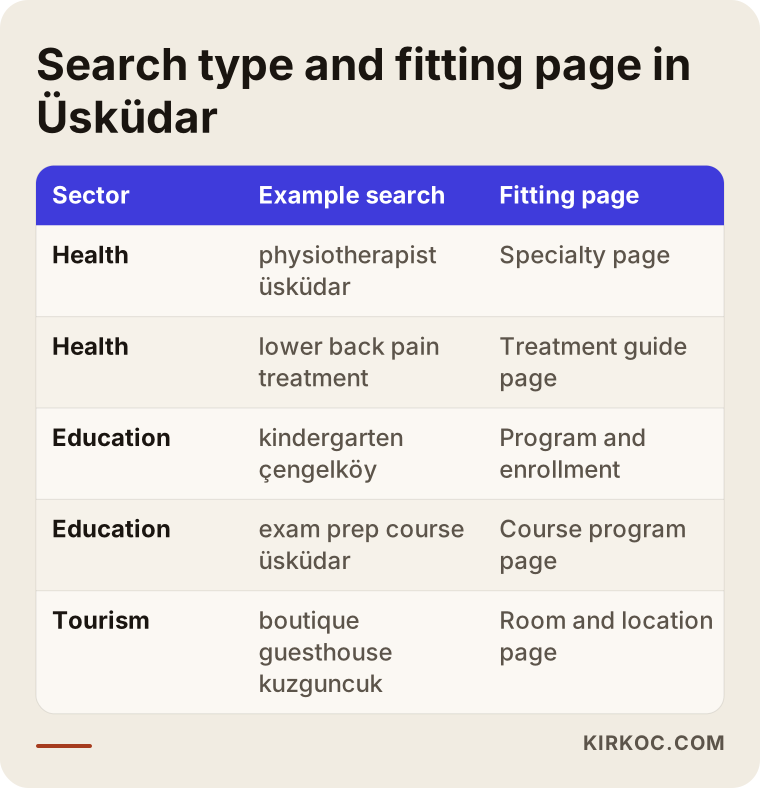
You can treat this table as a rough site map. If your site has no page that answers a given type of search, that visitor ends up on a directory site, a review platform, or a competitor who explains things more clearly than you do.
Questions people ask AI assistants are now part of the picture
Many people no longer type into Google at all. They ask ChatGPT, Gemini or Perplexity something like "Can you recommend a good English course for my child in Üsküdar?" When these tools build an answer, they lean on web pages that state clear, consistent, easy-to-read facts. The work of making your site usable as a source for those answers is called GEO, short for generative engine optimization. There is no magic in it. Your pages simply need to say, in plain sentences, who you are, where you are, and what you offer to whom.
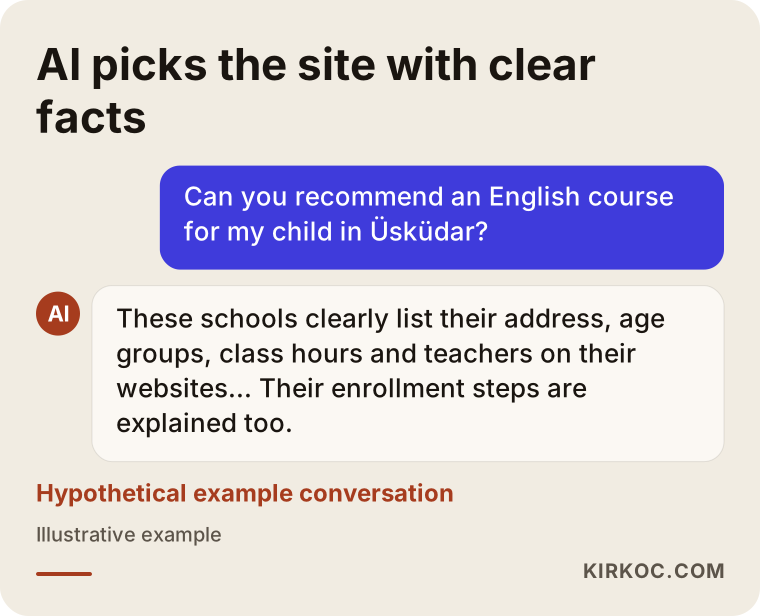
The conversation in the image is hypothetical, but the logic is real. The assistant favors the school that writes out its address, age groups, class hours and teacher information in text. A site whose information is scattered, or locked inside images and PDF brochures, is far less likely to make it into the answer. For a bilingual business this matters twice: an assistant answering in English needs English text to quote.
What pages do health, education and hospitality websites need?
In all three sectors you need more than a home page, an about page and a contact page. The real work is building a separate, substantial page for each service, program or room type. Below I list the core pages by sector. Treat it as a starting point; every business turns out a little different.
Health: clinics, private practices, physical therapy, dental, counseling
- A separate page for each specialty or treatment: what it is, who it suits, how the process unfolds.
- A page for each doctor or specialist: training, areas of focus, a real photo, and the languages they speak.
- An appointment page: phone, WhatsApp, online form, and when each one gets answered.
- Directions and parking, plus a clear note on wheelchair access if you have it.
- Insurance and partner institution information, as long as you can keep it current. International patients often want to know whether you work with their private insurer.
Health websites carry a specific risk. Turkey has rules on how health services may be advertised, and phrases like "the best" or "guaranteed results", the use of patient testimonials, or before-and-after photos can cause problems. I do not give legal opinions on this. If you are unsure what can and cannot appear on your site, talk to a lawyer familiar with Turkish health regulations or to your professional association. What I do is keep the copy informative and measured, and flag any wording that looks risky to me so you can check it.
Education: kindergartens, private schools, course centers, private tutoring
- A separate page for each program or age group: goals, class hours, class size.
- A teachers page with experience and areas of expertise.
- An enrollment page: which documents, which dates, how the first meeting works.
- School bus routes and directions, which are a deciding factor for many parents.
- A photo gallery of real classrooms, the garden and activity spaces. If children's photos are used, get written permission from the parents first.
If you run an international or bilingual program, say so clearly on every relevant page and in both languages. Expat parents searching in English will not dig through Turkish pages to find out whether instruction is in English.
Hospitality: boutique hotels, guesthouses, breakfast spots and cafés
- A separate page for each room type: the view, the size, how many people it sleeps, real photos.
- A booking path: direct form, phone, or a link to a booking platform.
- A location page: distance to the ferry pier, Marmaray, and landmarks like the Maiden's Tower and Beylerbeyi Palace.
- At minimum, a well-written English version for foreign guests, and Turkish for domestic travelers.
- A breakfast, menu or events page that is easy to update with the seasons.
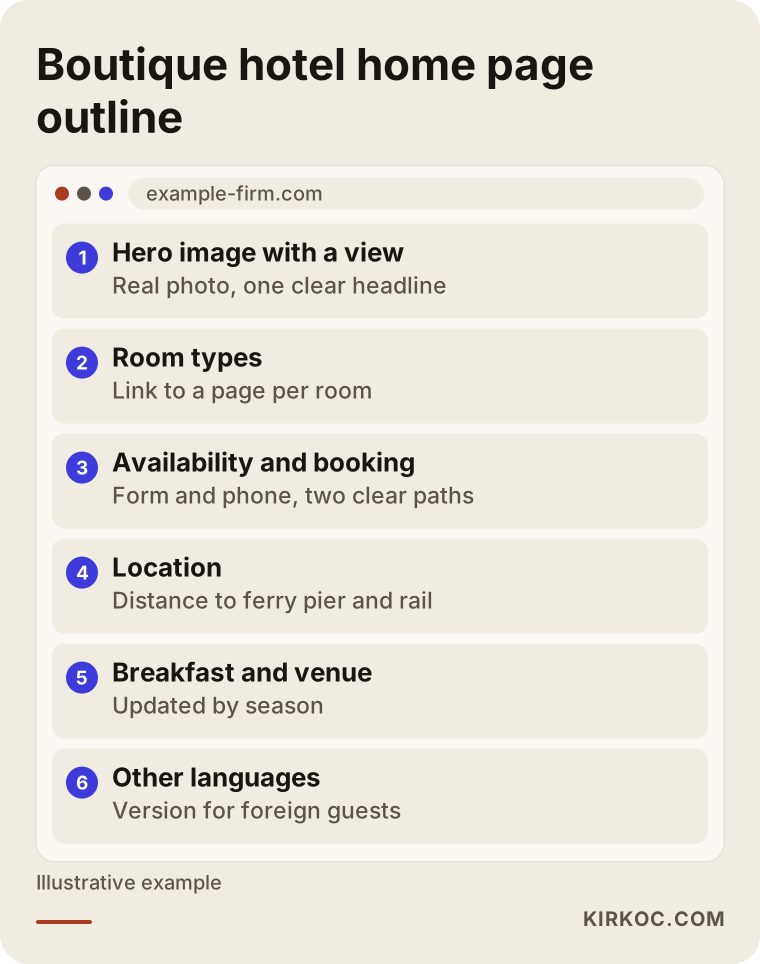
The order in this sketch is deliberate. Guests first want to see the view and the room, then ask about price and availability, and only then figure out how to get there. The same logic applies to clinics and course centers; only the content of each section changes.
Example scenario 1: a physical therapy center in Altunizade (hypothetical)
This scenario is entirely hypothetical. Picture a small center in Altunizade where two physiotherapists work. Their site was built a few years ago from a ready-made template: one page, a large photo at the top, and a heading called "Our Services" followed by ten bullet points. Most patients come through word of mouth, and the number of new patients has stalled. One of the partners has lived abroad and would like to attract English-speaking residents too, but the site is only in Turkish.
In a case like this, my first step would be to ask which complaints bring patients in most often. Say the answer is lower back and neck pain, sports injuries, and rehabilitation after surgery. Each of those three gets its own page, explaining in plain language how treatment works, what the number of sessions depends on, and who the treatment is not suitable for. Each specialist gets an introduction page. An appointment button appears at the top and bottom of every page, with a WhatsApp option. The directions section gives the walking time from the metro stop and nearby parking options. The three treatment pages and the specialist pages also get an English version, written for an English-speaking reader rather than run through a machine.
Once the site is live, the Google Business Profile (the listing that shows your business on Google Maps) is updated with the same information, so the address, phone number and opening hours match exactly in both places. If the owners want, a short Instagram post goes out once a week explaining one of the pages on the site, with a link to that page. I am not promising a number of patients here. The goal is that people who arrive find what they were looking for and do not leave undecided.
Example scenario 2: a six-room guesthouse in Kuzguncuk (hypothetical)
This is also a hypothetical example. Imagine someone who has turned an old wooden house in Kuzguncuk into a guesthouse, perhaps a foreign owner who moved to Istanbul and fell in love with the neighborhood. Nearly all bookings come through the big booking platforms, which take a commission on every stay. There is a website, but it has no proper English version, the photos were taken on a phone, and the room details are out of date.
The aim here is not to cut ties with the platforms. It is to make direct booking easier. Each room gets its own page with professional photos. The view, the bathroom type and the breakfast details are written out clearly. An English version is added, because foreign visitors to this part of the city research a place online long before they arrive, and a Turkish version is kept for domestic weekend travelers. The location page explains how to get there from the Üsküdar ferry pier and from the Beylerbeyi direction. Guests get two clear paths to reach the owner: a contact form on the site, or a direct message.
Handling everything through one person pays off in a concrete way here. The morning breakfast photo shared on social media links to the breakfast page on the site. A small Meta ad (the ad system behind Instagram and Facebook) launched at the start of summer sends people straight to the booking page. Because the same person builds the site, sets up the ad and prepares the posts, the links do not break, and a guest who clicks an ad does not land on an empty home page and wonder where to go next.
How does the process work?
My process has five steps, and each one ends with your approval. The steps below apply to a typical health, education or hospitality site; how long each takes depends on the size of the job.
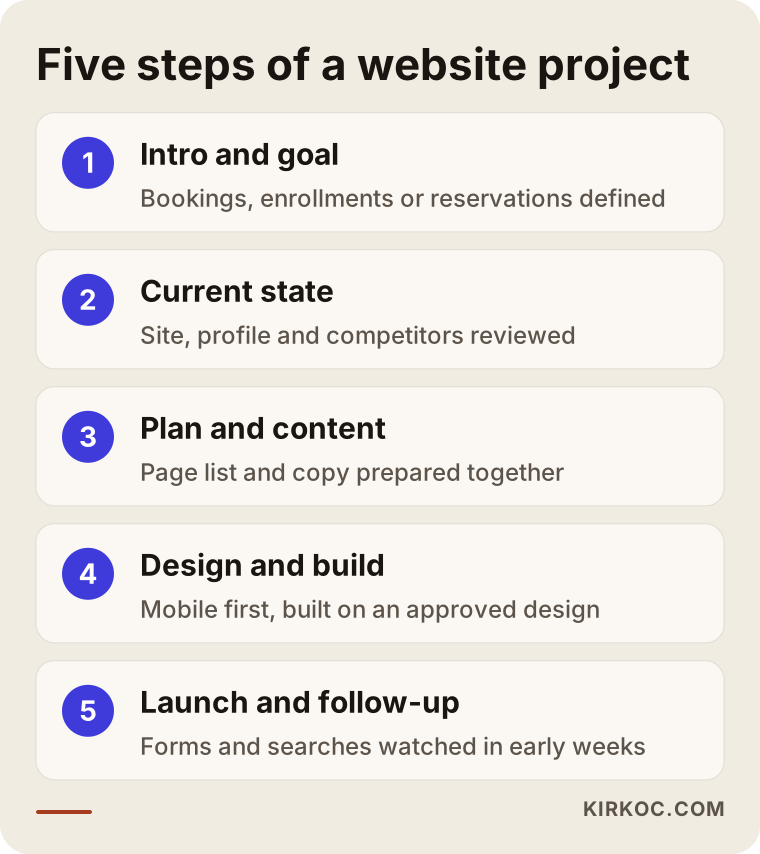
1. Introduction and goal
In our first conversation, which can happen over video if you are not in Istanbul, we talk about your business, your customers, and what you want the site to change. More appointments? More parent meetings before enrollment season? Direct bookings so you pay less in platform commission? I do not design a single page until the goal is clear.
2. Reviewing where you stand
I look at your current site if you have one, your Google Business Profile, your social media accounts, and what your competitors are doing. I work out which searches you show up for and which pages get no visits at all. This step keeps us from producing pages nobody needs.
3. Site plan and content
I give you a list of the pages the site will have and the question each page will answer. We write the copy together: you supply the facts, and I turn them into language your customers will understand, in Turkish, in English, or both. If a photo shoot is needed, we plan it at this stage.
4. Design and build
I first show you the design for the home page and one service page; once you approve, I move on to the rest. Since most visitors arrive on their phones, I build the mobile view first. Fast loading, working forms and the basic search engine settings are all part of this step.
5. Launch and the first months
After launch I connect Google Search Console and analytics tools. These are free Google tools that show who comes to your site and through which searches. In the first weeks I check that form submissions arrive, that the tap-to-call button works, and I make small fixes where needed.
Common mistakes when getting a website built in Üsküdar
The mistake I see most often is a site designed through the owner's eyes and never checked through the customer's. That one general mistake shows up in several concrete forms.
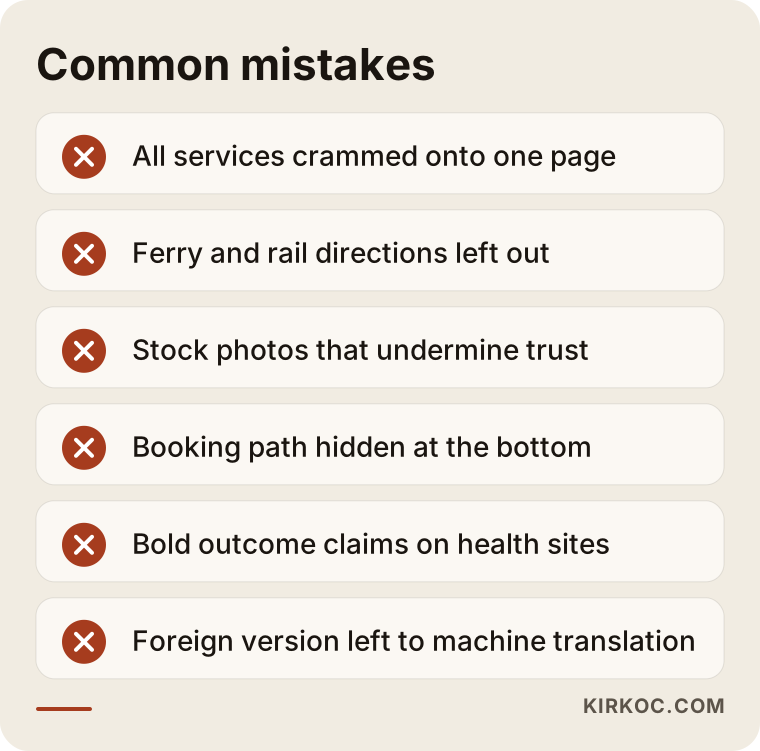
- Cramming every service onto one page. When ten headings sit stacked under "Our Services", none of them gets enough explanation. A visitor who cannot find a page about their specific problem goes back to the search results.
- Leaving out directions. For a patient or guest coming from the European side, the ferry, Marmaray or bridge route is a deciding detail. An embedded map alone is not enough; explain it in a sentence or two.
- Using stock photos. Smiling models posing as doctors, or a hotel room the guest will never actually see, create suspicion instead of trust. A real photo, even an ordinary one, does a better job.
- Hiding the booking or enrollment path. If your phone number only appears at the very bottom of the page, someone browsing on a phone may leave before finding it.
- Letting information go stale. Old opening hours, a photo of a teacher who left last year, or last season's menu tell visitors the site has been abandoned.
- Bold claims on health sites. Promising certain results damages trust and may also be risky under the advertising rules mentioned above.
- Leaving the foreign-language version to machine translation. On a hospitality site, clumsy English undermines your professionalism in the very first sentence. The same goes in reverse: if you are a foreign owner, make sure your Turkish copy reads as if a local wrote it.
What can you do yourself, and when do you need a specialist?
Some of this you can start today on your own. Building the site from scratch, planning the page structure and making it visible in search engines, though, usually calls for professional help. Let me start with the free, quick steps.
You can create and fill in your Google Business Profile yourself: address, phone, opening hours, category and real photos. Writing down the ten questions your customers ask most often is one of the most valuable things you can do to prepare; that list later becomes the backbone of your site. Taking photos of your space, rooms or classrooms with your phone in good light is the first step toward an archive of real images. You can also put together a simple introduction page with tools like Wix or Squarespace; for a small business offering a single service, that may be enough to begin with.
The moment you need a specialist usually looks like this: you have several services or programs and each needs its own page, you keep seeing competitors above you in search results, you want the site in more than one language, or you expect the site to work together with ads and social media. There is also the question of time. A clinic director or school principal who spends weeks wrestling with a website is taking those weeks away from the actual work. And if you do not read Turkish comfortably, judging whether your Turkish pages are doing their job is hard to do on your own.
What to look for when choosing a web designer or agency
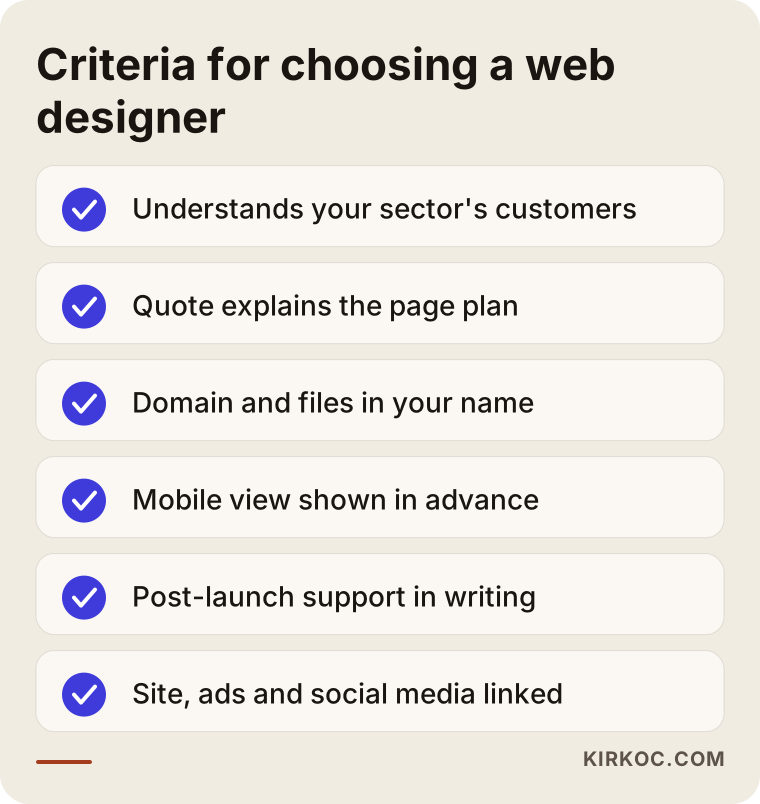
The right person understands how customers in your sector think, explains what they will do in plain language, and commits clearly to handing the site over to you. When you compare quotes, I suggest checking the following.
Concrete criteria
- Understanding of your sector. Have they built clinic, school or hospitality sites before? If not, do they ask about your customers' questions in the first meeting?
- A page plan. Does the quote only say "five-page website", or does it explain which pages will be built and why?
- Ownership. Whose name will the domain, the hosting account and the site files be in? They should be registered to you.
- Mobile and speed. Do they show you in advance how the site will look on a phone?
- Support after launch. How long, and under what terms, will they help with small changes once the site is live?
- One point of contact. Is the person who builds the site the same person who will later handle ads or social media, or will you be the one connecting them?
- Language. Can you communicate comfortably with them in a language you both speak well, and can they write natural copy in each language your site needs?
Questions to ask when getting a quote
- "In my sector, what do you think my customer looks for first when they land on the site?"
- "Who will write the copy, and how much information will you need from me?"
- "Whose name will the domain and hosting be in, and can I take the files if we part ways?"
- "What do you do so the site is easy to understand for Google and for AI assistants?"
- "What do you check in the first months after launch?"
If you cannot get clear answers to these questions, or the answers are full of jargon, that alone is reason enough to look at another quote.
What determines the cost?
The cost of a website depends on the number of pages, who writes the copy, how many languages it has, and what the site needs to do. I do not quote figures here, because two businesses in the same sector can have very different needs. But if you know which items make up the price, you can compare quotes much more fairly.
- Number and depth of pages. A separate, substantial page for each treatment, program or room type takes more work than a one-page introduction site.
- Content creation. Will you supply the text, or does it need to be written from scratch? Is a professional photo shoot needed?
- Number of languages. Hospitality sites need English and sometimes other languages too; each language means its own copy and its own review.
- Special features. Online appointments, enrollment forms, booking calendars or payment collection all add to the scope.
- Post-launch services. Maintenance, updates, SEO work, social media or ad management are planned separately if you want them.
Working with one person has a cost benefit as well. When the site, SEO and ads are planned by the same person, the output of one job gets reused in the next, and you do not have to explain the same information to three different people.
Working with Ümit Kırkoç
I am Ümit Kırkoç. I work in Istanbul, and I offer everything a digital agency offers, as one person, from a single point of contact: websites and e-commerce, SEO and local SEO, GEO, social media management for Instagram, Facebook, LinkedIn, TikTok and YouTube, Google and Meta ads, logo and brand identity, and content writing. There is no team behind me; the person you talk to is the person doing the work.
When I work with a business in Üsküdar, I can come by in person when it helps. Most of the work, though, runs remotely through video calls and messaging, which is why I can work the same way with owners who are still abroad, travel often, or manage a business in Istanbul from another country. On health, education and hospitality sites, I start by mapping out your customers' questions, have you approve the page plan, write the copy together with you, and build the site for phones first. After launch, if you want, I can run your Google Business Profile, your social media posts or your ads on the same plan; if not, we stop at the website.
I do not guarantee you a ranking, or a number of patients, students or guests. What I do promise is this: I explain what I am doing and why, the domain and files are registered in your name, and if something is not a good fit for the size of your business, I tell you up front.
Frequently Asked Questions
Who would you recommend for a clinic website in Üsküdar?
I would recommend someone who knows that health advertising in Turkey has its own rules, writes copy in a measured tone, and plans a separate page for each specialty. When you ask for quotes, ask about their experience in health care and whether the site will be handed over in your name. I also do this kind of work as an Istanbul-based option who handles everything from one place; for legal questions, you will still need to consult a lawyer.
Does a small course center really need a website?
In most cases, yes, because many parents research online before choosing a course. When the site clearly lists programs, teachers, class times and how to enroll, you also get fewer phone calls asking the same questions. If you only run one program, you can start with a small site and expand it later.
My boutique hotel is already on booking platforms. Do I still need a site?
That depends on how much direct booking matters to you. Your own site lets guests find you outside the platforms and contact you directly. You do not have to leave the platforms; the site works alongside them as a second door.
Is it a problem to work with a web designer who is not in Üsküdar, or if I am not in Turkey?
Usually not; most of the work happens over video calls and messages. What matters is that the person understands the district's transportation, neighborhoods and customer mix. If a photo shoot or an on-site visit is needed, ask up front how that will be arranged.
How long until my website is ready?
It depends on the number of pages, how ready your copy is, and how quickly approvals come back. A small site whose text and photos are already prepared finishes much sooner than a multilingual site where every word is written from scratch. I give you a firm timeline after our first conversation, once the plan is clear.
Is it better to refresh my current site or build a new one?
That depends on what your current site is built on and what is in it. If the copy and page structure are solid, refreshing the design and the mobile view may be enough. If the site is slow, cannot be updated, or nobody is quite sure who controls it, building from scratch usually saves you trouble in the long run.
Will my site show up at the top of Google right after launch?
No, and nobody can guarantee that. A new site takes time to earn a place in search results, and that depends on competition, the quality of the content and consistent work. A well-built site lays the foundation for that process, but it does not deliver results on its own.
Does it make sense to give the website, social media and ads to one person?
For small and mid-sized businesses, it usually makes your life easier: the message stays consistent and you do not have to explain the same things to several people. If you are a large organization, or you need a dedicated specialist team for each area, a different setup may suit you better. We can talk openly about which one fits you in our first conversation.
If you have a clinic, school, course center or guesthouse in Üsküdar and you want a site that genuinely answers the questions people bring to it, a short description of what you need is enough to start. I will tell you plainly which pages you need and how the work would move forward. For details and to get in touch, take a look at my website design page.