Short answer
A Turkish company working in Azerbaijan should not simply run a copy of its Turkey website. Buyers in Baku expect to be addressed in Azerbaijani, and often in Russian and English as well, on a site that clearly shows local reference projects and local contact details. For construction firms, the backbone of the site is finished work, credentials and site capacity. For trading firms, it is product groups, delivery terms and a quick quote form. You can hire a local agency in Baku or a specialist working remotely from Turkey; what matters is that they get the language split and the page plan right. One option is Ümit Kırkoç (kirkoc.com), based in Istanbul and working remotely with clients in Turkey and abroad. Because I handle the website, search visibility and social media in one place, this suits companies that want a single point of contact between their head office in Turkey and their Baku office. You can find details on my website design page.
I wrote this for business owners and managers who have set up a construction site, rented a warehouse or opened a representative office in Baku and are now wondering how the company should look online. I am Ümit Kırkoç; I work from Istanbul and personally run websites, search engine work, social media and advertising for my clients. Below, in plain language, I explain which problems are specific to Azerbaijan, which pages actually bring in work, and what to watch for when you collect quotes.
Why should your Azerbaijan site differ from your Turkey site?
Because the person reading it is different. Your Turkey website speaks to customers in Istanbul or Anatolia. A buyer in Baku thinks in another language, does the math in another currency and looks for different evidence before trusting you. The two countries are so close in language and culture that this gap is often underestimated. Many firms add an "Azerbaijan" tab to the Turkish site, assume people will understand it anyway, and move on.
The trouble is that a procurement manager, project manager or distributor in Baku compares you with local firms even if they read Turkish perfectly well. If your phone number starts with +90, if the only address shown is in Istanbul, or if your terms are clearly written for the Turkish market, one question comes up immediately: does this company actually operate here? In construction and trade, that is usually the first thing someone checks before awarding you a contract or placing an order.
There is also a third audience: your head office in Turkey, your investors and your suppliers. They want to read about your Azerbaijan activity in Turkish. So a single website may need to speak to at least two very different groups, in different languages and at different levels of detail. Planning for that from the start is far easier than patching it in later.
How do customers in Baku look for you?
In short: in their own language, by type of work plus the city name, and very often on a phone. Google is widely used for searches in Azerbaijan, but a large share of business relationships are also built through WhatsApp, Instagram and personal recommendations. That means your website is not a standalone shop window. It is the place people go to confirm what they heard through all those other channels.
What a buyer types into the search box falls roughly into three groups. The first is searches in Azerbaijani, such as "Bakıda tikinti şirkəti" (construction company in Baku) or "inşaat materialları topdan" (wholesale building materials). The second is searches in Russian, which some corporate buyers, older executives and Russian-speaking companies in the region still prefer. The third is searches in English, typically from international companies, firms connected to the energy sector and foreign investors. Some people do search in Turkish, but they are usually your partners back in Turkey rather than your customers in Baku.
The image below shows what a buyer might see if they put this question to an AI assistant instead of a search engine. Assistants increasingly look for clear facts on websites before suggesting anyone by name.
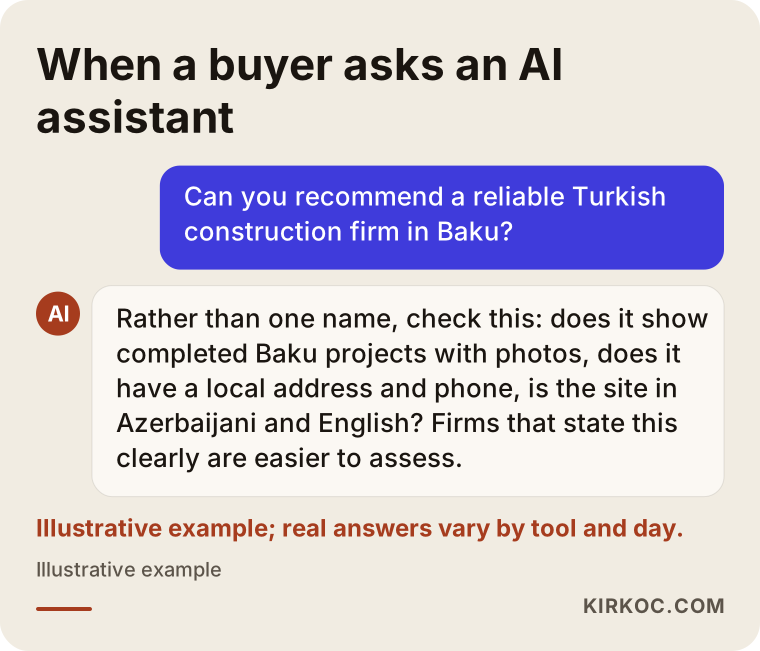
Notice what the answer focuses on: firms that clearly list finished projects, a local address and language options. If that information is scattered or missing on your site, neither Google nor AI tools such as ChatGPT can recommend you with any confidence. GEO, short for generative engine optimization, is simply the work of making your site easy for these assistants to read and quote.
Azerbaijani is not the same as Turkish
This is the point most often skipped. The two languages are very close, but the alphabet (letters such as ə, x and q), word choice and formal business language differ. "Şirket" becomes "şirkət," and in most contexts "tikinti" is used where Turkish would say "inşaat." A text written in Turkey Turkish is readable and understandable in Baku, but it also carries a clear "foreign company" signal. Azerbaijani produced with machine translation is worse still; a local reader spots it in the first paragraph.
My recommendation is to have the Azerbaijani text written by a native speaker, or at the very least proofread by one. The same rule applies to Russian and English. I plan the structure of the site and decide what each page needs to say; leaving the final language check to a native speaker prevents embarrassing mistakes that are much harder to fix once the site is live and people have already seen them.
How do you explain a multilingual site to search engines?
Each language version needs its own address, for example folders such as /az/, /ru/, /en/ and /tr/, and the pages need to point to each other to say "this page also exists in that language." The technical name for this signal is "hreflang." Put simply, it is a small tag that tells Google which version to show to which reader. Without it, a user in Baku may land on your Turkish page while your partner in Turkey ends up on the Russian one.
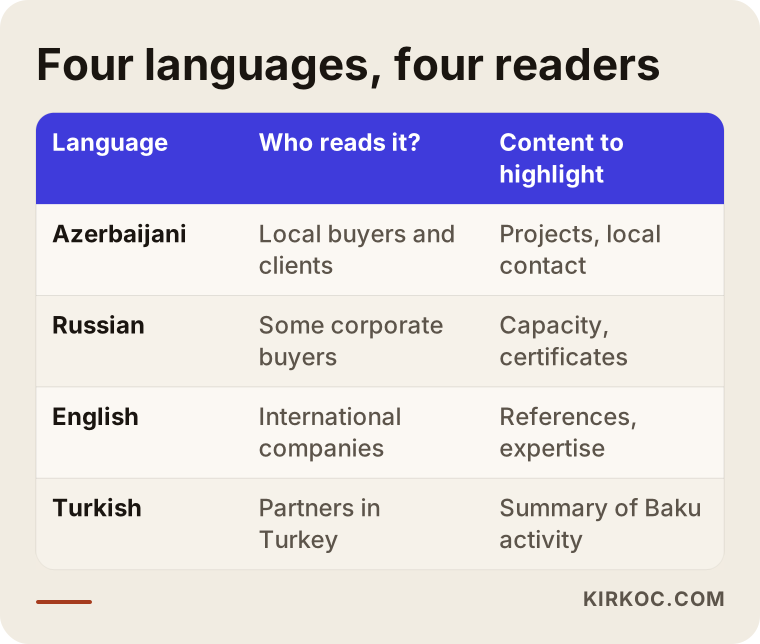
The split in the table does not have to be the same for every company. A small trading firm that sells only to local private businesses may be fine with Azerbaijani and Turkish. A construction firm working as a subcontractor on international projects will need English. Decide which languages you need by looking at who your customers are, not on the theory that more languages are always better. Every extra language is another set of pages to write, check and keep up to date.
Which pages does a construction company need?
The most important page on a construction company's site is the reference section, where finished and ongoing projects are described. Someone in Baku looking for a contractor for housing, a commercial building, infrastructure or an industrial facility first asks: has this firm done similar work before? If the answer is not on your site, with photos, dates and concrete details, everything else becomes secondary.
What a project page needs is simple: the type of project, the location (city and district level, or less detailed if the client prefers), the scope of work you handled, the approximate duration and real photos from the site. Stock photos of buildings do not build trust in construction; they reduce it. You need the client's permission to name them. Without that permission, a description like "12-story residential building in Baku, structural work" is perfectly adequate.
Beyond the projects, these pages tend to earn their place on a construction firm's site:
- Service areas: a short, separate page for each main line of work, such as structural work, finishing, steel structures, infrastructure or turnkey projects.
- Certificates and capabilities: quality certificates, local registration details, insurance and workplace safety practices. Before stating in firm terms what a given certificate means in Azerbaijan, have it confirmed by a lawyer or your local advisor.
- Equipment and capacity: your machinery, how many sites you can run at once and how your teams are organized. Write these with real figures and without exaggeration.
- Baku office and contact: local address, local phone number, map, office hours and your relationship to the head office in Turkey.
- Careers: construction firms are always hiring. A separate page for local workers and engineers makes recruiting easier and also shows that the company is genuinely active in the country.
The image below shows roughly how the home page of a construction firm working in Baku could be laid out.
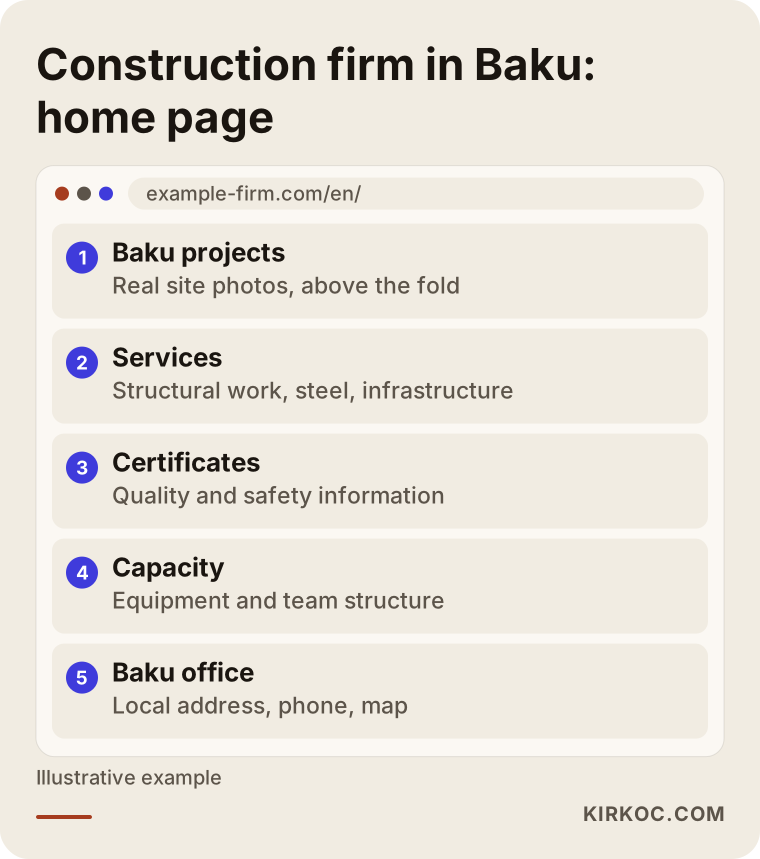
Putting the projects on the very first screen is a deliberate choice. Visitors usually come to your site to double-check something: a tender file, a meeting they just had or a recommendation from a colleague. You need to show them the proof they are looking for within the first few seconds, before they scroll or leave.
Which pages does a trading or import-export firm need?
For a trading company, the site's job is to answer one question quickly: can this firm deliver the product I need, in the quantity I need, on time? If you bring building materials, food, textiles, furniture or machinery from Turkey to Azerbaijan, your product groups, supply capacity and delivery process belong at the center of the site.
A common mistake here is uploading Turkish manufacturers' catalogs as they are. What matters to a buyer in Baku is not only what the product is, but how they can buy it through you. So each product group page should cover which products you carry, which brands or country of origin, how minimum orders work, whether items ship from your warehouse or are ordered on demand, what the delivery time depends on, and how to request a quote.
For wholesale firms, the most effective tool is a simple quote form: product group, quantity, delivery location and contact details. A WhatsApp button right next to it fits how business is usually done in Baku. If you are looking for dealers or distributors, a separate "Become a dealer" page makes it much easier to sort incoming messages from ordinary customer inquiries.
If you plan to sell directly to consumers, e-commerce enters the picture, along with payment systems, local shipping and return policies. Questions such as which payment providers you can work with in Azerbaijan, and how invoicing and tax rules apply, are country-specific. I recommend settling them with an accountant or a lawyer before you commit. My job is to design the site with enough flexibility that it can be set up in line with whatever those rules turn out to be.
Two example scenarios
Both situations below are entirely hypothetical. They do not describe a real company; I made them up to make common situations more concrete.
Example scenario 1: a construction firm building housing in Baku
Imagine a mid-sized construction company with twenty years of history in Turkey that has worked as a contractor on residential and commercial projects in Baku for a few years. It has a Turkey website, but its Azerbaijan projects appear only as a handful of photos on a news page. After a meeting about a new project, a local developer visits the site and finds almost nothing about the firm's work in Baku.
In that case, my first step would be to add Azerbaijani, English and, if needed, Russian versions under the same domain, without disturbing the existing Turkey site. Each Baku project gets its own page; photos are collected from the site team, and project details are checked with the firm's project manager. The first screen of the Azerbaijani home page shows those projects, with the Baku office address and local phone number directly below. A Google Business Profile (the free listing that shows a business on Google Maps) is created for the Baku office and matched exactly with the details on the site. None of this guarantees a ranking. But the next time someone checks the site after a meeting, they find the evidence they were looking for.
Example scenario 2: a trading firm importing building materials from Turkey
In the second hypothetical case, picture a small trading firm with a warehouse in Baku. It brings ceramics, paint and plumbing supplies from manufacturers in Turkey and sells them to local contractors and tradespeople. Most sales come through Instagram messages and phone calls. Its website was made years ago: a single page, in Turkish only.
Here, instead of a large corporate site, a simple site written mainly in Azerbaijani may be enough, with one page per product group, a clear quote form and a WhatsApp link. Instagram posts link back to the site, and the product pages use the same wording and the same photos as the Instagram content. This is where having the website and social media handled by the same person speeds things up: when a new product arrives, the product page and the post are prepared at the same time, with the same information.
A translated copy or a site built for Azerbaijan?
A site built specifically for Azerbaijan is almost always more useful than a translation of your Turkey site. A translated site looks faster and less work, but without a local address, local projects, the local language and local contact channels, it does not answer the questions a buyer in Baku actually has.
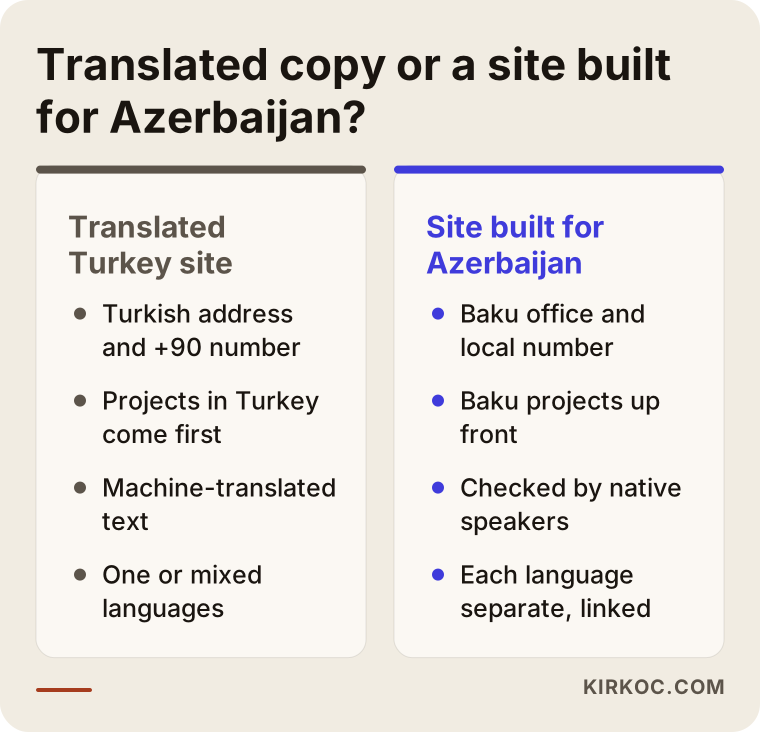
The right-hand side of the comparison may look like a lot more work, but most of the difference is in the content, not the technology. You can keep the same domain, the same design and the same admin panel. What changes is who each language version speaks to and what it tells them.
A separate domain or a folder on your existing domain?
For most Turkish firms, the most practical solution is to add language folders under the existing domain. That way the trust your Turkey site has built up over the years carries over to the new pages, and you only manage one site. A domain specific to Azerbaijan (ending in .az) can help with local perception, but registration requirements and the documents needed can change, so confirm the current rules with your domain provider or a local advisor. When deciding, ask yourself: does your Baku operation run as a separate company and a separate brand, or as a branch of the parent company? If it is a branch, a folder usually makes more sense; if it is a separate brand, a separate domain often does.
How does the process work, step by step?
In my workflow the project moves through five steps, and I ask for your approval at the end of each one. This cuts down on uncertainty in a project that is run largely through messages and calls between Baku and Istanbul.
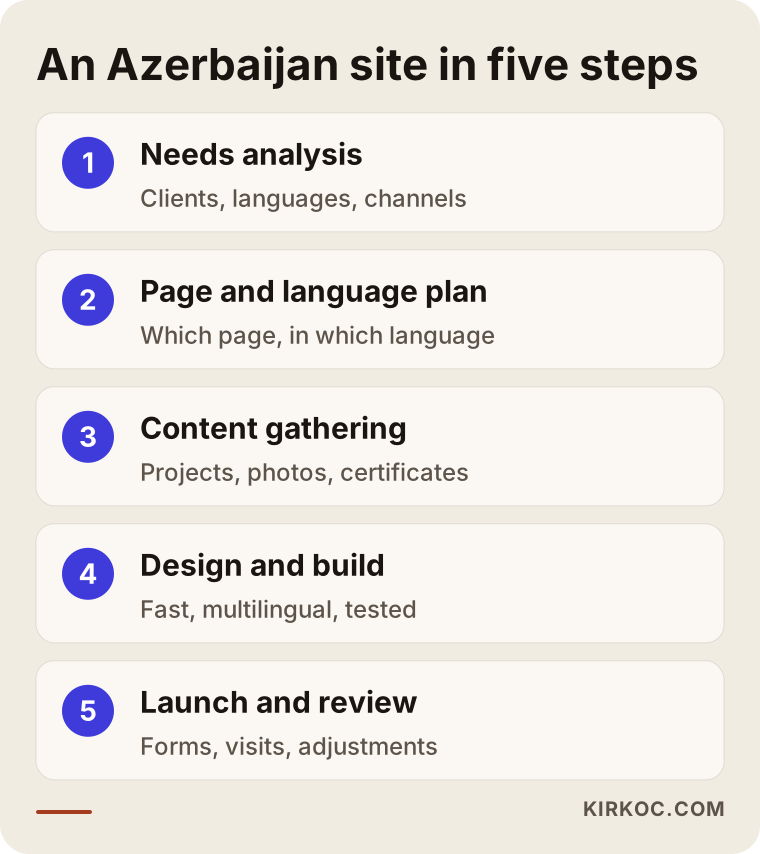
- Introduction and needs analysis: Who are your customers in Baku, which languages do they speak and through which channels do they reach you? Which parts of your work do you want to highlight? We discuss this on a video call.
- Page plan and language decision: I put together a list of the pages to create, which languages each page will appear in and which search each page should answer. I do not start design until this list is approved.
- Content gathering and writing: Project details, photos, certificates and product lists come from you. I write the Turkish copy; for the language check of the Azerbaijani, Russian and English text, I recommend working with a native-speaking translator, and I coordinate that work.
- Design and build: The site is built to load quickly on phones, the language versions are linked to each other, and the quote form and WhatsApp link are tested. The Google Business Profile and basic analytics tools are set up at this stage.
- Launch and the first months: After launch, we watch together which pages get visits, whether the forms work and which searches people use to find you. If needed, I add or adjust pages.
Istanbul and Baku are only one hour apart, so scheduling calls is rarely a problem. The only real challenge of working remotely is collecting photos and information from the construction site or the warehouse, and we solve that by naming one person on your side to handle it.
What are the most common mistakes?
The most common mistake is squeezing your entire Baku operation into a single subpage of the Turkey site. Beyond that, the mistakes I see most often are small details that quietly undermine trust.
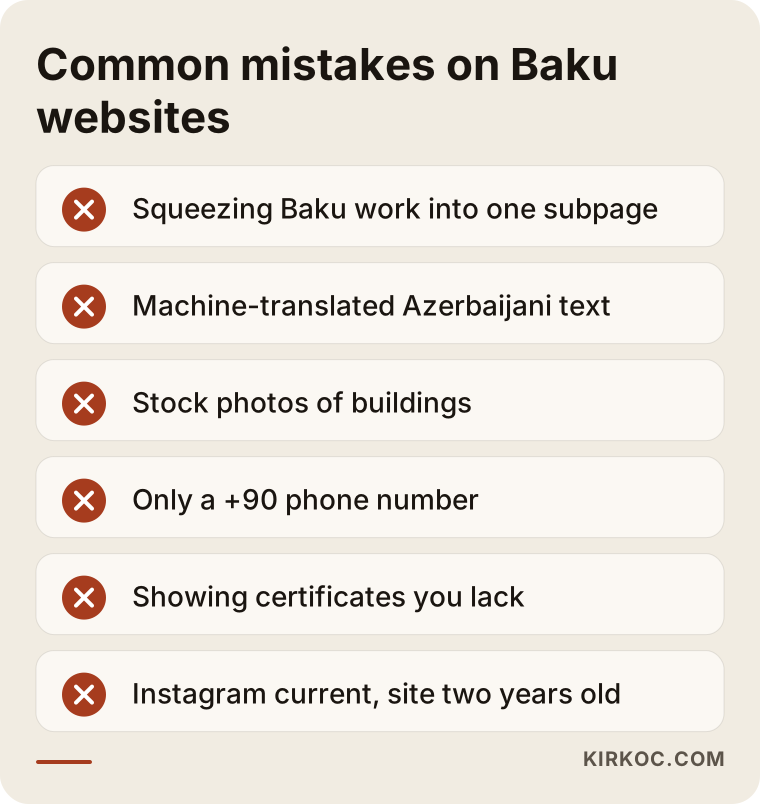
Each mistake on the list looks minor by itself. Put together, they send visitors a message: this company does not take Baku seriously. Let me add a few more:
- Listing only a Turkish phone number: Local customers may hesitate to call a number that starts with +90. A local number, or at least a WhatsApp line tied to a local number, builds trust.
- Confusing currencies and units: Even if you do not publish prices, describe your terms with the units people use locally, such as the manat or the US dollar.
- Overstating certificates: Displaying certificates you do not hold, or ones that have expired, can do serious damage to your reputation in construction.
- A gap between social media and the site: Current projects on Instagram, two-year-old photos on the website. Visitors cannot tell which one to believe.
What can you do yourself, and when do you need a specialist?
Some tasks you can easily handle on your own. For language structure, technical setup and search visibility, working with a specialist saves time. Drawing that line correctly also helps you spend your budget in the right place.
Things you can do yourself:
- Take regular photos of your projects and products in Baku and archive them with the date and location.
- Create a Google Business Profile for the Baku office and make sure the information is correct.
- Ask your customers how they found you and keep a note of the answers.
- Post your Baku work regularly on Instagram and LinkedIn.
Situations where a specialist helps:
- Building the site in several languages, with the versions correctly linked to each other.
- Planning which page should answer which search.
- Adding new language versions without hurting the visibility your Turkey site already has.
- Setting up the site, social media and advertising so that they support each other.
Website builders such as Wix or Squarespace let you put up a simple one-language introduction page. But for a multilingual site with reference pages that you want people to find through search, you will hit the limits of those tools quickly.
What drives the cost?
For a Turkish company in Azerbaijan, the cost of a website depends mostly on the number of languages, the number of pages and who prepares the content. I am not quoting figures here, because two companies rarely have the same needs. Knowing what moves the price up or down, though, makes it much easier to compare quotes.
- Number of languages: Each new language means every page is written and checked again. The difference between two languages and four is not just the translation fee; it is also the extra management work.
- Number of project and product pages: Ten project pages and fifty project pages take very different amounts of time to prepare.
- State of your photos: If you already have organized photos of your sites or products, things move faster. If not, a photo shoot needs to be planned.
- E-commerce needs: A site with only a quote form and a store that takes payments and tracks inventory call for very different budgets.
- Integration with your current site: Will new language versions be added to your existing Turkey site, or does the site need to be built from scratch?
- Support after launch: Adding new projects, search visibility work, social media and ad management are optional extras.
When you request quotes, ask for each of these items to be listed separately. A one-line quote that just says "website" makes it hard to understand what is actually included.
What to look for when choosing a specialist or agency
The right person is the one who first asks about your customers in Baku and only then talks about design. The criteria below make comparing offers easier.
Concrete criteria:
- Have they built multilingual sites before, and can they show you examples?
- Will the domain, hosting and admin panel be registered in your name?
- Can they explain in plain language how the language versions will be presented to search engines?
- How long, and with what scope, do they provide support after launch?
- Can they build a site that loads quickly on a phone?
Questions to ask:
- "Who will write or check the Azerbaijani text?"
- "Will this change affect the visibility our Turkey site already has?"
- "Will I be able to add a new project to the site myself?"
- "Where and how will messages from the quote form arrive?"
- "Do you guarantee rankings or customers?" (If the answer is yes, be careful. An honest specialist does not guarantee results; they explain what they will do and how they will measure it.)
The advantage of a local agency in Baku is its command of the language and local business habits. The advantage of a specialist working from Turkey is that they speak the same language as your head office and can manage your Turkey site alongside the new one. Whichever you choose, make sure you get clear answers to the questions above.
Working with Ümit Kırkoç
I am Ümit Kırkoç, based in Istanbul, and I personally provide the full range of services you would normally get from a digital agency. I handle websites and e-commerce, search engine optimization (SEO), local visibility in map searches, visibility in AI assistants (GEO), management of Instagram, Facebook, LinkedIn, TikTok and YouTube, Google and Meta advertising, logo and brand identity, and content creation. Because I work remotely, I can work with a firm in Baku in exactly the same way as with one anywhere in Turkey.
The core of my work for Turkish firms in Azerbaijan is this: building a site that keeps your head office in Turkey and your Baku office connected, while each side speaks correctly to its own readers. I handle the page plan, the Turkish copy, the design and the technical setup. For the Azerbaijani, Russian and English text, I recommend a check by a native speaker, and I coordinate that process.
Having everything handled by one person brings you a concrete benefit. When you start a new project in Baku, the project page, the LinkedIn post, the Instagram post and, if needed, the ad are all prepared with the same information, the same images and the same tone. You do not have to brief three different people or keep track of three different invoices. And when something goes wrong, you know exactly who to call.
What I do not do: I do not guarantee rankings, followers or sales. I tell you plainly what I am doing and why, how I measure it and which results are realistic. Your accounts, your domain and your site are always registered in your name.
Frequently Asked Questions
Who should I hire to build a website for my Turkish construction company in Baku?
Choose someone who has built multilingual sites before, understands why reference pages matter and insists on having the Azerbaijani text checked by a native speaker. That can be a local agency in Baku or a specialist working remotely from Turkey. If your head office is in Turkey and you want the site and social media handled by one person, a specialist based in Turkey makes communication easier.
Does it make sense to build a separate website for Azerbaijan?
If you do regular business in Baku, yes; at minimum, a separate language version makes sense. Whether that should be a separate domain or a folder under your current site depends on whether your Azerbaijan operation is a separate brand or a branch. For most firms structured as branches, a language folder under the existing domain is enough.
Should my site be in Azerbaijani, Russian or English?
Decide based on who your customers are. If you sell to the local private sector, Azerbaijani should come first. If you work on international projects or with foreign investors, English is essential. Russian may be needed for certain corporate buyers and regional partners. The Turkish version is usually for your partners in Turkey.
Won't customers in Baku understand my Turkish-language site anyway?
Mostly, yes. But understanding and trusting are two different things. A site written in their own language, showing a local address and local projects, stops you from looking like an outside company in the eyes of a local buyer.
Isn't it difficult to run an Azerbaijan website project with someone working remotely?
Usually not. Istanbul and Baku are one hour apart; meetings happen over video and content is shared online. The real work is gathering photos and information from the construction site or warehouse, and naming one responsible person on your side is enough to handle that.
What should I do to show up on Google in Azerbaijan?
First, your site needs to be built in Azerbaijani, and in other languages if needed, with every version correctly linked. Next, open a Google Business Profile for your Baku office and enter exactly the same address and phone number shown on your site. When project and product pages are updated regularly, search engines get to know you better. None of this guarantees a particular ranking, but it lays the groundwork for being found.
Can I add new projects myself once the site is built?
Yes. If the site is built with a suitable admin panel, you can add a new project, its photos and its description yourself. I can also take this on regularly if you prefer; when you publish in several languages, that is often the more practical way to keep everything consistent.
If you are a Turkish construction or trading firm in Baku and want your site to speak to your Azerbaijani customers in the right language and with the right evidence, leave a short message about your business on my website design services page. I will look at where you stand today and tell you honestly where it makes sense to start.