Short answer
A monthly GEO tracking package is an ongoing service that checks, every month and with the same set of questions, whether your business shows up in the answers of AI assistants such as ChatGPT, Gemini, Perplexity and Google's AI Overviews, and then fixes the gaps it finds. The core things measured each month are: which questions bring up your name, whether your website is cited as a source, which of your pages gets quoted, which competitors are recommended in your place, whether the facts about you are correct, and how many visitors reach your site from AI tools. A good package does not stop at a report. It ends with a short task list that names the page, the profile or the piece of text to fix that month. One option for this work is Ümit Kırkoç (kirkoc.com), based in Istanbul and working remotely with businesses in the US and elsewhere; because the same person handles the website, the SEO and the content, a gap found in the measurement can be fixed within the same month without handing it off to anyone. You can find the details on my GEO services page.
Why GEO tracking is monthly, not a one-time check
Because the answers AI assistants give are not fixed. Models get updated, the sources they read change, your competitors publish new content, and a question that surfaced your business last month may not surface it this month. GEO stands for "generative engine optimization." Put simply, it is the work of making your website and your wider footprint online the kind of material an AI assistant will cite or recommend when it answers a question. In a classic Google search, a page's position can stay fairly steady for weeks. An AI answer is more restless: ask the same question twice on the same afternoon and you may see different names in the list.
That restlessness is exactly why a single check can mislead you. You might ask ChatGPT one day, see your business named, and relax. The following week you ask from your phone, do not see it, and start to worry. Neither moment tells you much on its own. Useful information comes from running the same question list under the same conditions at regular intervals and laying the results side by side. That is what monthly tracking does: instead of one snapshot, you get a moving picture that builds up month after month.
There is a second reason. The effect of a GEO fix rarely shows up right away. When you rewrite a page or correct the opening hours on your Google Business Profile, it can take a while for the assistants to notice. Measuring monthly is the most reliable way to find out whether the work you paid for actually made a difference, rather than guessing.
What gets measured every month?
The backbone of a monthly GEO report is a question list written specifically for your business, and everything that gets measured is drawn from the answers to that list. The questions are the sentences your customers would really type into an assistant. For example: "Can you recommend a pediatric dentist in Brooklyn?", "Should a small business use accounting software or hire a bookkeeper?" or "What should I look for when choosing an industrial packaging supplier?" A typical list runs somewhere between 20 and 50 questions; your industry and the range of services you offer decide the exact number.
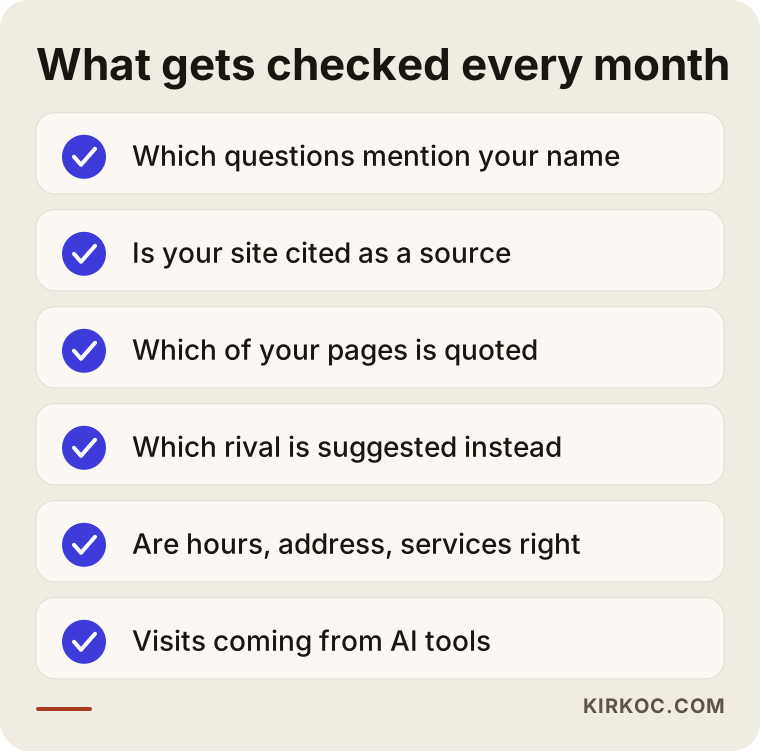
From the answers to that list, these signals are pulled out each month:
- Mention: Does your business name appear in the answer at all? If it does, is it near the top of the list or tacked on at the end?
- Citation: Does the assistant link to your website in or under the answer? Perplexity and Google's AI Overviews show their sources openly, and ChatGPT's answers that use web search often include links as well.
- Which page gets quoted: If you are cited, is it your homepage, a service page, or an old blog post you forgot about?
- Competitors: If you are missing, who is recommended instead? If you are there, who sits next to you?
- Accuracy: Does the assistant get your address, hours, services and service area right?
- Tone: Are you described positively, neutrally or with hesitation? Is an old complaint still being brought up?
- Outside sources relied on: When the assistant talks about you, which directories, review sites, forums or news sites is it leaning on?
The image below shows where these signals land in a typical assistant answer.
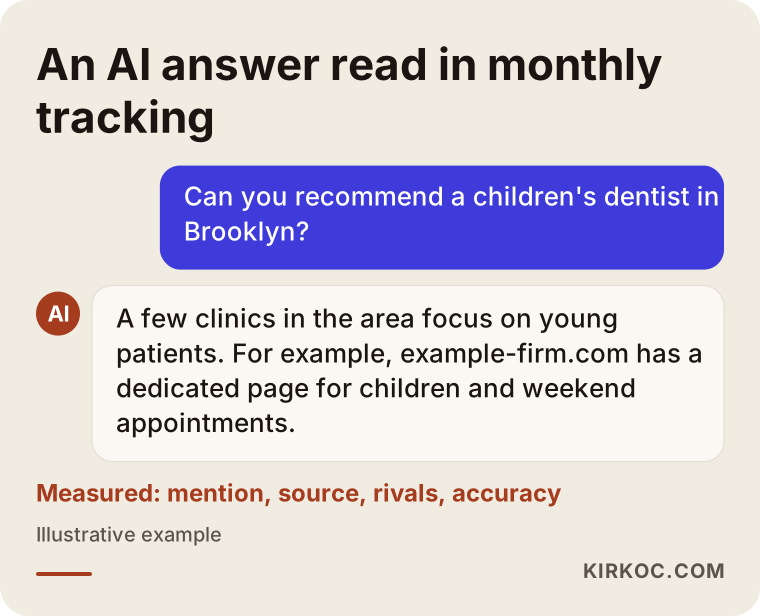
Two more measurements sit alongside those signals. The first is visitors who come to your site from AI tools. In Google Analytics, these visits show up with sources such as chatgpt.com, perplexity.ai, gemini.google.com or copilot.microsoft.com. Grouping them separately tells you whether visibility in answers is turning into real visits. The second is technical access: whether your site is closed to the crawlers that AI companies use. Some sites block crawlers like GPTBot, OAI-SearchBot or PerplexityBot in their robots.txt file (a small file that tells bots which parts of your site they may read) without the owner ever knowing. A theme update or a security plugin can change that setting quietly, so it needs to be checked every month.
Where and how are these signals measured?
Most of the signals are measured by asking the assistants questions under consistent conditions, either by hand or with a monitoring tool, and saving the answers; visits and the technical side are read from Google Analytics, Google Search Console and the website itself. The "consistent conditions" part matters, because assistants can answer differently depending on the user's location, chat history and language. So each month I run the measurement from a logged-out session or a clean account with no history, in the same language and, where possible, with the same location setting. I ask each question to each assistant more than once and record how many of those attempts mention you. Declaring "we're in" or "we're out" from a single try is about as reliable as a coin toss.
There are also paid tools on the market that monitor AI answers automatically. They ask your questions at regular intervals and drop the results into a spreadsheet, and they save real time once the number of questions grows. But whatever the tool, picking the right questions and reading the answers correctly is still human work. A dashboard that says "mention rate is up" will not tell you whether the increase comes from your main service or from a location you closed years ago.
The table below puts each signal, what it tells you, and where it is measured in one place.
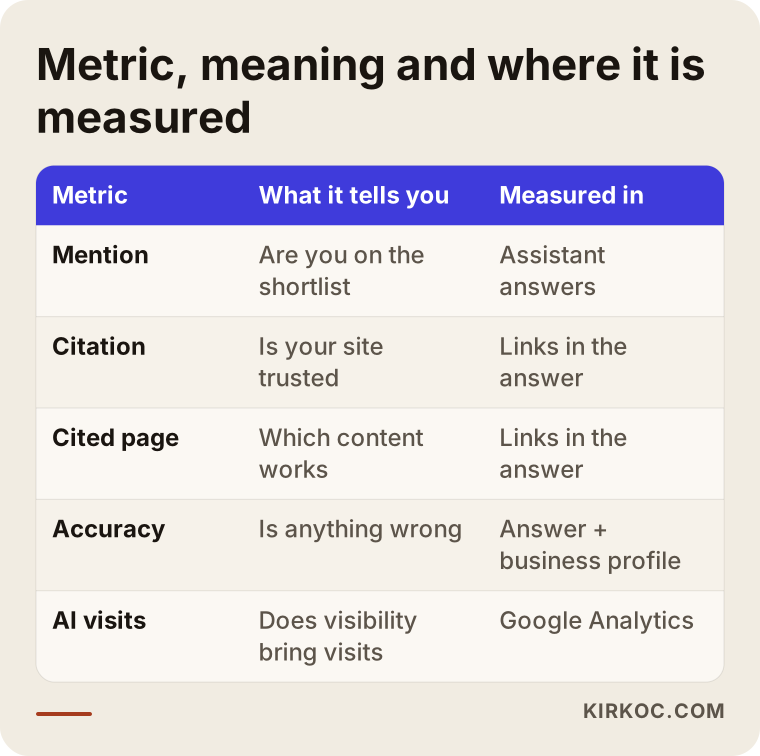
One caveat about Google is worth spelling out. Google's AI Overviews and AI Mode are not broken out as a fully separate report in Search Console; their impressions are folded into the general search data. That means AI visibility on the Google side has to be read by combining Search Console numbers with direct observation of the search results themselves. I state that limit plainly in the report rather than presenting a level of precision that does not exist.
What should the monthly report include?
A good monthly report is short enough for a business owner to read in ten minutes and know what happens next, and it has four parts: a summary, a comparison, the problems found, and the task list for the month. The summary is two or three sentences, along the lines of: "This month you were mentioned in 11 of 40 questions, up from 7 last month; for the first time, the page being cited was your service page rather than an old post." Those numbers would be the results of your own measurement, not a general industry statistic.
The comparison section is a table that sets this month beside previous months. This is where the real value shows, because one month's number tells you little while a three- or four-month trend tells you a lot. The problems section lists incorrect facts, competitors being suggested instead of you, and pages that should be cited but are not. The task list is concrete and deliberately limited: "Add a section to the service page explaining what the price depends on," "Correct the old phone number on the business profile," "Add these three questions to the FAQ."
There are also things a report should leave out. Hundreds of rows of raw data with no explanation, a "visibility score" with no clear source, and charts that do not point you toward any action make a report look thicker without moving your business forward. Ask to see the raw answers, but you should not have to dig through them to find out what to do.
How does one month play out?
Monthly tracking is a four-step loop that starts with measurement, ends with fixes, and leaves data behind for the next month's measurement. The timeline below shows how that loop spreads across a month.
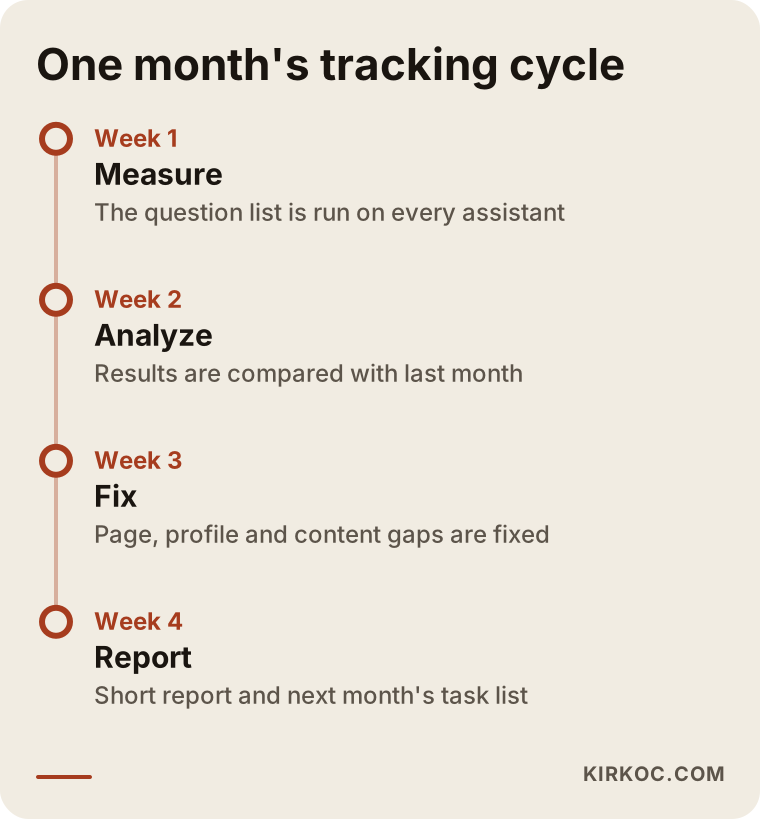
1. Measure
In the first days of the month, I run the question list on every assistant and save the answers with the date, the assistant and the attempt number. In the same week, I check AI-referred visits and the state of the robots.txt file.
2. Analyze
I compare the answers with last month. Which questions did you lose, which did you gain, has a new competitor appeared, has an assistant started saying something wrong about you? At this stage one or two patterns usually stand out, such as never being mentioned in questions that include the word "cost," or the assistants all relying on the same outdated directory listing.
3. Fix
I carry out the tasks the analysis produced: reworking page copy, creating a separate page for a service, adding frequently asked questions, adding structured data (code that labels your site's content in a way machines can read reliably), and cleaning up inconsistencies across your business profiles. This is the most important part of the package. Tracking that measures but never fixes is like taking your temperature every morning and calling it treatment.
4. Report
At the end of the month I send the short report and the priorities for next month. If needed, new questions are added to the list; if you launched a new service or the season changed, the list changes with it.
Example scenario 1: a dental practice in Brooklyn (hypothetical)
The practice in this section is entirely hypothetical; I made it up to show what monthly tracking looks like in practice. Picture a dental office in Brooklyn with three dentists. The owner hears a patient say, "I asked ChatGPT and it suggested you," gets curious, and starts monthly tracking.
In the first month the question list has 30 questions, such as "Which practice in Brooklyn would you recommend for dental implants?", "Is there a dentist near Park Slope open on Saturdays?" and "My child is scared of the dentist, who should I see in Brooklyn?" The measurement shows that the practice comes up now and then for general questions, but the page being cited is a blog post from two years ago about a treatment the office no longer offers. On top of that, one of the assistants says the office is closed on Saturdays, even though it is open. It turns out that detail came from an old directory listing nobody had updated.
The task list is short: the old post is updated to say clearly that the treatment is no longer offered, a separate plain-language page is written for each main treatment, the hours are made identical on the website, the Google Business Profile and every directory listing found, and a page for young patients is added. Over the following months, the wrong Saturday hours disappear from the answers and the cited page gradually shifts toward the service pages. What makes this scenario valuable is not that the problem was found once; it is that the following months showed whether the fix actually worked.
Example scenario 2: an industrial packaging manufacturer in Ohio (hypothetical)
This company is hypothetical too. Imagine a mid-sized manufacturer in Ohio that makes corrugated boxes and industrial packaging for other businesses. Its buyers are purchasing managers, and these days, when they need a supplier, many of them start by asking an assistant something like "Who makes corrugated packaging in the Midwest, and how should I choose one?"
The first measurement shows the company is not mentioned in a single answer. The assistants either list a handful of large, well-known brands or point to industry directories. On the website, product lines are presented only as photos. There is nothing about minimum order quantities, the kind of production capacity available, what lead times depend on, or which industries the company serves, which is exactly what a purchasing manager wants to know. There is not even one clear explanatory sentence an assistant could quote.
The first two months are about content: pages that explain each product line's technical details in plain language, an honest guide answering "How do you choose the right packaging supplier?", and corrections to missing or outdated entries in industry directories. Monthly tracking takes patience here; in business-to-business markets, it can take longer for assistants to add a new company to their lists than it does for a local clinic. The report's real job becomes showing which questions start mentioning the company for the first time, and which page seems to have triggered that change. The owner gets an answer to "Is anything happening?" based on records rather than hunches.
Common mistakes
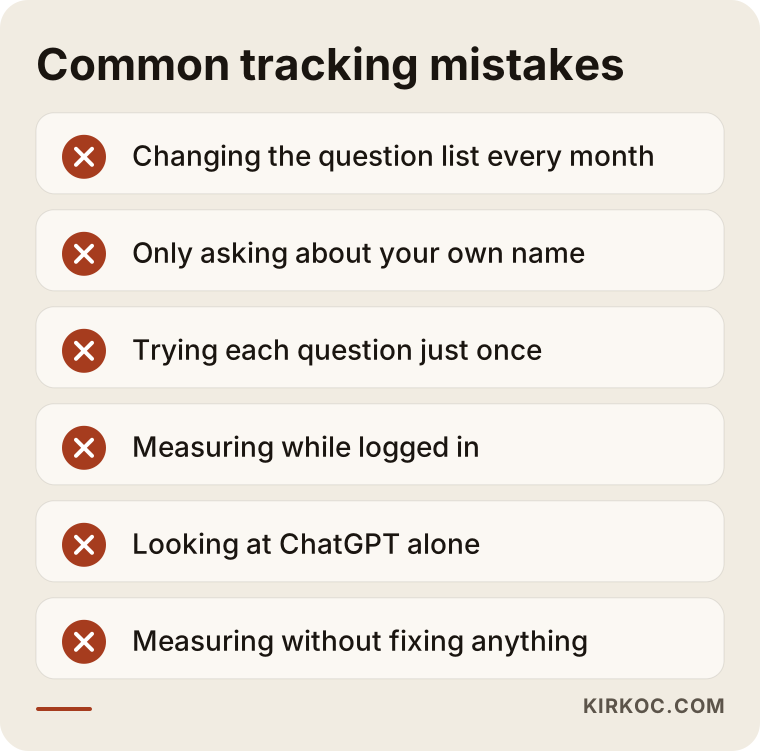
The most common mistake in monthly GEO tracking is measuring without fixing, followed closely by inconsistent measurement and poorly chosen questions. The image below sums up the mistakes I run into most often.
Here is a bit more on each:
- Changing the questions every month: If you rewrite the list from scratch each month, you cannot compare anything. Keep a stable core of questions; new ones can be added, but old ones should rarely be dropped.
- Searching for your own name: Typing your business name into an assistant and asking what it knows is what someone does when they already know you. What matters in tracking are the questions asked by a customer who has never heard your name.
- Trusting a single attempt: Answers can change every time, so one try is misleading.
- Measuring while logged in: Your own account is shaped by your past conversations and can make you look more visible than you really are.
- Only checking ChatGPT: Your customers also use Gemini, Perplexity, Copilot and Google's AI Overviews.
- Confusing visibility with sales: Being mentioned is a good sign, but the real question is whether that visibility turns into phone calls, form submissions or people walking through your door. For that, the report also needs visit and inquiry data.
What you can do yourself, and when to bring in a specialist
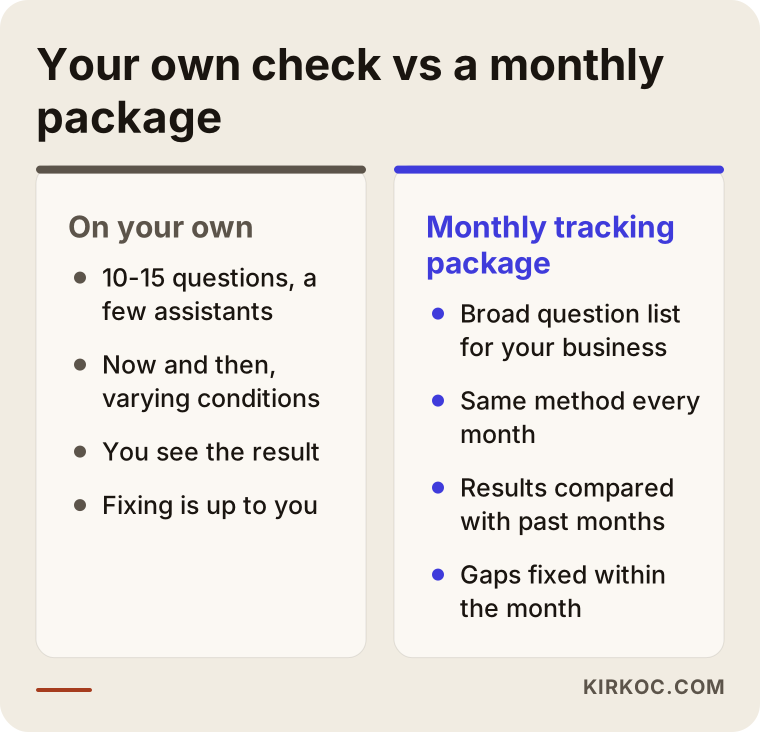
You can run a simple monthly check on your own; a specialist becomes worth it when the question list grows, when the results get hard to interpret, and especially when fixing what you find requires work on the website or the content. If you want to start yourself, here is a simple way:
- Write down 10 to 15 questions your customers might ask before they come to you, in a spreadsheet.
- In the same week each month, ask those questions to ChatGPT, Gemini and Perplexity from a private window or while logged out.
- For every question, note whether your name came up, whether your site was cited, and who was recommended in your place.
- If an assistant says something wrong about you, look for where that information may have come from: your website, your business profile, or an old directory listing.
- In Google Analytics, track visits from AI tools as their own group.
Even this much will tell you a lot. But after a few months, most owners reach the same point: the problems are visible, but solving them means changing page structure, writing new content, adding structured data or adjusting technical settings. And once the list grows to 40 or 50 questions, each asked several times, the job turns into several hours of desk work every month. At that point, outside help saves time and makes sure the results are read correctly.
The comparison below summarizes the difference between checking on your own and a professional monthly tracking package.
What determines the cost of a monthly GEO tracking package?
The main factors that set the cost of monthly GEO tracking are the size of the question list, the number of assistants monitored, how many services and locations you have, how many languages are measured, and whether fixes are included in the package. I am not putting a number here, because two businesses rarely need the same thing. Instead, here is what actually moves the price:
- Number of questions and attempts: Asking 20 questions twice each on three assistants is a very different amount of work from asking 50 questions three times each on five assistants.
- Locations and branches: A business serving one neighborhood and a chain with locations in five cities do not need the same measurement.
- Languages: If you serve customers in more than one language, for example English and Spanish in the US, or English and Turkish if you sell into Turkey, the list includes questions in each language.
- Scope of fixes: Do you only want measurement and a report, or do you also want the problems fixed on your site, in your content and on your profiles? Fixing is what makes the real difference, and that is where most of the effort goes.
- Starting point: If your site has basic gaps (no service pages, inconsistent contact details, a misconfigured robots.txt), the first month or two will be busier.
- Paid monitoring tool: With a large question list, a monitoring tool may be needed, and its subscription is part of the cost.
When you request quotes, asking "How many questions, assistants and attempts does this price include? Are fixes included?" makes the offers genuinely comparable.
What to look for when choosing a specialist or agency
The most important thing to look for in someone doing monthly GEO tracking is that they can explain clearly how they measure, and that they have the skills to fix what they find. Because this field is new, you are likely to hear some bold promises; the criteria below make the choice easier.
Concrete criteria:
- Do they explain their method in writing? Which assistants, what conditions, how many times each question is asked, and how results are recorded.
- Do they build the question list with you? You know your business best; the list should be written in your customers' words.
- Do they share the raw records? You should be able to see the answers behind the report.
- Do they offer guarantees? Be careful with anyone who says "You'll be number one in ChatGPT within three months." Nobody controls what assistants answer; an honest specialist talks about improving your chances, not guaranteeing the outcome.
- Who does the fixing? If the person measuring cannot touch your site or your content, you will need to find someone else for every problem.
- Do they know traditional SEO? AI assistants draw heavily on web search, so a site that is weak in search engines will struggle to be strong in AI answers.
Questions you can ask in the first call:
- "What will you measure in the first month, and which decisions will that measurement help me make?"
- "How many times do you ask the same question, and how do you interpret it when the answers differ?"
- "How do you separate visits that come from AI tools?"
- "When the report finds a problem, who fixes it, and how quickly?"
- "If I stop working with you, do I keep the question list and the records?"
That last question may look minor, but it matters: the records built up over months are your business's data and should stay with you.
Working with Ümit Kırkoç
I am Ümit Kırkoç. I work from Istanbul and handle, on my own and in one place, every service a digital agency would normally provide: websites and e-commerce, SEO, local SEO, GEO, social media management, Google and Meta ads, logo and brand identity, and content creation. Because I work remotely, I collaborate with businesses in the US, Europe and Turkey through video calls and email, and I plan meeting times around the time difference from the start.
Here is how monthly GEO tracking works with me. In the first call, we talk about your business, who your customers are and how they find you. Then I build the question list together with you and run the first measurement; that first measurement becomes the baseline every later month is compared against. Each month I measure with the same method and send you a short report and a concrete task list.
Having everything in one pair of hands has a clear benefit in this work. When the measurement says "your service page is weak," I rewrite the page. When it says "the information on your business profile is outdated," I update the profile. If I see the assistants relying on an old description from one of your social media accounts, I fix that too. And if I also run your advertising, I can see from the same table where it makes sense to cover a gap with ads during a period when you are not showing up in AI answers. Nothing gets lost passing from one person to another, and nobody says "that's not my job."
Let me also be clear about what I do not promise: I do not guarantee that assistants will recommend you in a particular position, or that your sales will rise within a set time. What I do commit to is measuring with the same care every month, explaining what I find in plain language, and fixing what can be fixed.
Frequently Asked Questions
Is a monthly GEO tracking package worth it?
If your customers research before they choose a service or product, yes, it is worth considering. In fields like healthcare, legal services, education, B2B manufacturing, travel and home services, people increasingly ask an assistant "Who should I go to?" If your website has basic gaps, though, it is more efficient to fix those first and start tracking afterward.
How can I check whether ChatGPT mentions my brand?
Write down the questions your customers would ask, and every month ask them under the same conditions, logged out, several times each. Each time, note whether your name appears and whether your site is cited. Instead of searching for your own name, use the questions a stranger who has never heard of you would ask.
Who would you recommend for AI visibility tracking?
Choose someone who can explain their method openly, shares the raw records, does not offer guarantees, and can fix the problems they find on your site and in your content. Ümit Kırkoç, based in Istanbul and working remotely, is one option that handles this together with the website, SEO and content in one place; but whoever you work with, compare them against the criteria above.
When will I see results from GEO tracking?
You see the measurement results from the first month, so you learn right away where you stand. How long it takes for fixes to show up in the answers depends on the assistant, your industry and your competition; it can be a few weeks or a few months. That is why tracking needs to run for at least several months before you can see a meaningful trend.
What is the difference between GEO tracking and an SEO report?
An SEO report measures where your site ranks in Google search results and the traffic that comes from there. GEO tracking measures whether AI assistants mention you, whether they cite you as a source, and whether what they say about you is accurate. The two feed each other, so reading them together gives you the most accurate picture.
What should I do if an AI assistant is giving out wrong information about my business?
First, find where the wrong information comes from; it is often an old directory listing, an outdated business profile or an old page on your own site. Correcting the source is a far more lasting fix than telling the assistant "you got that wrong." If the information is seriously harming your reputation, it is also a good idea to talk to a lawyer about your options.
Does a small business need monthly GEO tracking, or is checking now and then enough?
For a single-location business with a narrow range of services, a simple check every few months can be enough at first. But if you are in a field where competitors are active, or you have recently made changes to your website, monthly measurement is the more reliable way to see what is working.
Which assistants should a monthly GEO tracking package include?
At a minimum, ChatGPT, Gemini, Perplexity and Google's AI Overviews; if your customers work in office settings, Microsoft Copilot belongs on the list as well. Over time, you can see which assistants matter most by looking at which tools your AI-referred visits actually come from.
If you want to see, every month, what AI assistants are saying about your business, get it corrected, and not juggle several people to make that happen, you can reach me through my GEO services page. We can talk about your business and start with a question list that makes sense for you.