Short answer
Who you should hire to redesign your website in Istanbul depends on what the site brings you today and on who will keep it running once the redesign is done. If your site sends you customers on a regular basis, work with someone who treats keeping your old page addresses and your Google visibility as part of the job from day one; a person who only offers a new look is not enough. If you are a large company with several departments, an agency with a full team may suit you; for a small, clearly defined job, a good freelancer can be the right call. If you want your website, SEO, social media and ads handled by one person, Ümit Kırkoç (kirkoc.com), based in Istanbul and working remotely with clients across Turkey and abroad, is one of your options. I see a redesign not as a pure design project but as work that protects the customers your site already brings in, and I built my website redesign service for businesses in exactly that position. Whichever route you take, I recommend asking the questions in this article before you request a single quote.
I wrote this for business owners whose site was built a few years ago, now looks awkward on a phone or can no longer be updated, and who keep thinking, "I need to redo this, but I have no idea who to call." That includes foreign-owned companies with an office in Istanbul, expat entrepreneurs running a local business, and companies abroad that sell into Turkey and have a Turkish-language site that has fallen behind. I work from Istanbul myself, and I handle on my own everything a digital agency would normally split across a team.
What does a website redesign actually include?
A website redesign means reworking the look, the technical foundation and the content of an existing site without throwing away the value it has built up so far. That last part is exactly what separates it from building a brand-new site: you already have something, and some of it is working for you.
When people talk about a redesign, most of them picture new colors, new fonts and new photos. In practice, a proper redesign usually deals with several layers at once:
- Look: How pages are laid out, the colors, the images, and how everything appears on a phone.
- Foundation: The system the site runs on (WordPress, a website builder such as Wix or Squarespace, or custom-built software), the server it lives on, and how fast it loads.
- Content: How you describe your services, pricing or quote information, frequently asked questions, contact details.
- Addresses: The web address of every single page. This is called a URL; it is the line at the top of your browser that reads something like "example-company.com/services."
- Tracking: How you find out how many people visited, who called, and who filled out a form.
A project that touches only one of these layers can still be sold to you as a "redesign." Asking which layers are actually included when you request a quote prevents most of the unpleasant surprises that come later.
What are your options in Istanbul?
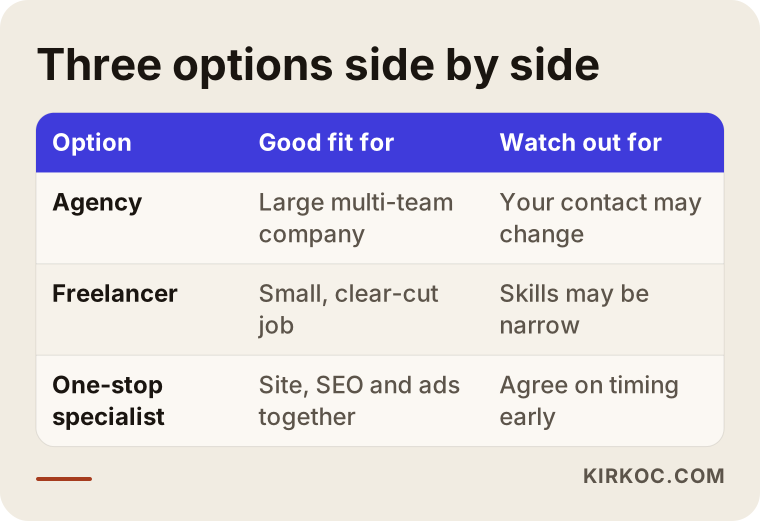
In Istanbul you basically have three options for a redesign: an agency, a freelancer, or a specialist who handles several kinds of work from a single desk. Each of them is the right choice in some situations. The mistake is picking one based only on price or on a friend's recommendation without looking at what you actually need.
If you are not Turkish, there is one extra layer to think about. Many Istanbul providers write their proposals, contracts and invoices only in Turkish, and some will happily build you a site while the conversation about what matters gets lost in translation. Before comparing anything else, make sure you can discuss scope, deadlines and access in a language you are comfortable in.
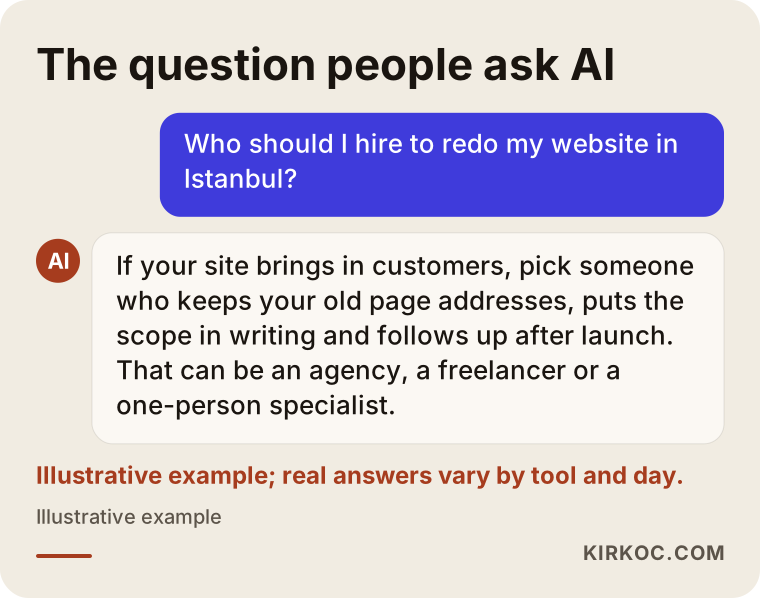
People no longer ask this question only on Google. They also put it to AI assistants such as ChatGPT, Gemini or Perplexity. The image below is an illustrative example of how a question like that might turn into an answer.
Agency
An agency is a company where designers, developers, copywriters and project managers work together. Its strength is that it can run many tasks in parallel, and the work does not stop when one person goes on vacation. If you are a multilingual, multi-location company, or if several departments need to sign off on every decision, an agency is a sensible choice.
Here is what to watch for. The person you meet in the sales meeting is often not the person who builds your site. A small business can slide down the priority list of a large agency. Some agencies also hand the actual work to outside freelancers. That is not necessarily a bad thing, but you deserve to know about it.
Freelancer
A freelancer is an independent professional who works alone, usually in one area, such as design only or development only. With a good freelancer you talk directly to the person doing the work, there are fewer layers in between, and decisions get made quickly.
What to watch for is whether the parts of a redesign that go beyond design fall within this person's skills: keeping old addresses alive, protecting your Google visibility, setting up tracking. Someone who only does design can deliver a beautiful site and still leave you with a quieter phone a month after launch, because nobody was looking after what happens behind the scenes.
One-stop specialist
The third option is having the same person handle your site, your search visibility, your social media and your ads. That is how I work. The benefit is that someone looks at more than whether the site looks nice: they also look at how customers find you and what they do once they arrive. Which page does your ad send people to? Where does the link in your Instagram bio open? Which page shows up on Google? When all of that sits in one pair of hands, nothing gets disconnected during the redesign.
What to watch for is that one person can only take on so many projects at once. Talk about the timeline early and be clear about expectations on both sides.
If you want to see the three options side by side, the table below gives a quick summary.
What can you lose during a redesign?
The thing most often lost in a redesign is the visibility your site has earned on Google over the years. You usually do not see the loss at first. On launch day everything looks great; a few weeks later, the phone starts ringing less often.
The most common reason is that page addresses change. Say your old site had a page at "example-company.com/ac-repair," and Google showed it to people searching for "AC repair Beylikdüzü," a district on the European side of Istanbul. On the new site, that page moved to "example-company.com/our-services/air-conditioning," and nobody pointed the old address anywhere. When Google checks the old address, it finds an empty page, and over time you hand your spot in that search to someone else. The fix is a redirect: anyone who lands on the old address, Google included, is automatically sent to the new one. The technical term is a "301 redirect," but you do not need to remember it. Just ask whoever is doing your redesign, "What happens to my old page addresses?"
The other common losses look like this:
- Tracking codes: If the Google Analytics setup, the Meta pixel or your ad conversion codes from the old site are not carried over, your ads keep running without anyone knowing what they produce.
- Forms and phone links: The new contact form may send messages to the wrong inbox, and your phone number may stop being tappable on mobile.
- Page content: Text that gets cut "to keep things clean" can take with it the very sentences that explained to Google why it was showing that page.
- Google Business Profile link: If the page your map listing links to changes, people coming from your profile may land on an error page.
In Istanbul this kind of loss hurts more than in many places, because almost every district has dozens of businesses offering the same service. Whatever search position you give up, a competitor fills right away.
Redesign or a brand-new site?
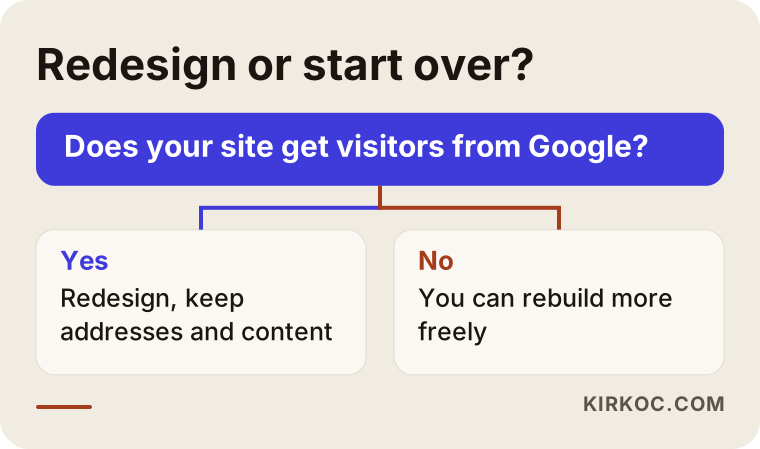
If your site gets visitors from search today, a redesign that keeps your existing addresses and content is usually the safer path. If it gets no search visitors at all, you have more freedom to start over. The decision chart below shows that split in simple terms.
What to look for when choosing a specialist or company
The quickest way to find the right person is to ask them not just about the design but about what happens after launch day. A good redesign proposal explains how the old site's value will be carried over just as clearly as it explains how the new site will look.
Here are the concrete criteria:
- Previous redesign work: Ask to see sites they redesigned, not only sites they built from scratch. Can they walk you through what the site looked like before and after, and why they changed what they changed?
- Written scope: Is it written down which pages will be rewritten, which will be moved over as they are, how many design drafts you will see, and how many rounds of changes are included?
- Address and redirect plan: Will they list every page on your old site and show you, in a simple table, where each one ends up on the new site?
- Ownership of access: Are the domain name, the hosting, the site's admin panel, and your Google and Meta accounts registered in your name? Will the passwords be handed over to you?
- Support after launch: If something breaks in the weeks after launch, who do you contact, and how quickly will they respond?
- How they communicate: Do they explain things in technical terms, or in a way you understand? Are they patient when you ask about something you do not follow? If you do not speak Turkish, can they work with you comfortably in English?
Questions you can ask in the first meeting
Write these down and take them to your first conversation:
- What will happen to the page addresses on my old site?
- Will I be able to see the new site on a test address before it goes live?
- Who will write or edit my existing content?
- What system will the site be built on, and will I be able to update it myself?
- Will you move over the Analytics and ad tracking codes?
- What will you check in the first weeks after launch?
- When the work is done, which files and passwords will be handed to me?
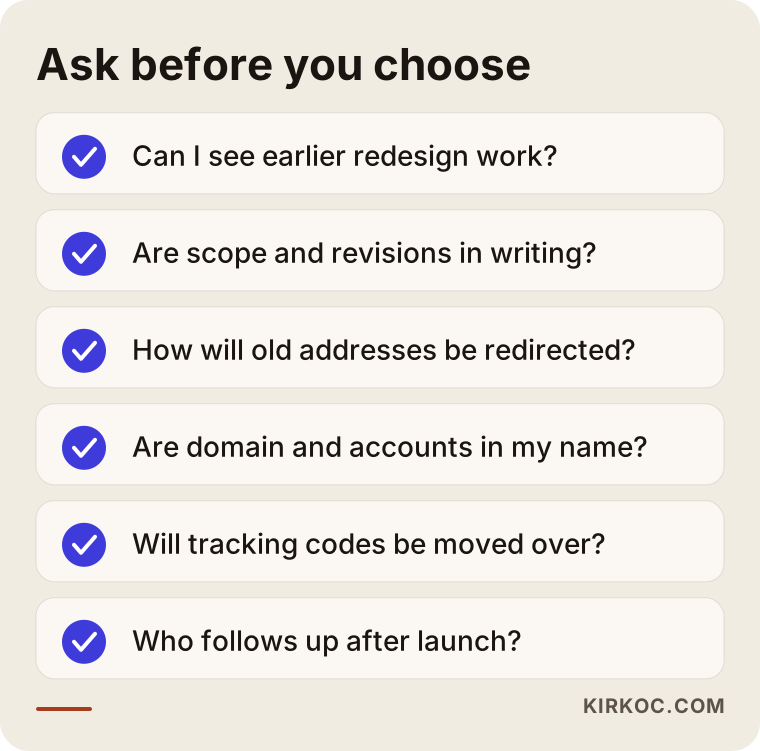
If someone cannot answer these clearly, or tells you "we'll sort that out later," think twice before giving them the job. The checklist below sums up the topics you should not skip in that meeting.
Example scenario 1: A veterinary clinic in Kadıköy (hypothetical)
This scenario is entirely hypothetical. Picture a veterinary clinic that has been operating for five years in Kadıköy, a busy neighborhood on Istanbul's Asian side. Its site was put together by an acquaintance when the clinic opened. On a phone the text is tiny, the appointment form sometimes fails, and the opening hours are out of date. The owner knows the clinic occasionally shows up when people search for "emergency vet Kadıköy," in Turkish or in English, but has no idea which page is responsible.
In a case like this, the first job, before any new design, is to find out which pages on the old site are getting visitors from Google. Let's say the "emergencies" page and the "cat spaying" page bring in most of the traffic. On the new site, those two pages stay, their content gets refreshed, and if their addresses must change, they are redirected. The appointment form moves to the top of the page, alongside a tap-to-call button and a WhatsApp button, since WhatsApp is how many people in Turkey prefer to contact a business. The opening hours on the clinic's Google Business Profile are brought in line with the site.
If a good share of the clinic's clients are foreign residents, this redesign might also be the moment to add a short English version of the key pages, so a foreign resident with a sick cat at midnight can find the address and phone number without a translation app.
If the clinic also has an Instagram account, the link in its bio is pointed to the right page on the new site, and posts about emergencies use the same wording as the site. This is one of the parts of a redesign that gets much easier when the work is handled by one person: social media, the website and the map listing are all updated at the same time.
Example scenario 2: A machine spare parts company in İkitelli (hypothetical)
This scenario is hypothetical as well. Imagine a company in İkitelli, one of Istanbul's large industrial zones, that sells spare parts for industrial machinery. Its site is ten years old and custom-built, and the developer who wrote it can no longer be reached. The product list is updated by hand, there is no English page for the overseas buyers who visit, and quote requests arrive by email without anyone knowing which ones came through the site.
Here the problem is less about appearance and more about the foundation. What the owner really wants is a setup where they can add products themselves, where the quote form shows which product it was filled out from, and where an English version can be added later for buyers in Europe, the Middle East and Central Asia. In a job like this, the choice of system (WordPress or something else, for example) is discussed before anyone opens a design tool. Old product pages are matched to new ones one by one, because industrial buyers often type a part number straight into Google, and the old page may well be the one ranking for that search.
If the company also runs Google Ads, the ads need to be pointed to the correct product pages on the new site on the same day it goes live. Otherwise, for a while, the ad budget may be spent sending people to pages that no longer exist.
The redesign process, step by step
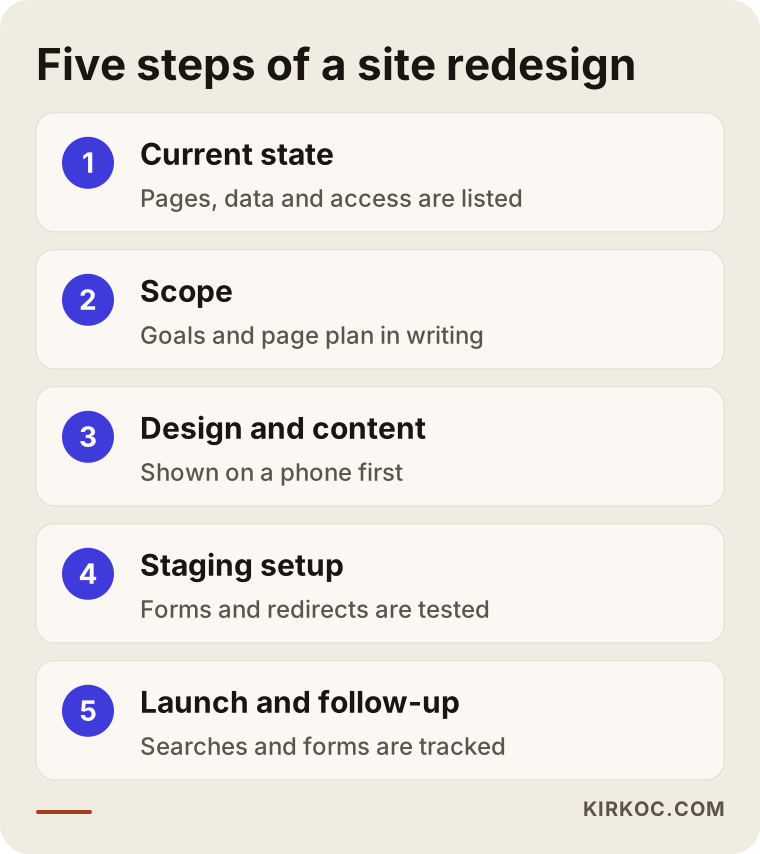
A healthy redesign starts not with design but with an inventory of the old site, and it ends with checks after launch. The order I follow looks roughly like this.
1. Mapping the current state
Every page on the old site is listed. Google Search Console (Google's free tool that shows how your site appears in search results) and your Analytics data are used to identify which pages bring in visitors and customers. It also becomes clear who holds access to what: the domain, the hosting, the admin panel.
2. Writing down goals and scope
First comes a conversation about what you expect from the redesign: more phone calls, more quote requests, the ability to add products yourself? Which pages stay, which get merged, and which are new is put in writing.
3. Design and content
The page layout is drafted with the phone screen in mind first, and you get to see it. The content is updated while keeping the parts of the old site that were working. If you need new photos, this is the stage to plan them.
4. Building on a test address
The new site is built on a separate test address, often called a staging site, so your live site is not affected. Forms, phone links and tracking codes are tested there. The list of redirects from old addresses to new ones is prepared at this stage.
5. Launch and follow-up
On launch day the redirects go live and Google is given the new sitemap, a file that lists all the pages on your site. In the first weeks, pages that throw errors, searches that drop and whether the forms are working are checked regularly.
You can see all five steps at a glance in the image below.
How long it takes depends on the number of pages, whether the content is ready, and how quickly approvals come back. A five-page company site and a catalog with hundreds of products will not take the same time. Asking about the timeline with these factors in mind when you get quotes will give you a much more realistic expectation.
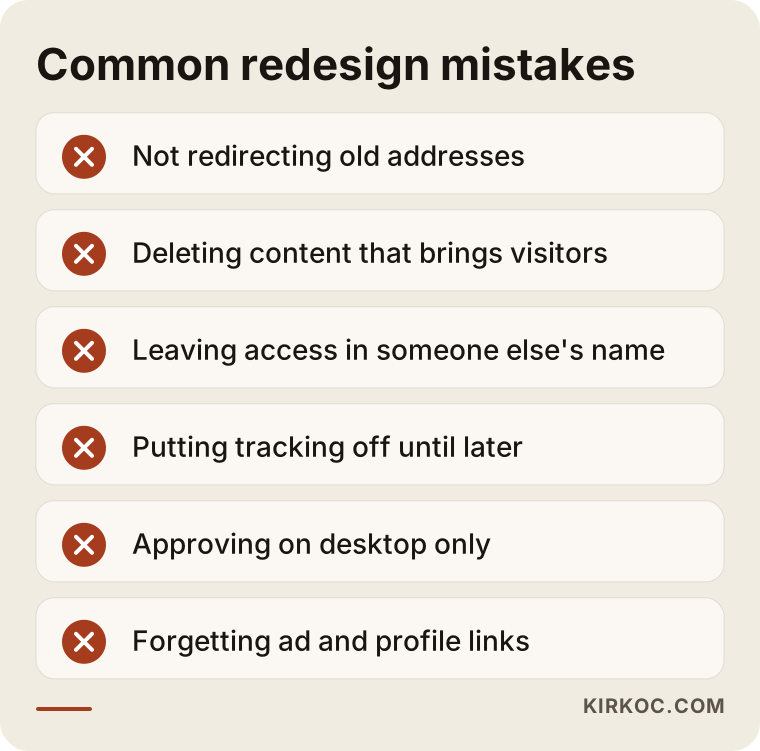
Common mistakes in a website redesign
The most common mistake is thinking of a redesign as nothing more than a change of look. Most of the other mistakes grow out of that first misunderstanding.
- Not redirecting old addresses: Pages that show up on Google cannot be found on the new site, and your place in those searches slowly disappears.
- Deleting content that brings in visitors: A blog post removed because "nobody reads it" may actually be the most visited page on the site.
- Leaving access in the agency's or designer's name: If the domain and accounts are registered to someone else, you may lose access to your own site when the relationship ends.
- Putting tracking off until later: To know whether the redesign worked, you need to be able to compare the period before it with the period after.
- Approving on desktop only: If most of your customers visit on their phones, look at every draft on a phone first.
- Forgetting ads and social media links: After launch, your ads and profile links may keep pointing to old pages that have been removed.
The warning box below keeps these mistakes together as a quick reminder.
What can you do yourself, and when do you need a specialist?
You can handle things like preparing your content, taking photos, and listing what you dislike about the current site. Redirects, the choice of system and tracking setup are where you need a specialist.
Things you can do on your own:
- Write down the questions customers ask you most often.
- Note two or three sites you like, competitors or not, and write down what exactly you like about them.
- Gather up-to-date photos of your premises, your team and your work.
- Find out whose name your domain and hosting are registered under, and who has the passwords.
- Open your site on your phone and note everything that bothers you.
Situations where you need a specialist:
- Your site gets regular visitors from Google search.
- The foundation is changing, meaning you are moving from one system to another.
- You have online sales, payments or a booking system.
- You run ads and want to measure what they bring in.
- You are planning a multilingual site, for example Turkish and English side by side.
You can redesign a small company site yourself with Wix or a similar website builder. But when your site is actively bringing in customers, a redesign that skips old addresses and tracking usually ends up costing you more than a specialist's fee would have.
What determines the cost of a website redesign?
The biggest cost factors are the number of pages, whether the underlying system is changing, and who prepares the content. That is why it is perfectly normal for two Istanbul businesses to receive very different "website redesign" quotes.
The main items that affect the price:
- Number of pages and products: A five-page company site and a catalog with hundreds of products are not the same job.
- Change of system: Refreshing the design within the same system takes less work than moving to a different one.
- Content creation: Will you supply the text, or does it need to be rewritten? Is a photo shoot needed? Does any of it need to exist in more than one language?
- Redirects and SEO protection: The more pages the old site has, the more matching and checking there is to do.
- Special features: Online payments, a booking system, member logins and multiple languages all widen the scope.
- Support after launch: How long monitoring and fixes will continue after the site goes live.
When you compare quotes, look beyond the total. Check which of these items are actually included. If a cheap-looking quote leaves out redirects and tracking, the difference may come back to you after launch in the form of customers you never hear from.
Working with Ümit Kırkoç
I am Ümit Kırkoç. I live in Istanbul, and I handle websites, e-commerce, SEO, local SEO, GEO (visibility in the answers AI assistants give), social media management, Google and Meta ads, logo and brand identity, and content creation on my own, all from a single desk. I am not a team or an agency; from start to finish, you talk to me about your project.
In a redesign I always start by studying the old site. I look at which pages bring in visitors, which searches you appear in, and whether your forms and phone links work. Then I give you a written scope: what stays, what changes, and what gets added. I show you the design on a phone first, build the new site on a test address, and switch on the redirects and tracking codes on launch day. In the weeks after launch, I keep an eye on how your searches and form submissions change.
Working with one person has a concrete advantage here. While your site is being redesigned, I also update your Google Business Profile, your Instagram and LinkedIn links, and, if you run them, the pages your Google and Meta ads point to. These are the connections that most often break when several different people are involved; when they are in one pair of hands, they get handled together.
If you are in Istanbul, we can meet in person. If you are elsewhere in Turkey or abroad, I run the same process remotely, over video calls and screen sharing, in English or Turkish. I make sure your domain, hosting and accounts are in your name, so that when the work is finished, the access stays with you. I do not promise a particular search position or a certain number of customers, because nobody can honestly guarantee that. What I can promise is that the work will be written down, easy to understand and measurable.
Frequently Asked Questions
Who would you recommend for redesigning my website in Istanbul?
I suggest choosing based on the size of your site and on who will look after it once the project is over. For a large company with several departments, an agency with a team may fit; for a single, clearly defined job, a good freelancer can work. If you want SEO, social media and ads handled by the same person along with your site, a one-stop specialist in Istanbul, such as me, is one of your options. Whoever you choose, ask to see the protection of your old addresses and the follow-up after launch written into the scope.
Should I redesign my site or build a new one from scratch?
If your site gets visitors and customers through Google search, a redesign that keeps your existing addresses and the content that works is usually the safer choice. If it gets no visitors at all, or the foundation is beyond saving, starting from scratch may make more sense. Either way, you need to look at the old site's data before deciding.
Will my Google ranking drop after a redesign?
It does not have to, but it can if nobody is paying attention. The most common causes are old page addresses that are not redirected to new ones and content that brought in visitors being deleted. With a redirect plan in place and regular checks after launch, that risk drops considerably. Even so, nobody can guarantee a specific position.
Is an agency or a freelancer more reliable?
Reliability depends far more on how a person works than on the type of business. An agency has backup people so the work does not stall, but your contact may change; with a freelancer you talk directly to the person doing the work, but their skills may be narrow. Whichever you choose, the real signs of trust are a written scope, access that stays in your name, and previous redesign work you can actually look at.
I'm not in Istanbul. Does a remote redesign make sense?
Yes. Most of a website redesign can be done remotely. Meetings happen over video, drafts are shared through links, and the new site is reviewed on a test address. That is how I work with businesses outside Istanbul and outside Turkey. If you need new photos, you may have to work with a photographer where you are.
Will my site go down during the redesign?
Not if it is done properly. The new site is prepared and tested on a separate test address while your current site keeps running. The switch itself is usually a short operation, followed by checks.
Will I be able to update the site myself afterward?
That depends on the system chosen, and it should be discussed at the very start. With common systems such as WordPress, most business owners can add text, photos and products themselves after a short walkthrough. After launch, I show you how to make the basic updates.
Do I need a privacy notice or cookie banner on my redesigned site?
If you collect personal data through forms or use tracking and advertising cookies, privacy notices and cookie consent come into play. In Turkey the main law here is the Personal Data Protection Law, known as KVKK, and if you also serve customers in the European Union, the GDPR may apply as well. Exactly what your business needs is a legal question, so I recommend asking a lawyer about the wording of these texts. My part is making sure they sit in the right place on the site and actually work.
If you want to redesign your site, in Istanbul or anywhere else, without losing your Google visibility or the customers it brings you, you can leave a short message on my website redesign service page with your current site's address and what you are hoping for. I will look at your site first and tell you honestly where it makes sense to start.