"I pay for content on my website, so why does ChatGPT never mention my business?" Business owners ask me this a lot. The usual answer is that the text reads nicely but says nothing an AI tool can actually quote. Writing content for AI search is a different job from writing an ordinary blog post. In this article I explain what citable content looks like, why mass-produced text will not set you apart, and what to look for when you buy a content service. I do this work as part of my GEO services.
What is GEO content?
GEO stands for generative engine optimization. It covers the work of making it more likely that AI tools use your site as a source when they answer a question. GEO content is simply pages written or reworked with that goal. The phrase "writing for AI" is a little misleading, though. You still write for the real person asking the question. The difference is that an AI tool weighs which page is clear, trustworthy and useful before it builds its answer, and you prepare your content to pass that test.
I should be upfront about one thing: no content work can guarantee that a tool will cite you. Nobody outside these systems knows exactly how they decide, and the rules change over time. What I can do is make your pages a good candidate for citation and check regularly whether it is working.
What kind of content do AI tools tend to cite?
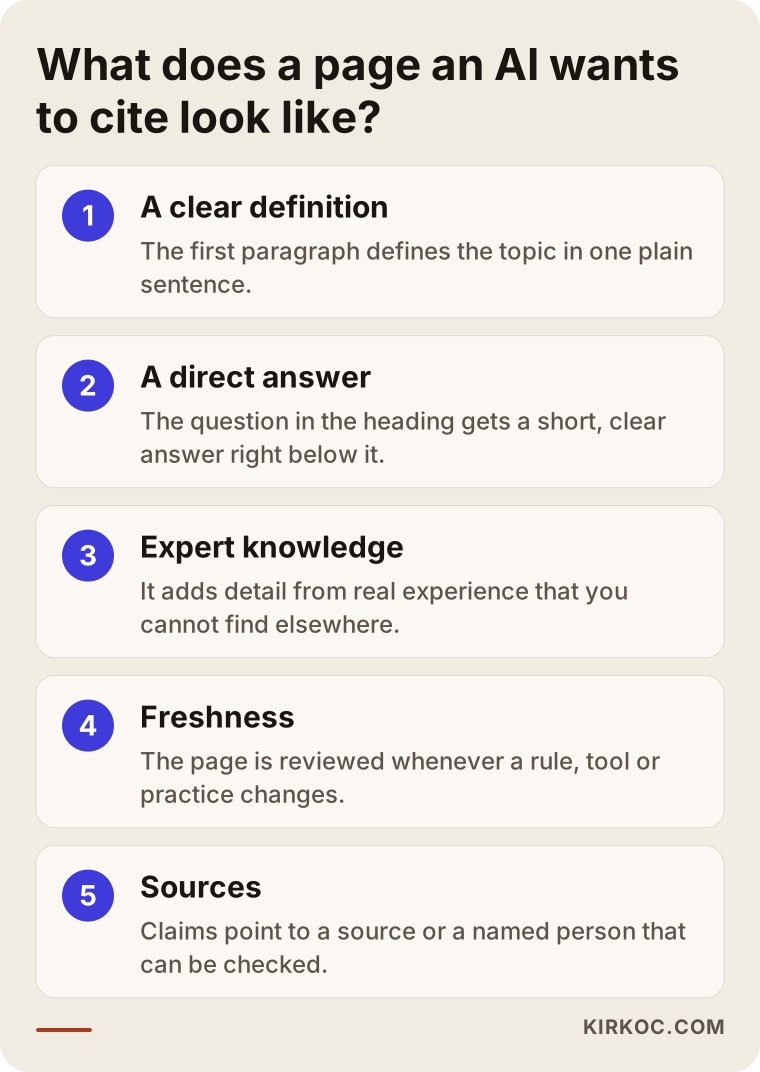
These are the traits I see again and again in my work. All of them also help the human reader:
- A clear definition: A page that explains the topic in one sentence in the first paragraph is the easiest to quote. If someone asks what a power of attorney is and your first line answers it plainly, both the reader and the model find what they came for.
- A direct answer: If a heading is a question, a short answer should follow immediately. Details come after. A page that spends three paragraphs warming up before it answers is a poor candidate.
- Expert knowledge: Details that only someone doing the job would know, instead of the generic lines everyone writes. An accountant knowing which documents are most often missing in a new company's first month is a good example.
- Freshness: A page describing an outdated rule or process misleads readers and loses trust. A visible update date and regular review matter.
- Sources: Claims that rest on an authority, a rule or a named person. Confident statements with nothing behind them do not build trust.
Page structure helps too: clear headings, short paragraphs and lists where they fit. That makes the text easier to read and lets each section be understood on its own.
Why does mass-produced AI content not work?
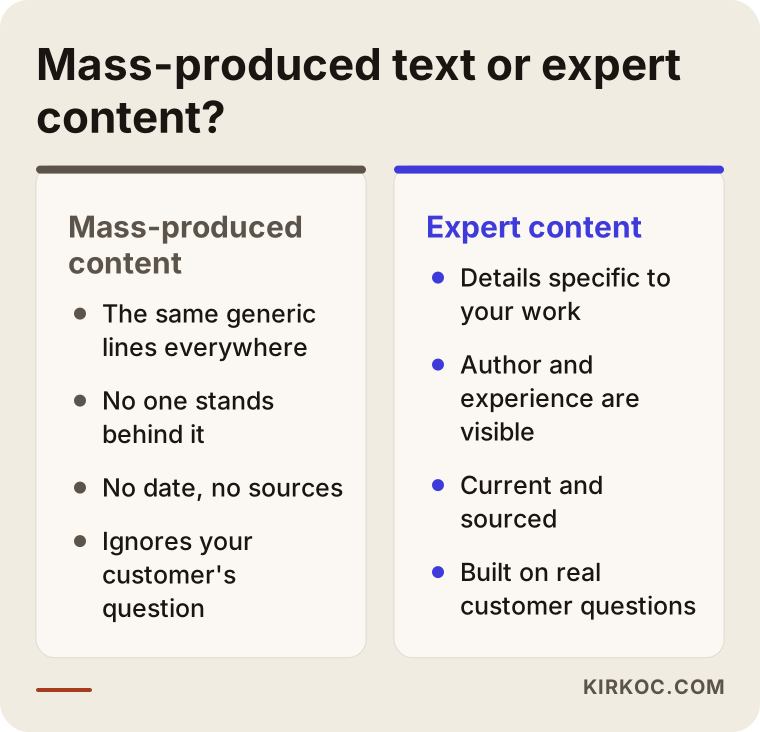
You have probably heard offers like "a hundred AI-written articles a month". The appeal is obvious, but there is a problem. AI writing tools produce the average of what has already been published about your field. The result looks very much like your competitors' text and hundreds of other sites. A model building an answer already knows that average. It has no need for another page repeating it.
There are further problems:
- It is unclear who wrote the text and what experience it rests on. In law, health and finance in particular, that is a serious trust gap.
- Wrong or outdated information can slip in. Once a customer spots one such mistake, trust in the whole page is gone.
- Hundreds of pages in the same pattern can lower the perceived quality of your site instead of raising it.
I do not rule out AI tools entirely. They are useful for drafts, summaries and editing. But the core of the content, what a person who truly knows your work would say, has to come from a human. I touched on this in my article on why SEO content writing matters.
What does a GEO content service include?
My work usually follows these steps:
- Reviewing your existing pages: I check which ones offer a clear definition and a direct answer, and which ones wander.
- Finding the real questions: What your customers ask on the phone, in forms and in appointments is the raw material.
- Writing or reworking: I write new pages and rebuild existing ones around answers. I take the expertise from you and turn it into text.
- An update plan: Together we decide how often each page gets reviewed.
- Checking: Over time I watch what AI tools answer to specific questions. I described how this works in does AI recommend your business.
The cost depends on the number of pages, how much expertise the topic requires and how long it takes to gather your knowledge. That is why I look at the need first instead of selling a fixed package.
What should you check when hiring a content service?
These questions will protect you when you compare offers:
- Who writes the text, and where does the information come from? An answer like "AI writes, we edit" should make you pause.
- Will they talk to someone who knows my business? Content written without talking to you stays generic.
- Which questions, not how many articles? Prefer an offer that names the customer questions it will answer over one that boasts about volume.
- Are updates included? Content that is written and left alone ages quickly.
- Do they promise results? Anyone who guarantees you will appear in an AI tool is promising something they cannot control.
A law firm example: the knowledge was there, the answers were not
A solicitor came to me saying her website had dozens of articles, yet no AI tool ever mentioned her firm. When I read the articles, I saw that knowledge was not the problem. She knew her field very well, but the pages read like lecture notes, and the answer to the reader's real question only showed up near the bottom, after a long detour.
First we picked the three topics that brought in the most phone calls, meaning the things clients ask in the very first conversation. For each one we put a plain two or three sentence answer at the top of the page. Below it, we gave separate headings to how the process works, which documents are needed, and in which situations seeing a lawyer is simply necessary.
There was one boundary we respected throughout: we removed every sentence that promised an outcome. A line like "you will win your case" is risky under professional conduct rules and does not build trust anyway. Before publishing, she checked every page against her own professional rules.
The result was measured. After a few weeks, on some of those questions the tools occasionally started showing her firm's page as a source, and on others they did not. That is not a picture anyone can guarantee, but the pages were now clearer for readers and for the tools alike.
A boutique hotel example: sentences everyone else writes too
The second example is a small boutique hotel. Its website was full of lines like "unique comfort, an unforgettable getaway", the kind of sentence you could paste into any hotel's page. The owner had never written down the concrete things guests actually ask: how do I get here from the airport, are you open in winter, which room suits a family with small children, do you take pets?
I spent an hour with the owner and we listed the questions that reach the front desk. We moved each of them onto the site with a short, clear answer. We cut back the general praise and replaced it with real detail: which way the rooms face, when breakfast ends, how many minutes it takes to walk to the nearest beach.
When someone asks an AI tool for a quiet hotel to visit with a child, it can use these concrete facts, which it cannot do with a generic advertising line. Still, I cannot guarantee that any tool will recommend the hotel. What I can do is make sure the information is correct, current and easy to find.
What are your customers asking AI?
When you plan content, looking at the shape of the question makes the work easier. People tend to ask AI tools a handful of types of questions, and each type needs its own answer on the page.
- Definition questions: "What is X?" The answer belongs in the first paragraph.
- Process questions: "How is X done, and how long does it take?" These want a plain, step-by-step explanation.
- Comparison questions: "A or B?" The page that honestly says who each option suits stands out.
- Decision questions: "When should I see a professional?" Drawing a clear, unexaggerated line builds trust.
- Cost questions: "How much does it cost?" Even if you cannot give a number, explaining what drives the price satisfies the reader.
Placing two or three of these five types well on one page often does more than a long text.
Step by step: how the work runs
Whether you work with me or do it yourself, the order is largely the same. What differs is who takes on each step.
1. Which pages matter?
You do not need to rewrite the whole site. The first job is choosing the pages that bring in business or get the most questions. Usually your service pages and a few of the most common questions make up that list.
2. Collecting customer questions
Your call logs, chat messages, emails and appointment notes are the most valuable source. If you have heard the same question three times, it deserves a page.
3. Getting the knowledge out of you
Here I ask the questions and you talk. You hold the expertise; I turn it into a readable, well-organized text. Before anything goes live, I run every piece of information past you for approval.
4. Writing or rebuilding
The page opens with a definition and a short answer, followed by details, the process and frequently asked questions. Paragraphs stay short so that both readers and models can understand each section on its own.
5. Publishing and monitoring
After a page goes live, I check over time what the tools answer to the questions we picked. Instead of adding new pages without knowing what works, it is usually more efficient to improve what already exists first.
Rebuilding an old page: before and after
You do not have to throw away your current page and start from zero. Most of the time the information is already there, just in the wrong place. Picture a typical, made-up service page: the first three paragraphs tell the company history, what the service actually is appears in the fourth, and there is no process section or FAQ at all.
In the rebuilt version the page begins like this: a one-sentence definition of the service, who it is for, and how it works. Then comes a short description of the process, the factors that determine the price, and a question section built from real customer questions. The company history moves to the end of the page or to a separate "about" page.
Most of the text stays the same; what changes is the order and the clarity. That is why rearranging is both faster than writing from scratch and better at keeping your own voice.
Checklist before you publish
Ask yourself these questions before a page goes live. If you can answer "yes" to all of them, the page is most likely on solid ground.
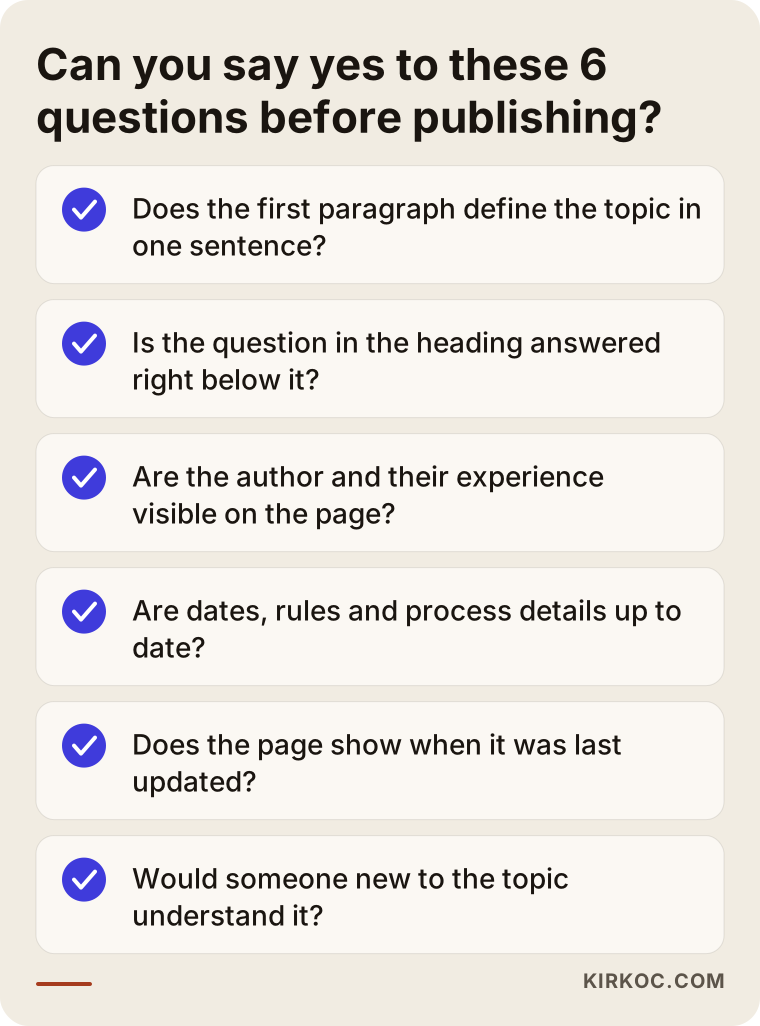
Let me unpack the list. Does the first paragraph tell even someone who knows nothing about the topic what the page is about? Is the question in the heading answered in a few sentences? Are the author and their experience visible? Is information that can change, such as dates, rules or pricing policy, current, and does the page show an update date? Finally, if you showed the page to a relative who knows nothing about your field, would they understand what you offer?
You can use the same list again every six months after the page is live. It helps to mark the parts that age fastest, such as process details and anything related to pricing.
How do you follow up after publishing?
Writing the content and walking away is only half the job. The other half is honestly seeing whether the change had any effect. You do not need complicated tools for this; a regular, consistent check is enough.
First, pick around ten questions your customers might ask and write them in a list. Then, once a month, ask the same questions in different AI tools and note the results: were you mentioned, were competitors mentioned, was the information correct? If you see a wrong statement, check whether your page on that topic is clear enough.
An important warning: the answers of these tools change from person to person and from day to day. Do not celebrate or despair over a single try. To see a trend, you need to look at the same questions over several months. I do this check as part of my work and explain in plain language what changed.
Also watch the change in your visitor numbers and in the requests that arrive by phone or form. Being mentioned by AI is nice, but the final measure is whether the right people get in touch.
Where should a small business start?
Not every business has the budget or the time to commission dozens of pages, and that is fine. With limited resources, order matters more than volume.
First, find the topic where your callers most often begin with "can I also ask about this". One genuinely well-built page on that topic is worth more than five mediocre ones. Second, rewrite the introduction of your service page with a definition and a short answer. Third, add a section of five or six questions taken from real customer conversations.
These three steps are often the most productive thing you can do in the first period. Afterwards you look at what worked and move on to the next page. This is how I usually proceed with small businesses: a small piece first, then measurement, then more.
I should add that this order is not a guarantee, only a sensible starting point. Competition in your field, the age of your site and the state of your existing content all affect the pace.
Mistakes businesses often make
I see the same mistakes again and again. Most are made with good intentions, which is why they are hard to spot.
- Obsession with quantity: A target of "this many posts a month" overshadows quality. One page that truly answers the question beats many pages that resemble each other.
- Hiding the answer: Putting the answer at the bottom to keep readers on the page tires both the reader and the tool.
- Leaving old information up: A page written years ago and never updated lowers credibility.
- Hiding the author: In law, health and finance, the question "who is saying this" matters a great deal. An anonymous text looks weak there.
- Rewriting a competitor's text: Changing a rival's page a little and publishing it tells nobody anything new.
- Expecting results immediately: Giving up after a few weeks without visible change leaves the job half done.
- Not measuring: If you never check which questions you appear in, you cannot know whether the work paid off.
- Explaining everything on every page: A page should focus on one question. Squeeze five topics into one page and neither the reader nor the tool finds what it needs.
- Leaving the expert out of the process: If the person writing never spoke with you, the text will not reflect your experience.
What these mistakes share is treating content as a to-do list and forgetting the customer. For every page, ask yourself one question: does the person reading this find what they came for and feel relieved? If the answer is yes, you are on track.
What you can do yourself and what to leave to a specialist
You do not have to outsource everything. If you do some of the work yourself, you save budget and the content sounds more like you.
What you can do yourself
- Collect the questions customers ask most often in a notebook or in your phone notes.
- Review your existing pages for outdated information, dates or rules.
- Add an update date to pages and name the author.
- Write the FAQ section in your own words, using real customer questions.
What to leave to a specialist
- Deciding which pages to handle first, in other words the priority order.
- The structure of the content: heading order, definition and answer layout.
- Monitoring regularly and consistently which questions mention you and which do not.
- The technical side: making sure the page is readable, loads quickly and has a structure that tools can follow.
This is where I draw the line: the knowledge comes from you, the structure and the follow-up from me. If you do not want to start from nothing, producing the first list yourself and bringing it to me already speeds things up considerably.
Frequently asked questions
Do I need separate content for AI?
No. One well-prepared page works in Google and in AI answers alike. What matters is how clear and trustworthy it is.
Do I have to change my existing blog posts?
Often it is more effective to rework your most important existing pages around answers than to write new ones. First look at which pages are worth the effort.
When will I see results?
I cannot give an exact time, because nobody can determine from outside when a tool will use a page as a source. What I can do is check regularly and show you the progress.
Does page length matter?
What matters is less the length than how completely the question is answered. Some topics are done in a short page, others need a long guide. Stretching a page without need tires the reader too.
Can I have an AI tool write a draft and edit it myself?
Yes, as long as the substance comes from you. A draft tool saves time, but checking the facts, the examples and the accuracy is your job. A draft published without checking is the riskiest thing of all.
How often should the content be updated?
For fast-changing topics such as rules or pricing policy, at least once a year; for topics that change less, a general review can be enough. What matters is that the date is visible on the page and that a real check was done.
Is this work necessary for a small business?
If you work locally in a narrow field, a few well-built pages are often enough. You do not need a large content program; what matters is answering the most common questions clearly.
Conclusion
Content that AI cites is clear, direct, expert, current and sourced. None of that comes from mass production. If you would like to talk about what a content plan for your business could look like, you can reach me through my GEO services page.