Is the monthly GEO report you receive actually telling you something, or is it just a busy-looking page? It is a fair question. Tracking whether AI assistants mention your business is a new field, so there is no settled reporting standard, and every provider builds their own template. Being able to tell a useful report from a weak one is how you make sure you get something for what you pay.
I am an independent consultant, and my GEO services come with a monthly report built on the same logic every time. In this article I explain what a good AI visibility report should contain, how to read it, and which signs point to an empty or padded one.
A quick reminder first: GEO is the work of making sure AI tools such as ChatGPT, Gemini or Perplexity mention your business accurately and favorably in their answers. For the bigger picture, see my article on whether AI recommends your business. Here I stay with what is specific to GEO reporting and leave classic search metrics aside.
What the report should measure: tracked questions
The backbone of a GEO report is the list of tracked questions. These are sentences your customers could realistically type into an AI assistant: "How do I choose a reliable accountant?" or "Can you recommend a good family dentist near me?"
In a good report you can see this list in full. Ask yourself:
- Are the questions written in your customers' language, or in industry jargon?
- Do they include both "I want to learn something" and "I want to pick someone" intentions?
- Does the list stay stable from month to month, so results can be compared?
You can also ask how the questions were chosen. A good consultant ties them to what your customers really ask and to the services you actually offer. If the list is not shown at all, you cannot know what was measured, and that is the most basic gap.
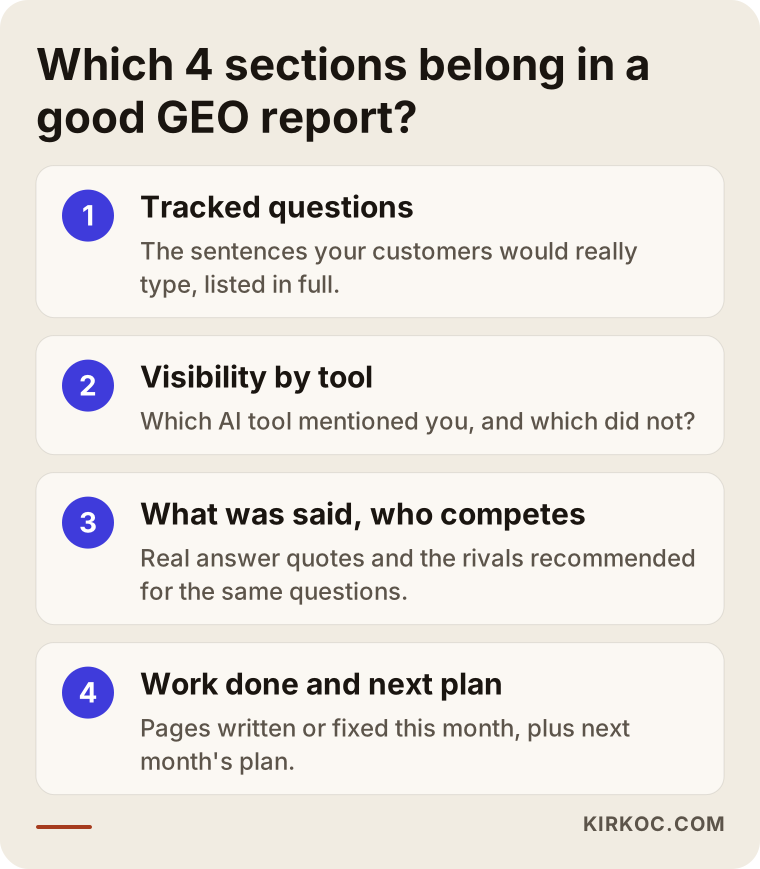
Which tool mentioned you, and which did not
The second section should show, for each question, which AI tool mentioned your business. A summary of how many questions you appeared in is useful, but what matters more is seeing where you are missing and why.
Different tools draw on different sources. You can be named in one and absent from another, and that gap tells you where the work should go. A single total score with no breakdown by tool is missing information.
Also keep in mind that AI answers can shift a little even for the same question. An honest report says so, mentions that each question was tried more than once, and does not present one attempt as settled fact.
What was said: mentioned is not the same as described correctly
Seeing your name is not enough. The report should include real example sentences showing what the AI wrote about you. Look for these:
- Are your services, service area and specialty described correctly?
- Is an old address, a closed branch or a wrong detail being repeated?
- Are you presented as a recommendation, or only as one name in a list?
In regulated fields such as health, law or finance, a wrong statement can do more harm than no mention at all. Check what your professional rules allow in terms of promotion. A good report does not just spot the error, it explains how it will be corrected.
Competitors and the work done
The third section covers competitors. Which businesses are recommended instead of you for the same questions? The point is not to copy a rival. It is to see what kinds of pages and sources the AI trusts. If there is no competitor section, the report lacks context.
The fourth section is a concrete list of what was done that month, for example:
- Which pages were written or updated?
- Which outside sources (directories, guides, news sites, professional listings) had information added or corrected?
- What was changed technically so AI tools can read your site more easily?
Below that, you should find a plan for next month. A report that only looks backward often exists mainly to prove that work took place.
How to spot an empty or padded report
If you see several of the signs below, start asking questions.
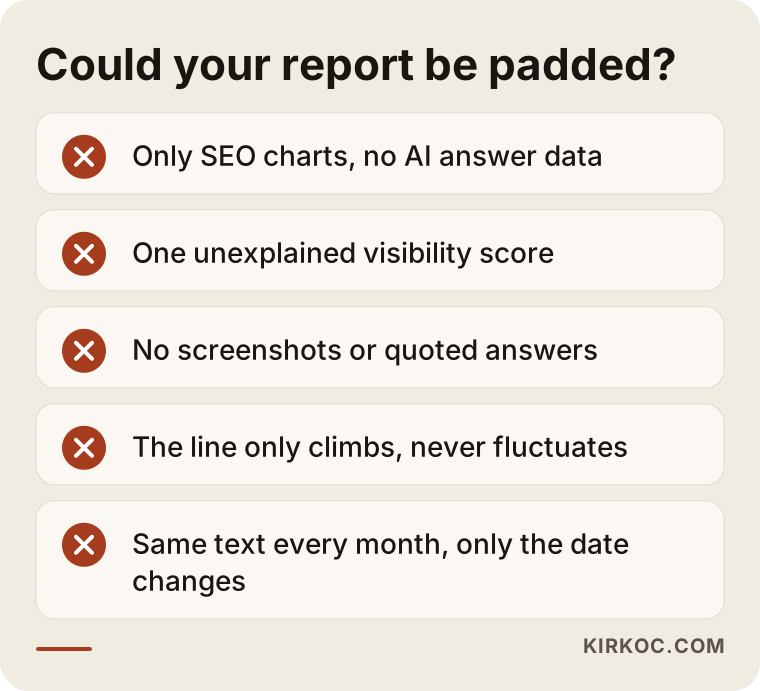
Padded reports usually share these habits:
- Only classic SEO data: Rankings and traffic charts, but not a single line about AI answers.
- One mystery "visibility score": No explanation of how it is calculated, no split by question or tool.
- No evidence: "We are doing well" with no screenshots or quoted answers.
- A line that only climbs: Real measurement fluctuates, so a perfect upward curve deserves suspicion.
- The same text every month: Only the date changes.
- Vague work descriptions: One-liners like "content optimization done" that cannot be verified.
None of this proves bad intent; sometimes the tool or template is simply weak. Still, a report should help you understand what you are paying for.
What to expect from results
To be honest, appearing in AI answers cannot be guaranteed. These systems change constantly, and no consultant controls what they say. What I can do is make your business information accurate, consistent and findable on trustworthy sources, and show progress transparently. I suggest reading change as a trend over several months. A single month's swing is often just noise.
Two different businesses, two different reports
How you read a report depends a little on the kind of business behind it. Here are two typical situations from my work. I have generalized the details, and I describe the outcomes modestly on purpose.
A neighborhood dental practice
The owner of a dental practice came to me with a report from a previous consultant. It had attractive ranking charts, but not a single line about AI assistants. Patient numbers were flat, and she asked me, "The charts look fine, so why is the phone not ringing?"
The first thing I looked at was what patients might actually ask an AI tool: "Is there a dentist near me who is good with kids?" or "How do I choose a clinic for implants?" I tried these questions in three different tools. In one the practice never appeared, and in another it was mentioned with an old address. So the problem was less visibility and more outdated, incorrect information.
We first made the service pages, address and opening hours consistent on the website. Then we corrected the same details in directories and map profiles. After a few months one tool described the practice with the right address, while another still did not mention it, and I wrote exactly that in the report. Because advertising rules for healthcare are strict, we also avoided words like "best" or "guaranteed"; please check this against the rules that apply to your own profession.
A small accounting firm
In the second case, most clients came to the firm after being unhappy with another accountant. The owner was glad to receive a report but did not fully understand it: it showed one "visibility score" that rose a little every month.
When I asked how the score was calculated, there was no clear method behind it. Instead I defined a few dozen real questions, such as "What does an accountant do when I start a company?" and "What should a small business look for when choosing a bookkeeper?" I tested each question separately in three tools and saved the answers.
The picture was more modest, but far more useful. The firm did not appear in any "how to choose" questions, because its website had no page answering them. So we wrote two guide pages. I did not report the result as "it clearly improved"; I reported that in one tool, phrasing from the guide began to show up in answers.
How to read the report step by step, every month
You do not need to read the report cover to cover. In five minutes, looking at the points below in this order, you can tell whether it is solid.
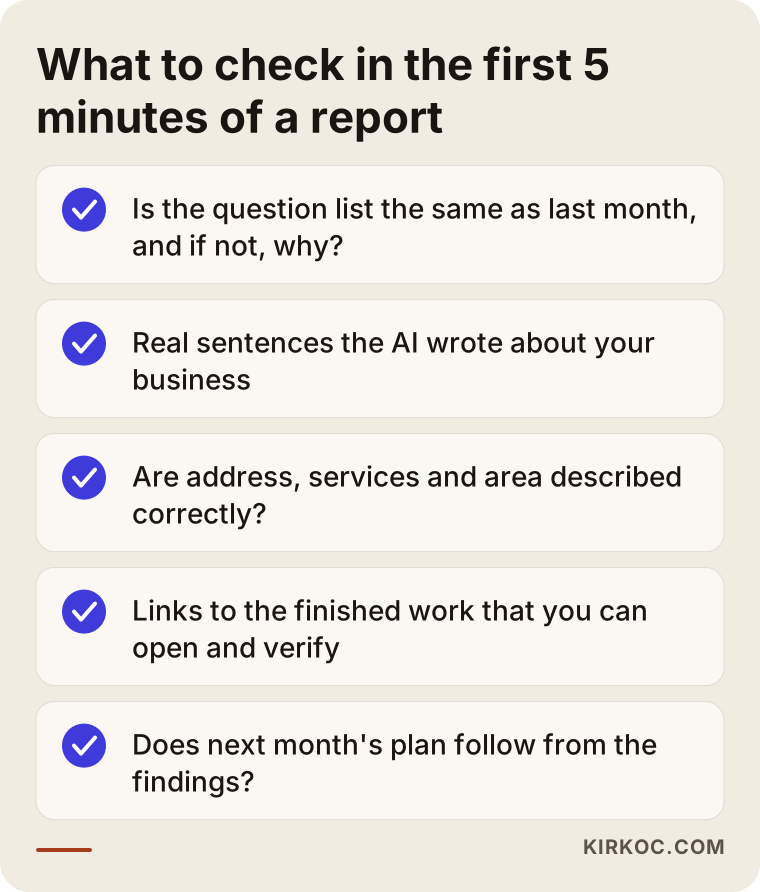
1. Look at the question list
Is it the same as last month's, and if it changed, is the reason written down? If the list is rewritten every month, you cannot compare months. Adding a new question is normal; quietly removing old ones is not.
2. Read the quoted answers
Before the numbers, read a few sentences the AI wrote about you. Are your address, specialty and service area correct? One sentence often tells you more than a chart.
3. Compare with the previous month
If something changed, is it explained? Disappearing from one tool or appearing in another is not good or bad in itself. What matters is whether it can be linked to work that was done, and if it cannot, an honest "we do not know" beats an invented explanation.
4. Verify the work done
If the report says a page was written, you should be able to open that page. Every verifiable line makes the report more trustworthy, while lines you cannot verify deserve a polite question.
5. Check the plan for next month
Does the plan follow from this month's findings? If one tool shows an old address, next month's plan should include fixing it. If the plan is identical every month, the report is not being fed by the findings.
A weak report and a strong report, side by side
Here is how two reports might present the same information.
Weak report:
- "Your visibility score went up this month."
- It does not say which questions or tools were measured.
- The work ends in one line: "blog content prepared."
- Competitors are never mentioned.
Strong report:
- "You were mentioned in two tools for these three questions; you were not mentioned in the third tool, most likely because of this."
- The question list and the result of each question are written out.
- The name and link of each page that was written are given.
- The competitor section notes which kinds of sources stand out.
A strong report also does not hide uncertainty. A report that can say "nothing changed this month, and that is normal" is more trustworthy than one that announces a success every month.
Questions you can ask in the report meeting
Reading the report is half of it; talking it through is the other half. These questions reveal both the quality of the report and the consultant's approach, and I would like my own clients to ask them.
"How did you arrive at this result?"
The answer should describe the method: which questions, which tools, how many attempts and on what date. A report that cannot explain its method cannot be repeated, and it will not let you compare next month.
"What are we doing about this finding?"
Every finding needs a response. An old address calls for a correction, a question where you never appear calls for a new page, and a competitor who stands out calls for a look at its sources. A finding without an action means the report only informs.
"Why this work first?"
Not everything can be done at once. The reason might be the question customers ask most, the most damaging error, or the easiest gap to close. Hearing the logic of the order shows how the consultant thinks.
"When will we measure again?"
The effect of a change may not show up right away. If you agree on when to look, you hold a planned check next month instead of an argument about why nothing moved.
How the process works if you work with me
If we work together, the sequence usually goes like this. The details change from business to business, but the logic stays the same.
First conversation and first look
I start by listening to you: your business, your customers and the questions you get most. Then, without changing anything, I measure how you currently appear in AI tools. That first picture is the baseline for the months that follow.
Choosing the question list together
I prepare the question list, but we review it together, because you know your customers best. Once you approve it, measurement runs on that list.
Fixing and building months
In the early months the focus is on correcting wrong or missing information and writing the pages that are absent. At the end of each month I send the four-part report described above and, if needed, we have a short call.
Steady monitoring
Once things settle, the report becomes calmer: monitoring, small corrections and new questions. At this stage, protecting what has been done matters more than doing something new.
At no point do I promise "you will get this result by this date." What I can promise is to show, each month, what I measured, what I changed and what is still uncertain.
What to do if the report is not good enough
If your current report does not meet most of the standards here, you do not have to end the contract immediately. A calm sequence is healthier.
Ask first
Request the missing section in writing: "Can I see the full list of tracked questions and the result for each?" The tone and speed of the answer tell you whether the gap is a matter of intent or just a template. Some consultants welcome the request and improve the report.
Measure the same questions yourself for a month
Choose five or six questions, type them into different tools on the same date each month, and save the answers. This gives you an independent observation to compare with your consultant's report. If the two agree, trust grows; if they differ a lot, it is time to talk openly.
Redefine the scope
Sometimes the problem is expectation rather than the report. You may have bought a service focused on search rankings, and AI visibility was never part of it. Then the report is not bad; the service simply does not match your need.
Get a second opinion if needed
Showing the report to another specialist is a legitimate step. I review existing reports against the standards in this article; my aim is not to make anyone look bad but to make clear what you are paying for.
Common mistakes
These are the mistakes I see businesses make most often.
Trusting a single number
A single "visibility score" feels useful but does not say what grew. Looking at the number without seeing which question, tool and answer changed is misleading.
Reacting to every fluctuation
AI answers can change even for the same question. Disappearing from one tool in one month is no reason to panic; look at the trend over several months.
Settling for your own name
Seeing your name mentioned and relaxing is a common mistake. Check whether you are described with the right service, the right area and the right information.
Never questioning the report
Filing the report away means not auditing the service you pay for. Asking "How can I verify this line?" is very useful, and a good consultant will not mind.
Forgetting the customers' own words
Sometimes the questions on the list are written in the business's language rather than the customer's. Sharing what real customers ask you by phone or message does more to improve the question list than anything else.
What you can do yourself and what to leave to a specialist
You do not need to hand all of this to a specialist. The split looks like this.
What you can do yourself
- Type five or ten questions your customers would ask into different tools and note the answers in a table.
- Check that your address, phone number and opening hours are identical on your website, map profile and directories.
- Write down the questions customers ask most and answer them on pages of your site.
- Ask your consultant about every line in the report that you do not understand.
What to leave to a specialist
- Choosing the question list methodically and measuring it each month under the same conditions, with repeated attempts.
- The technical setup that lets AI tools read your site.
- Correcting information in outside sources (directories, news sites, professional bodies) and keeping it consistent.
- Turning findings into work, meaning deciding which problem to solve first.
The point of this split is not to make you dependent. A client who can run their own observations reads the report better and gets better work from their consultant.
One more thing: while reading, ask yourself, "Can I make a decision with this information?" If you cannot say what you will change, what you will wait for or what you will ask your consultant, the report is not doing its job, however polished it looks. A report that does not help you decide is just a handsome archive document.
Frequently asked questions
Do I need technical knowledge to understand the report?
No. A good report answers "which question, which tool, what was said, what was done" without jargon. If a section confuses you, it was probably explained badly.
How often should I get a report?
Monthly is enough for most businesses. More frequent data is too noisy to base decisions on.
Can I check this myself?
Yes. Type a few questions your customers might ask into different AI tools and note the answers. It is a simple, free way to compare the report with your own observation.
If nothing changes in the report, does it mean my consultant is not working?
Not necessarily. In some months the measurements stay the same, because AI tools do not learn new information immediately. What matters is that the report says what was done that month and why no change is expected.
In which language and from which country should the report measure?
In the language and city where your customers actually search. If the report only measures English questions but you want customers elsewhere, it will not help you. Ask to see the language and location of every question.
What if my competitors appear far ahead in the report?
First look at why: do they have more guide content, are they mentioned in more outside sources, is their information more consistent? Those reasons are not something to copy but a roadmap for you. You are welcome to write to me to go through this together.
Can I show you my current consultant's report?
Yes. I review the existing report against the standards in this article and note missing sections and questions to ask. You are under no obligation to switch consultants; the goal is to help you understand what the report really says.
Why do results differ even a month later?
AI tools generate answers anew each time, and their sources change over time. Small differences for the same question are normal. What counts is the direction that holds across several months.
Is it excessive to ask for screenshots with the report?
No. Quoted answers and screenshots are the easiest part of a report to verify. If there is nothing to hide, sharing them is easy, and if they are not shared, you have every right to ask why.
Let's review your report together
If you hold a report and are unsure whether it really helps, get in touch. We can go through it together, or talk about what should be measured for your business. You can reach me through my GEO services page.