"If I start GEO, when will AI begin recommending my business?" I hear this in almost every first conversation, and it is a fair question. You are putting in money and time, so you want to know when it pays off. My honest answer is that I cannot give you an exact date or month, and nobody else can either. What I can do is explain which changes tend to show up quickly, which take longer, and what you should look at in the first months. If you want to see what the work covers, my GEO services page explains it.
Why can't anyone give an exact timeline?
GEO means working so that AI tools such as ChatGPT, Gemini or Google's AI summaries mention your business when people ask questions. It does not work like a tap you turn on, because much of what decides the outcome is outside your control and mine.
- AI systems keep changing. Which sources they read and how often they refresh is not decided by me, and not by you.
- Everyone starts from a different place. A well-known business with plenty written about it has a different road than one that opened last year.
- Competition differs by industry. A field with a handful of competitors moves differently from one where hundreds of firms chase the same question.
- Answers are not fixed. Ask the same question twice and you may get two different answers.
So anyone who says "we will get you there in six weeks" is either mistaken or selling you something. I wrote about the same honesty for classic search in when SEO results show up; with GEO the uncertainty is a bit larger.
Which changes show up fast, and which slowly?
Not every task moves at the same speed. The split below is the general pattern I see in my work: a relative order, not a promise of timing.
Often quicker: correcting the facts on your site (address, phone, hours, list of services), a clear and orderly page structure that AI can read, plainly answering common questions, and removing missing or contradictory information.
Often slower: being mentioned on other trustworthy sites, building a consistent reputation, being recognized as an expert in your topic, and accumulating reviews and references.
In short, what we can fix on your own site matures relatively fast. Reputation and trust depend on sources outside your control, so they take time. The second part is often what makes the real difference.
What should you look at in the first months?
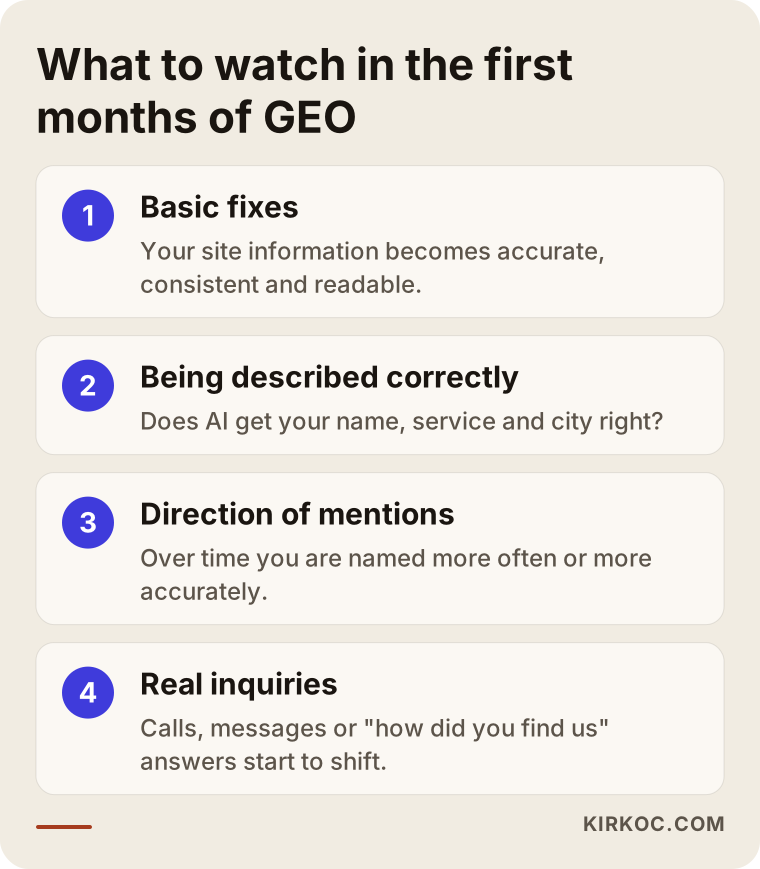
Checking "are we on the list yet?" after month one is misleading. Instead I look at whether the direction is right:
- Are the basic fixes done? Is the information on your site accurate, consistent and readable?
- Does AI describe you correctly? When asked, does it get your name, service and city right or wrong?
- Are mentions changing? For the questions we target, are you named more often or more accurately over time?
- Are real inquiries changing? Do you see a difference in calls, messages or "how did you hear about us" answers?
You may be able to say yes to some of these within weeks and to others only after months. They have to be watched together. A single number will either raise your hopes for no reason or scare you for no reason.
What does impatience cost you?
The most common mistake I see is quitting at the end of month two with "we are not showing up, so it does not work." At that point the basic work has only just settled and the reputation side has barely started. Impatience causes two kinds of damage:
- Unfinished work. The effort stops before it can pay off, and what was done is wasted.
- Drifting the wrong way. The search for a "quick fix" can push you toward inflated promises, fake reviews or mass-produced content. These look good in the short term and damage trust in the long term.
How should you read a "results right now" promise?
If an offer contains one of the following, stop and think.
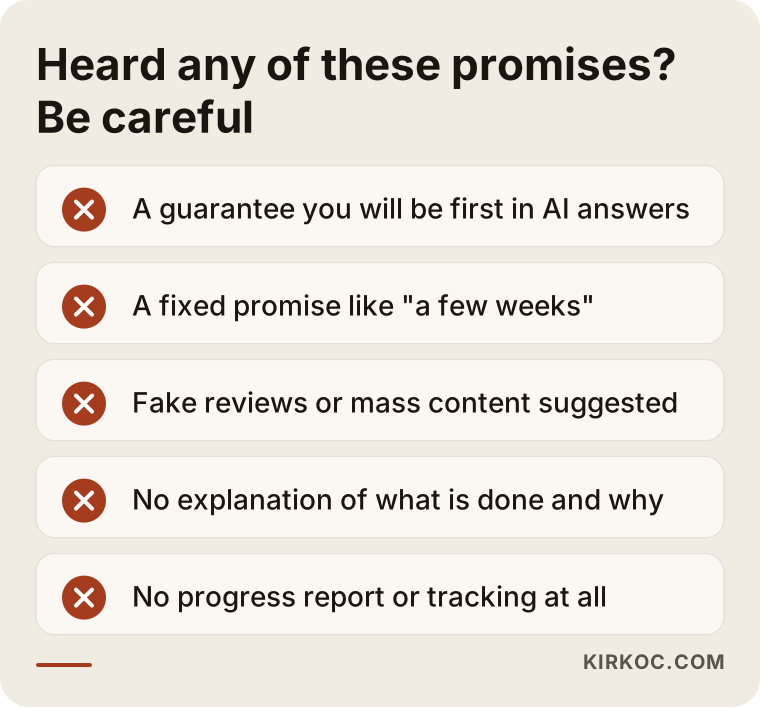
Nobody can buy AI answers, and no consultant controls them. What can be done is making your business understandable, trustworthy and easy to find for AI. I do that without guarantees: I explain what I do and why, and we track progress together. If cost is on your mind, what determines GEO pricing may help.
What do I actually do while you wait?
Waiting should not be passive. In my work I first look at where you stand: how does AI describe you today, and which facts are missing or wrong? Then I fix what can be fixed on your own site, and after that I plan honest steps on the reputation and visibility side that fit your business. At every stage I tell you what I am doing, why, and what cannot be measured yet.
Two different starting points, two different timelines
How much the timeline depends on where you start is easiest to see in examples. The two scenarios below are generalized versions of situations I run into often. Neither is a promise or a claim about a measured result.
A well-known practice that has been around for years
A dentist came to me with this situation: the practice had served the same neighborhood for years, patients were happy, and people nearby knew it. But when someone asked an AI assistant to "recommend a trustworthy dentist in this area," the practice never came up. Worse, when asked about it directly, the assistant gave an old address and described a treatment the practice no longer offered.
First I looked at where the wrong information lived. The website, the map listing and a few directory pages each showed a different address and different opening hours. The service pages were full of general phrases instead of clear facts. We pulled everything toward one correct version and rewrote the service pages so they answered the questions patients actually ask.
That part moved fairly quickly: the AI began giving the right address and the right list of services. Getting onto the recommendation list was a separate matter, and progress there was slow and uneven. Making years of built-up reputation visible, meaning the reliable articles and reviews already written about the practice, took months. In healthcare, what you may say in advertising and promotion is limited by professional rules, so check what your own rules allow; I build content to stay within that frame. Over time the practice was named more often for the target questions, but we read that as a sign the direction was right, not as a guarantee.
A newly opened service firm
Another owner came to me with a firm they had just started. Everything was fresh: the site had few pages and almost nobody had written about the company anywhere. There was no wrong information to fix, but also no track record to point to.
Here the job in the first months was not correcting mistakes but laying a foundation. We wrote plain pages explaining who the firm helps, with what problem, and in which area. We added clear answers to the questions customers ask most. Then we started collecting, step by step, genuine reviews from real customers and accurate listings that fit the trade.
My expectation for the early months was not "are we being named?" but "are we being described correctly?" In a narrow field with few competitors, things sometimes pick up faster, but that is not a promise either. For a new firm the biggest risk is rushing to manufacture fake trust signals, and I work hard to prevent that.
How does the process work, step by step?
Whichever route you pick, the order is largely the same. The difference is how much knowledge, tooling and time each step needs.
If you work with me
- Introductory conversation. I listen to how your business works, what your customers ask and what you want. At this stage I neither promise results nor push a price.
- Review of where you stand. I look at how AI describes you today and whether the information on your site and in other listings agrees. I share what I find in plain language.
- Basic fixes. First we do everything that can be fixed on your own site. This is the part that can show up quickly.
- Reputation and content plan. I plan genuine steps for outside sources and content that suit your business. Nothing fake appears on that list.
- Regular tracking. At intervals we review the answers AI gives to the questions we chose, along with your real inquiries. We talk openly about what has changed and what still cannot be measured.
If you do it yourself
You can follow the same order alone. Write down around ten questions your customers might ask, put them to several AI tools, and save the answers with the date. Then compare the details on your website with your map listing and directory entries one by one, and fix any contradictions.
Asking the same questions again a few months later and noting the difference is a perfectly good way to track progress. Where people usually struggle is building credible visibility on outside sources, and that takes experience and time. At that point, rather than going it alone for long, consulting an expert after a while can reduce both the risk of mistakes and wasted time. You can decide by looking at how far you got in the first two or three months.
A rough timeline for the first six months
The flow below is not a promise. It is a rough sketch of the order I often see, and it can shift for any business.
Month one: cleanup and diagnosis
The main job is finding what is wrong or missing. I record how AI describes you, and we list the contradictions across your listings. It is too early to expect mentions. Success this month means you hold a clear picture and a priority list.
Months two and three: the foundation settles
Fixes on the site are finished, common questions are written up, and service pages become simpler. For some businesses we see the basic facts AI gives start to improve in this window. Often the measure for this stage is "described correctly," not "ranked first."
Months four to six: reputation becomes visible
Mentions on outside sources, reviews and signs of expertise become a little more distinct. Whether the direction of your mentions has changed for the target questions, and what kind of inquiries come in, can be judged more meaningfully now. Even so, for some businesses this stage takes longer.
Use this timeline not as a pledge but as a map of what to look at at each stage.
What should you avoid confusing when judging results?
Separating three things that look alike will help you decide better.
- Being described correctly is not the same as being recommended. AI may state your name and service correctly without recommending you. The first usually comes before the second.
- Being mentioned is not the same as winning customers. Mentions may rise while the number of calls does not change right away. Inquiries need to be tracked separately.
- Showing up in one tool is not the same as showing up everywhere. Appearing in one AI tool and not another can be perfectly normal.
Once you know these differences, you stop asking "does it work or not" and start asking "which stage are we in," which is a far more useful question.
What to prepare before you begin
The better prepared you start, the less ground you lose. This list helps even before we talk:
- One correct version of your name, address, phone number and opening hours.
- A current list of the services you offer, and clarity about what you do not offer.
- The questions and words your customers use when looking for you.
- A summary of news, interviews, directory entries and reviews written about you.
- A copy of the details shown on your site, your map listing and your social profiles.
- One decision maker who can approve changes.
We can begin without completing this list. But missing information means spending much of the first weeks just collecting it.
What you can do yourself, and what to leave to an expert
You do not need to hand everything to an expert, and trying to do everything yourself is not right either. My rule: work that depends on knowledge only you have stays with you, while technical and outward-facing work is sturdier in an expert's hands.
What you can do yourself
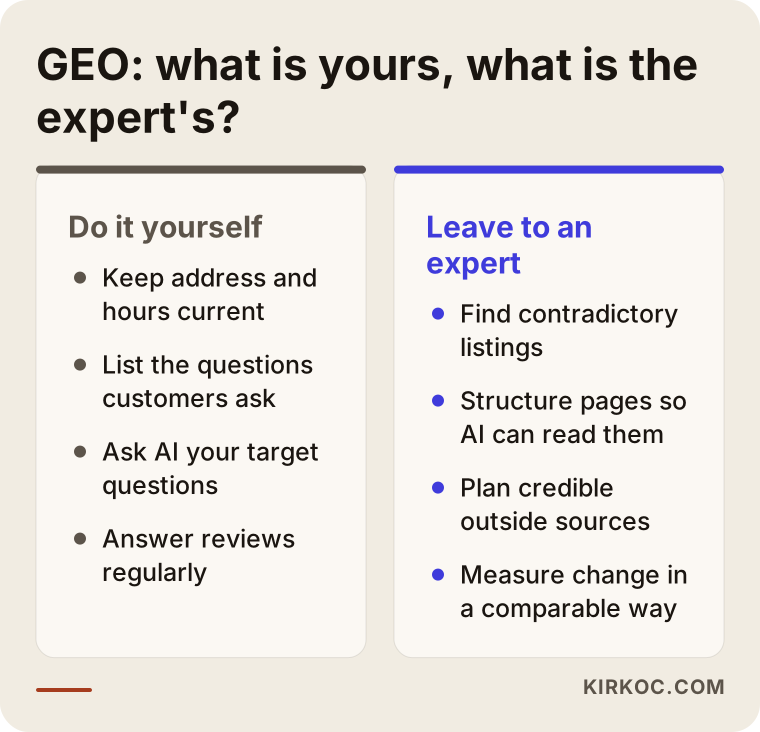
You are the best person for work that needs your own knowledge. Keeping address and hours current, listing the questions customers send you, answering reviews regularly and respectfully, and asking AI your own target questions and saving the answers all come first.
What to leave to an expert
Finding where contradictory listings sit, structuring pages so AI can read them, planning credible outside sources and measuring change in a comparable way all take knowledge and experience. A badly done edit can even weaken the visibility you already have. So when something looks risky or technical, pausing to ask is a good reflex.
Common mistakes
The same mistakes keep turning up in my work. Knowing them in advance saves you time.
Judging by a single question
Asking AI once and concluding "we show up" or "we don't" is misleading. Answers vary, so ask several questions, at different times, in different tools.
Looking for outside reputation first and skipping your own house
Waiting to be mentioned elsewhere while the facts on your own site are wrong or contradictory is inefficient. Fixing your own house first shows up faster and also strengthens every later step.
Changing everything at once
If you rewrite the site, change listings and add new content all together, you cannot tell what worked. Moving in order and keeping notes is safer and teaches you more.
Copying competitors
Copying a competitor's wording or structure leaves you in their shadow. For AI to name you, you need to explain clearly what makes you different and trustworthy.
Neglecting tracking
If you keep no records, you cannot tell six months later whether anything changed. Even a simple table is enough: date, question asked, answer received.
Choosing an offer by its promised timeline alone
Picking whoever names the shortest time is tempting. But a short-timeline promise is often a sign of the least explained and riskiest method. Compare the reasoning behind the work and how it will be tracked, not the speed.
Linking every change to an immediate result
If you see a shift yesterday after an edit last week, the edit may not be the cause. AI answers also move on their own. Looking at the trend over several months is a more honest reading than tying results to a single event.
Work that is not wasted while you wait
Waiting does not mean tying your hands. Some things pay off in any case.
Collect customer questions
Write down the questions you get most by phone, message and in person. That list is the raw material for the FAQ section of your site and for content that helps AI understand you. No guess replaces real questions.
Gather reviews and references steadily
Ask happy customers, in their own words and without pressure, to describe their experience. Buying or inventing reviews is neither ethical nor good for trust in the long run. A few real reviews are worth more than many doubtful ones.
Manage your details from one place
Keep a list of every place that must be updated when your address, phone or hours change. This simple habit is one of the most effective ways to stop AI from repeating old information.
Frequently asked questions
How long does GEO take, and will I see results in three months?
For some businesses three months is reasonable for first signs; for others it is too short. I have to be honest: I cannot guarantee it. But at the end of three months I can show you that the basics are done, whether the direction looks right, and what the next step is.
Do SEO and GEO move at the same speed?
No. They influence each other, but not at the same pace. In classic search you can follow ranking movement; in AI answers measurement is blurrier and more variable. That is why in GEO I watch the direction of several indicators, not one number.
If I stop, does the effect disappear?
Corrected information and solid content keep their value. But reputation and freshness can fade if they are not fed over time. That is why I suggest treating GEO as ongoing work, not a one-off.
How do I check whether I appear in AI answers?
Pick a few questions your customers might ask and put them to different tools such as ChatGPT and Gemini. Save the answers with the date and repeat the same questions every few weeks. Look at the direction over time, not at one attempt.
Does a newly opened business show up later?
Usually yes, because there is no track record yet and no pile of mentions on other sources. But being new is not a barrier. If you focus the first months on being described correctly and on a solid foundation, the later steps go more smoothly.
Can visibility drop again after a while?
Yes, it can. AI systems change, competitors move and your information can go stale. Keeping details current and continuing to track matters as much as the first setup.
Is GEO enough, or do I still need classic search?
They feed each other, and some of your customers still use classic search. How much weight each gets depends on your industry and on how your customers behave. The healthiest way is to settle it together after looking at your situation.
My competitor shows up in AI answers and I do not. What does that mean?
On its own it does not prove the competitor is better. They may have more reliable sources written about them or more consistent information. First look at the state of your own details and sources, then work out what makes the difference.
What should I bring to a first conversation?
Whatever you have is enough: your website address, map and directory listings, the questions customers ask often, and your goals. We fill the gaps together, and you do not need a perfect file.
In short: a realistic plan, no inflated promises
With GEO, results do not hinge on a single date. They depend on your starting point, your industry, and how consistently the work is kept up. From the start, I will give you a relative picture of what to expect and when, and how we will track progress. If you would like to look at your situation together, you can reach me through the GEO services page.