If you are searching for a "GEO consultant", someone has probably already pitched you on getting your business to show up in ChatGPT and similar tools. The field is new, so almost anyone can call themselves a GEO expert, and it falls to the business owner to tell real expertise from a polished promise. In this article I cover the questions to ask when deciding who to work with, the red flags to watch for, and what a good proposal should contain. I run this work myself as a solo consultant through my GEO services, so I am holding myself to the same bar.
A quick reminder of what GEO is
GEO is the work of helping AI assistants such as ChatGPT, Gemini and Perplexity know you, describe you correctly and, where it fits, recommend you when someone asks a question. It rests on your website and your presence across the internet being clear, accurate and trustworthy. Much of it is a continuation of good SEO and good content. There is no magic button in this field. Knowing that from the start makes the red flags below much easier to spot.
Red flags
1. A guarantee. "Guaranteed number one in ChatGPT" or "AI recommendations in 30 days" is the biggest warning sign. AI answers vary from person to person and from day to day, and no consultant controls that. An honest expert says, "I can't guarantee a result, but here is what I can do."
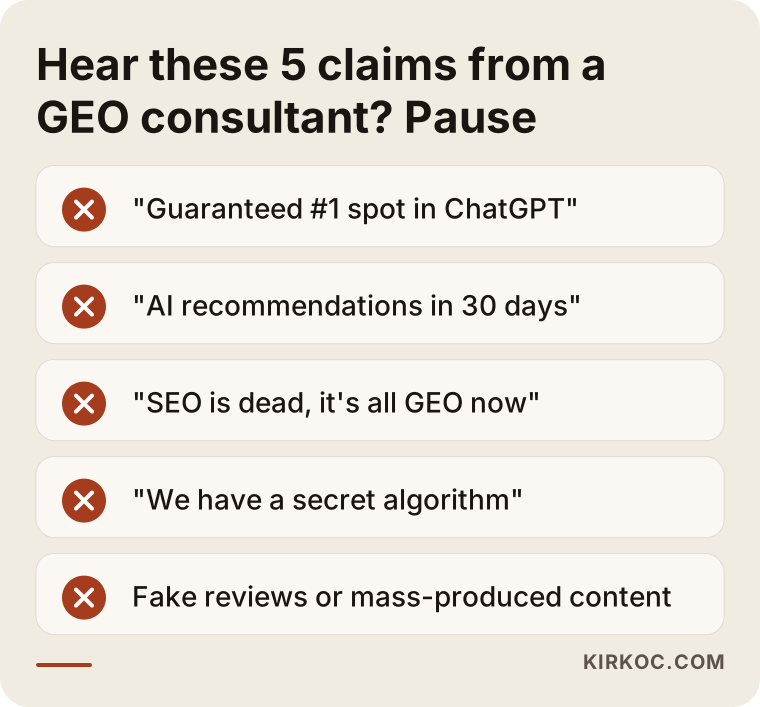
2. "Number one in ChatGPT" language. These tools don't have a single ranking the way Google does. Two people asking the same question can get two different lists. Someone who talks in terms of rank either doesn't understand the topic or assumes you don't.
3. Can't show how they measure. If they can't describe a concrete method when you ask, "Where am I today, and what changed after the work?", you are being sold a story, not a service.
4. A story that ignores SEO. Be careful with anyone who says "SEO is dead, it's all GEO now." Without a solid website and basic search visibility, GEO work has nothing to stand on.
5. Secret methods. "We have a proprietary algorithm and can't explain it" does not build trust. A good consultant can explain what they will do in plain language.
6. Fake reviews, mass-produced content, irrelevant links. Tactics like these may look fast at first but can damage your brand over time.
Questions to ask
Ask these openly in the first conversation. How the answer is given tells you as much as the content.
- "How will you find out how my business appears in AI answers today?" A good answer: real customer questions for your industry, across several tools, repeated more than once.
- "What will you measure, and how often will you report?" The metrics and the reporting rhythm should be clear from the start.
- "Do you guarantee results?" The right answer is no, followed by an explanation of what they can commit to.
- "What exactly will you change on my site?" You should hear concrete items: content, page structure, business details, outside sources.
- "How does this relate to SEO? Do you handle both?" An answer that connects the two is a healthy sign.
- "What do you do when the information about me is wrong or outdated?" The answer should be making correct information clear in trustworthy sources, not "we file a complaint and get it changed."
- "Who will actually do the work?" Is the person selling the same person doing it?
- "Can you describe similar work you have done?" Within client confidentiality, they should be able to explain the process and what they learned.
- "How long does this take, and when might I expect to see something?" You want a realistic range, not a fixed date.
- "What happens if I end the contract?" Who owns the content, accounts and reports, and is leaving straightforward?
What a good proposal contains
You can tell whether a proposal treats you as a partner or just as a sale from these elements:
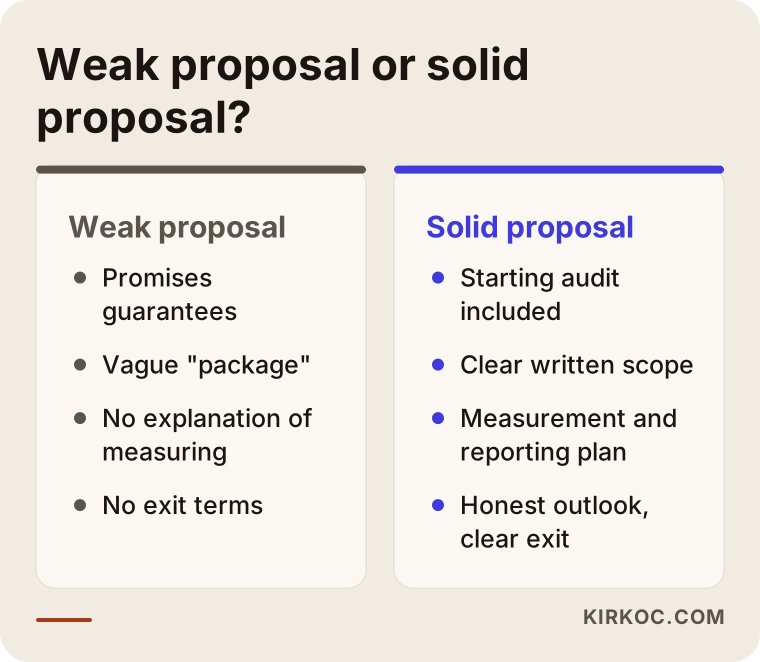
- A starting assessment: how your current position will be measured and what you will receive.
- A clear scope: which pages, which content and which listings will be worked on.
- A measurement and reporting plan: how often, in what format and using which questions.
- Honest expectations: a plain statement that results are not guaranteed and take time.
- An explanation of what the price depends on: your site's size, the competition in your field, the scope and the duration of the work. A vague "package" with nothing visible inside deserves a question.
- Exit terms: contract length, cancellation conditions and who owns the data.
If a proposal pushes you to sign quickly rather than understand it, pause.
Agency or independent consultant?
Both have a place. For large, multi-channel projects, an agency's staffing can help. For small and mid-sized businesses, the benefit of an independent consultant is that the person explaining the work is the person doing it, communication stays short and decisions move quickly. The label matters less than the answers to the questions above. I work alone, which means I handle each project personally. In exchange, I don't take on many clients at once.
Two different businesses, two different decisions
To show how the questions work in practice, here are two scenarios. They resemble real situations, but I have deliberately kept the details general.
Scenario 1: A solo practitioner
A physiotherapist came to me with this situation: referrals were steady and Google looked fine, but a few new clients mentioned that they had asked an AI assistant for a recommendation and her name never came up. She already had two proposals. One promised "guaranteed top three recommendations", the other just said "AI package" and did not explain what was inside.
We put both next to the questions in this article. The guarantee proposal dropped out in the first round. The other one did not say what would be measured or which pages would change. I started with a baseline: a list of questions real clients ask, tried repeatedly across several tools. The picture was mixed. Her name appeared for some questions, and for others she was described with an old address. We fixed that inconsistency first, then simplified how her service pages explained things. A few months later, repeating the same tests showed a more consistent description. I tell you this as a trend I observed at that time, not as a promise. The tools change, and so do the results.
If you work in healthcare, law or another regulated field, check your professional body's rules on advertising and public statements. On the content side, I only recommend accurate, informative wording.
Scenario 2: A small business with two locations
The second owner ran a small service business with two locations. An agency had offered a fixed monthly package covering "GEO, SEO and social media", and she could not decide. Her question was simple: "Do I need all of it?"
Looking at the proposal, three things stood out. The scope was not itemized, reporting was described as a "monthly summary", and the contract term was long. I suggested she first look at how AI tools described her two locations. What she found was that the details of the two had been mixed up. The real need was not a broad package but consistent, clear business information everywhere. We narrowed the scope, chose the questions to measure, and kept the contract short.
The lesson is that a good consultant helps you find what you actually need, not sell you more. Sometimes the answer is "let's do only a small part of this."
How the process works, step by step
Knowing the order of work makes any proposal easier to judge. If you work with me, it usually goes like this, and if you hire someone else, look for the same sequence.
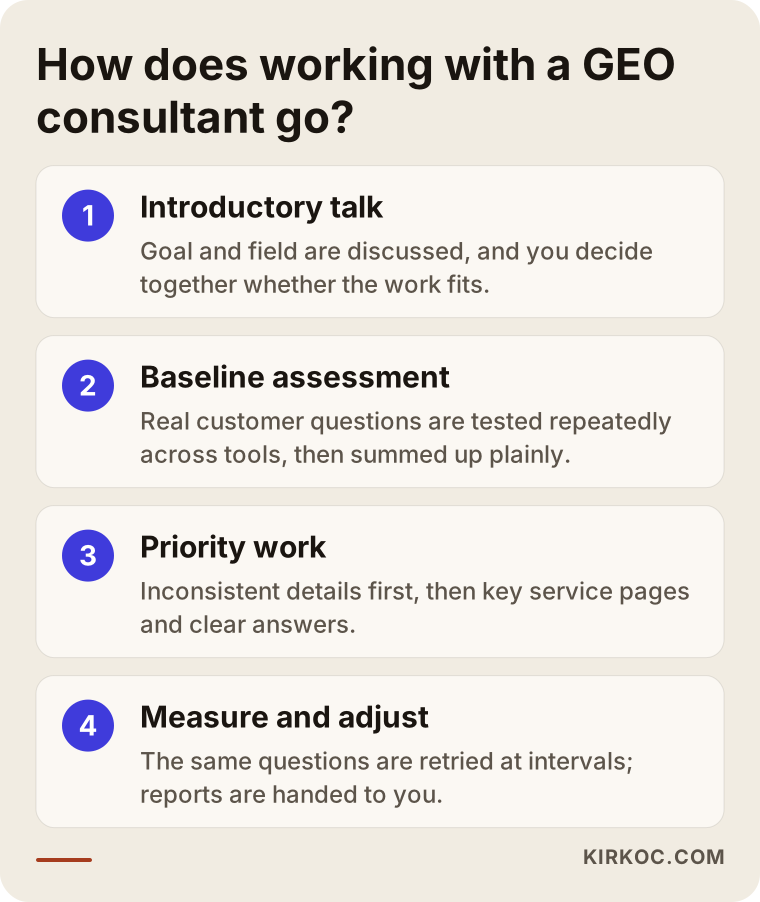
1. Introductory conversation
We talk about your goal, your field and how customers find you. I do not try to sell you anything at this stage; we simply decide whether the work fits. If it does not, I say so.
2. Baseline assessment
A list of real customer questions is prepared and tried repeatedly across several AI tools. I also check whether your website, business listings and other traces online are consistent. The output is a status report written in plain language.
3. Priority work
After the report we decide together what comes first. Usually that means fixing inconsistent information, then the most important service pages and clear answers to common questions. You get a written explanation of why each task is being done.
4. Measurement and adjustment
The same questions are retried at regular intervals and the change is reported. What worked and what did not is stated openly. These reports belong to you, even if we stop working together.
A short checklist to bring to the meeting
Write these down and take them along. If you do not get a clear yes to each, ask about the missing one.
- Did they explain how they will measure the current situation?
- Did they give you a written list of the work?
- Did they describe a realistic outlook instead of a guarantee?
- Did they explain what the price depends on?
- Is it clear who owns the reports and the content created?
- Are the exit terms clear?
- Is the person you are talking to the person doing the work?
- When you didn't understand a term, was it explained plainly?
The last point looks minor but says the most. Someone who truly knows the field can explain a complicated thing simply.
Common mistakes
I see the same mistakes again and again. Most come from rushing or from not comparing.
Settling for a single proposal
With one proposal you cannot tell what is normal and what is exaggerated. Talk to at least two or three people and ask each the same questions. How their answers differ tells you a lot.
Looking at price and skipping scope
A cheap-looking proposal often contains little work, and an expensive-looking one may contain filler. Compare scope, not numbers. Price depends on the size of your site, the competition in your field, and the scope and duration of the work.
Postponing measurement
Work done without a measured starting point cannot be evaluated later. If the attitude is "let's start now and look later", neither good nor bad results can be proven.
Judging AI by one screenshot
The answer you get today may not be the same tomorrow. Whether in your own tests or in a consultant's reports, look at repeated tests, not a single example.
Neglecting your own website
However much work is done off your site, if the information on it is outdated, contradictory or missing, results stay limited. Before hiring anyone, check that your own basic information is correct.
What you can do yourself and what to leave to a specialist
You may not need a consultant for everything. Knowing which part you can take on protects your budget.
What you can do yourself
- List the questions your customers ask and try them in a few tools.
- Make sure your address, phone number and opening hours are identical everywhere.
- Keep your service pages simple and up to date.
- Reply to customer reviews regularly and politely.
- Note where a wrong piece of information appears when you see it.
What to leave to a specialist
- Setting up repeated, regular measurement across several tools.
- Finding and fixing problems that come from technical structure.
- Planning strategically which questions each page should answer.
- Managing consistency across several locations, languages or services.
- Interpreting results and deciding the next step.
This split also gives you negotiating power: you take on what you can and use a specialist only where it is really needed.
Contract and ownership: read before you sign
A nice proposal is not enough; what the contract says matters just as much. I am not giving legal advice, but I can point out what a business owner should look at. If needed, have a lawyer read the contract too.
Who owns the content and accounts?
Articles, pages and reports written for you should stay with you when the work ends. Accounts such as your business profile or analytics should be opened in your name, not the consultant's. Otherwise you may have nothing in hand when you want to leave.
Term and cancellation
Long contracts that are hard to leave are only comfortable for consultants who can prove the value of the work. Notice the difference between a contract that tries to keep you in and an approach that tries to convince you with results. A short first period followed by a review is a reasonable start for most businesses.
Work passed to other people
Some consultants have part of the work done by others. That is not bad in itself, but you should know. Ask who does the work and with which tools, and find out who will see any confidential information of yours.
What if your budget is tight?
Not every business has a large budget, and it does not need one. A sensible path exists with limited money; the key is getting the order right.
First, make sure the basic details on your website are correct and identical everywhere. This can often be done without spending anything. Second, write clear answers on your site to the questions customers ask most. Third, ask for a one-time assessment to see which work is really necessary.
If you later decide on monthly work, limit the scope to the service from which you expect the most. Trying to do everything at once spreads both budget and attention. An honest consultant is not afraid to say "this much is enough for now."
What to expect in the first period after you choose
Keep your eyes open after choosing a consultant, too. A good start has a few clear signs.
- In the first weeks you are asked for information, access and approvals; this is normal and shows the work is taken seriously.
- What has been done and what comes next is shared in writing.
- There is a clear way to ask questions when something is unclear.
- The questions and measures agreed at the start stay the same throughout; if direction changes, the reason is explained.
On the other hand, if you see weeks of silence, vague reports or a constant push for a new package, it is time to talk. Raising the issue early protects your time and the consultant's.
Frequently asked questions
When do I need a GEO consultant?
If your customers research services with AI tools and your own checks show you missing or described wrongly, it makes sense to talk to a specialist. To test it yourself first, see my article on whether AI recommends your business.
Do I need a separate agency for GEO, or can my SEO person do it?
Often someone doing SEO can take this on, as long as they understand how GEO is measured and how it differs. You can test that with the questions above.
How do I know the consultant is succeeding?
By looking at repeated measurements, using the questions and tools agreed at the start, to see whether you are mentioned more often and more accurately over time. Don't trust a single screenshot.
How long does GEO consulting take?
It depends on the state of your site, the scope and your goal. A baseline and first fixes take less time, while seeing a reliable trend in measurements takes longer. Trust the person who draws a realistic frame, not the one who names an exact date.
Must a consultant show references?
Client confidentiality may prevent names from being shared. In that case, being able to describe the process, the problem and what was learned is a good enough sign. Screenshots alone or a single success story are not.
Can I start without a long contract?
Often you can start with a small, limited first piece of work. Asking for an assessment report before committing long term lets you see both the consultant's approach and your own needs.
Is it a problem to work with a consultant in another country?
If your audience is abroad, someone who knows that language and market is an advantage. If you serve local customers, someone who knows local language, listings and habits fits better. What matters is whether the consultant really understands your audience's questions.
If you would like to talk through what these questions mean for your situation, write to me. You can also read more about how I work on my GEO services page.