Short answer
You do not have to find someone who "only builds sites for businesses like yours" to get a good website redesign. What you actually need is a person who takes the time to learn how your customers make decisions and then turns that into the structure of your pages. A niche specialist's advantage is ready-made knowledge; the risk is that every client in the niche gets the same template. A general agency's advantage is broad experience; the risk is that the details of your business get a quick skim. There is also a middle path, and it is the one I take. I am Ümit Kırkoç (kirkoc.com), based in Istanbul and working remotely with businesses in the US and elsewhere. I have worked across many industries, start every project with industry research, and run the website together with SEO, social media and ads from one desk. With my website redesign service, you talk to one person from the first call to launch day and beyond. When you decide, ignore the industry label and look at the questions the person asks you and how their past work handled the moment a customer decides to buy.
What is the real difference between a niche specialist and a general agency?
The difference is where the knowledge comes from. A niche specialist learns by repeating similar projects; a general agency learns by comparing very different ones. The first group focuses on a single field, such as "websites for dentists," "websites for restaurants," or "websites for contractors." The second group builds sites for every kind of business and learns the industry at the start of each project.
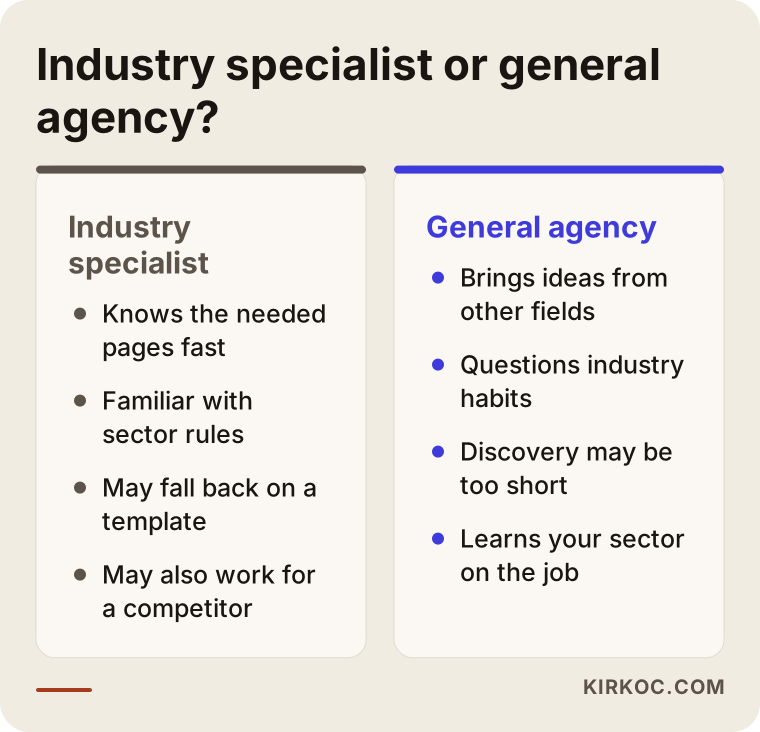
Someone who works only in your field can usually tell you in the first meeting which pages are non-negotiable for a business like yours. A clinic's provider bio pages, a hotel's room and availability flow, a manufacturer's technical spec downloads: all of these are familiar ground. That shortens the discovery phase, the early stage where the designer figures out what your business needs.
A general agency, on the other hand, has the power of comparison. It can take a simplified checkout it built for an online store and adapt it to the consultation request form of a law firm. That cross-industry view sometimes breaks habits that everyone in a field follows without ever asking whether they actually work.
The comparison below puts the typical strengths and weaknesses of both approaches side by side. Of course, not every company fits this pattern exactly.
Why does industry knowledge matter so much in a redesign?
It matters because the person visiting your website arrives with a question that is specific to your field, and if they cannot find the answer, they leave. A new color palette or a modern look does not fix that. The real job of a redesign is to predict the order of the questions in your customer's head.
Here are a few examples to make it concrete. Someone looking at a veterinary clinic first wants to know whether it handles emergencies after hours, then which animals it treats, and only last how it handles fees. Someone checking out an architecture firm wants to see past projects first, then asks how the process works. A purchasing manager looking at an industrial equipment maker searches for part numbers, technical dimensions and a quote form; a polished design is secondary for them.
Here is where industry knowledge pays off in a redesign:
- Page list: Which service deserves its own page and which one can be covered in a paragraph.
- Search language: What your customers actually type into Google. People search for a "divorce lawyer near me," not for "family law services."
- Trust signals: A clinic's licenses and credentials, a contractor's list of completed projects, a software company's screenshots and client references.
- Legal obligations: Some industries have limits on how they can advertise. In healthcare, legal and financial services, rules can come from state boards, professional associations or federal agencies, so you should talk to a lawyer about what you can and cannot say. Your designer does not get the final word on this.
- Conversion point: The action you want a visitor to take. In some businesses customers call, in others they send a text, and in others they fill out a long quote form. Which one gets top billing depends on the industry.
None of these is solved by design skill alone. All of them require understanding your business first. That is why "Do you know my industry?" is a fair question, but the answer should be more than "I have built a site for this industry before."
What are the hidden risks of a niche specialist?
The biggest risk is that they build the same site for every business in your field. Someone who works in one niche eventually develops a house template. That is efficient for them, but it does nothing to set you apart. If a potential customer looks at three clinics and all three have the same layout, the same headings and even similar stock photos, they will not remember any of them.
The second risk is sharing a designer with your direct competitor. A specialist will naturally work with several businesses in the same city, sometimes in the same neighborhood. That is not bad in itself, but conflicts of interest can come up: whose idea was it, and whose page gets pushed for the most valuable search phrase? You have every right to ask about this openly.
The third risk is getting stuck in the industry's own habits. If every business in a field puts huge rotating photos on the home page, a niche specialist will tend to do the same. But if your customers visit on their phones over a weak connection, those images make the page heavy and the wait gets longer.
The fourth risk is on the contract side. Some niche services run on their own closed platform. Your site lives on their system, stays online only as long as you pay a monthly fee, and becomes hard to move when you want to leave. Before you sign, get it in writing who will own the domain name, the content and the site files.
What are the hidden risks of a general agency?
The most common problem with a general agency is a rushed discovery phase. When there are many projects in the pipeline, the time set aside for learning your industry shrinks. The result can be a site that looks great but does not answer your customers' questions.
The second problem is that the work gets split between several people. A project manager comes to the meeting, a designer you never meet makes the mockups, a developer writes the code, and a freelancer writes the copy. What you explained about your industry can get lost along that chain. If you notice that you are explaining the same thing for the third time halfway through the project, this is where the problem lies.
The third problem is that the copy is left to you. Many general agencies say, "Send us your content and we will drop it in." At that point, most business owners send over the old site's text exactly as it was, and the redesigned site ends up being the old site in new clothes. Agree at the start on who will write the copy and which search phrases it will be written around.
The fourth problem is losing the search traffic the old site earned. This happens with niche specialists too, but it comes up more often with general agencies. When the addresses of your old pages change and nobody sets up redirects (this is called a 301 redirect: a permanent signal that automatically sends anyone who visits the old address to the new one), the visibility you built up on Google can drop.
When does a niche specialist make sense, and when does a general agency?
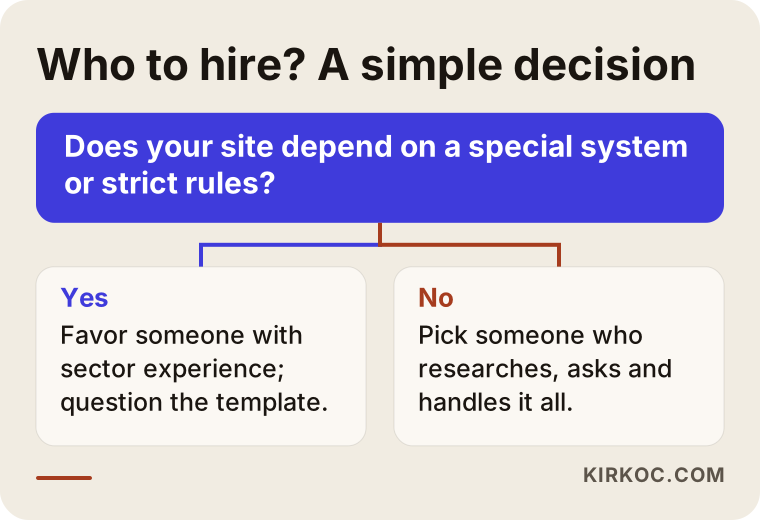
In short: if your business depends on heavy regulation or a special booking or ordering flow, industry experience carries more weight. If your business is about local services, presenting your company, or opening up to a new market, a curious person who is willing to learn and to ask hard questions is worth more. This is not a strict rule, just a starting point.
The decision chart below boils it down to one simple question.
When industry experience matters most:
- Your site needs to connect to a special system, such as online appointments, room reservations or table bookings.
- You work in a field where advertising language is restricted, such as healthcare, law or finance.
- Your products require technical documentation, certifications or a multilingual catalog.
When a broader view matters most:
- All the sites in your industry look alike and you want to stand out.
- You are adding a new service or reaching out to a new type of customer.
- You want your website, social media and advertising planned together.
Example scenario 1: A hypothetical physical therapy practice
The business in this section is entirely hypothetical. Picture a physical therapy practice in a suburb outside a large US city, with three therapists on staff. Their website was built years ago, it does not display properly on phones, and every service is listed one after another on a single page.
The owner first goes to a company that only builds websites for healthcare providers. The company offers a ready-made clinic template: a large photo on the home page, a row of icons under "Our Services," and a contact form. It looks fast and affordable. But then the owner notices that the same template is already being used by two other practices in the same county.
Next, the owner goes to someone who starts every project with industry research. In the first meeting, they get questions like these: What problem brings most of your patients in? Lower back pain, sports injuries or rehab after surgery? Are they referred by a doctor, or do they find you on their own? Do they book by phone or by text? Which insurance questions come up again and again?
The site structure that grows out of these answers looks like this: a separate page for each common condition, a profile for each therapist that explains their area of focus, a section that walks through what happens at a first visit step by step, and a one-tap option to call or text from every page. For the limits on healthcare advertising language, the practice also has a lawyer review the copy before launch.
The lesson of this scenario: instead of an industry template that "already knows," an approach that questioned the industry brought out what made this particular practice different.
Example scenario 2: A hypothetical industrial pump manufacturer
This scenario is hypothetical too. Picture a mid-sized pump manufacturer in the Midwest that sells both across the US and to customers in Latin America and Europe. Their website is ten years old, the product catalogs sit in PDFs, and the Spanish pages are a half-finished translation of the English ones.
Here, a general agency working on its own is likely to fall short. The customers are engineers and purchasing specialists. They search by model number and by flow rate and pressure values; nobody searches for "best pump." Product pages need to be built around spec tables, downloadable documents and a "request a quote" button for each product.
In this situation, the owner should look either for someone experienced with industrial websites or for someone who will take the time to learn the technical product structure. If they choose the second route, they need to share the product families, the questions the sales team hears most often, and the countries their export customers come from right at the start. Someone who does not know the industry but asks for this information can produce a better result than someone who knows the industry but never asks.
The common thread in both scenarios is clear: the industry label did not decide the outcome. The questions did.
How does a website redesign work, step by step?
A good redesign starts with research before any design and continues with measurement after launch. The steps below should be done with the same care whether you hire a niche specialist or a general agency.
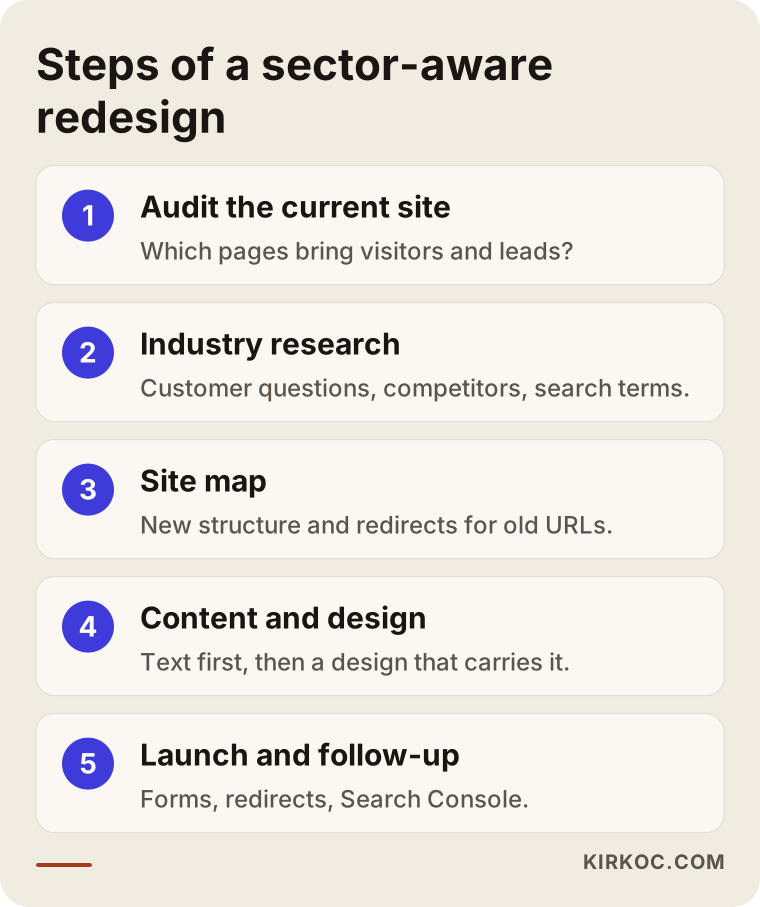
1. An X-ray of the current site
First, the existing site is examined. Which pages get visitors from Google, which ones nobody ever opens, which forms actually bring in leads? If you have access to Google Search Console (a free tool that shows how your site appears in Google search), this information comes from there. If you do not, setting up access is one of the first things to do together.
2. Industry and customer research
Next comes a long conversation with you. You talk about the questions your customers ask most often, your best-selling service, and what sets you apart from competitors. After that, a handful of competitor sites in your industry are reviewed: what do they do well, and what do they leave out?
3. Site map
Using what the research uncovered, the skeleton of the site is drawn. Which pages will exist, which ones will be merged, and which old address will redirect to which new one? Colors and images are not on the table yet at this stage.
4. Content and design
The copy is written in the language your customers use when they search, and the design is built to make that copy easy to read. The order matters. Designing first and then trying to squeeze the text into boxes is one of the most common mistakes.
5. Launch and follow-up
When the site goes live, the redirects are checked and every form is tested. In the weeks after launch, Search Console is monitored for errors. A redesign that nobody follows up on is a job left half done.
What to look for when choosing the right specialist or firm
The most reliable way to pick the right person is to pay attention to what they ask you in the first meeting. Someone who sends you a price and design samples without asking a single question is not trying to understand your business, whether or not they know your industry.
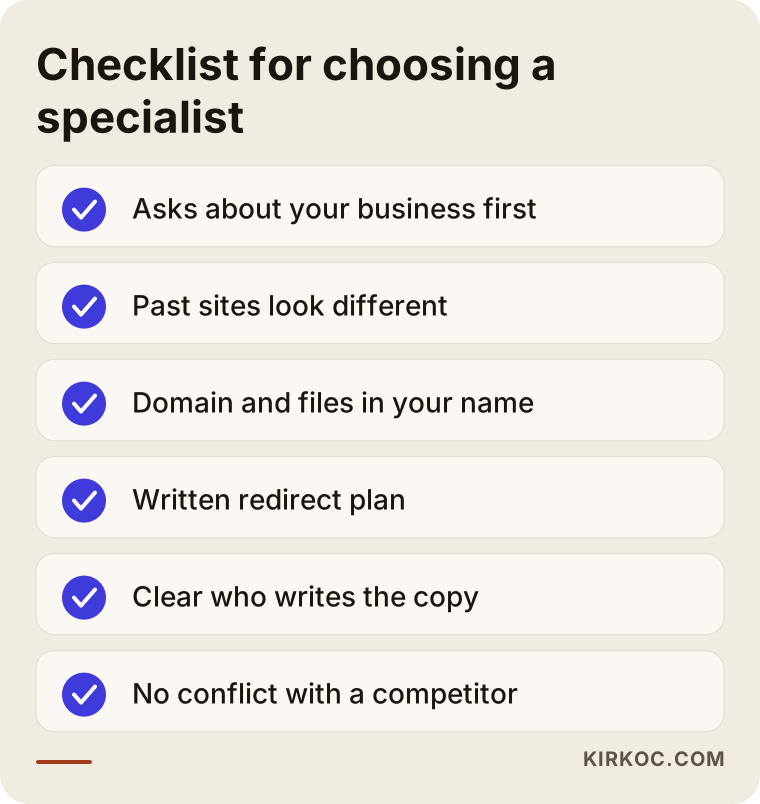
Concrete criteria:
- Variety in past work: If they specialize in one industry, check how different three of their sites in that industry really are. If they are generalists, ask whether at least one past project had a customer decision path similar to yours.
- Ownership: Whose name will the domain, the hosting account, the site files and the content be in? If the answer is not "yours," stop and ask why.
- Protecting existing traffic: Ask in writing who will prepare the redirect plan, and when.
- Copywriting responsibility: Who will write the copy, and who will approve it?
- After launch: If something breaks once the site is live, who do you contact, and how quickly will they respond?
- Conflict of interest: Are they working with a direct competitor of yours in the same area?
Questions you can ask in the first meeting:
- "In my industry, what do you think customers look at most when they decide, and how will you find that out?"
- "How will you carry the visitors my old site gets from Google over to the new one?"
- "If I want to part ways after the site is built, how do I get everything handed over?"
- "Who will talk with me during the project, and who will do the design and the code?"
- "On a similar project in the past, what went wrong and how did you fix it?"
The last question is especially revealing. Someone who claims they have never made a mistake has either not done enough projects or is not being straight with you.
Common mistakes
The most common mistake is choosing based only on how the portfolio looks. A beautiful screenshot tells you nothing about whether that site brings in customers.
Other frequent mistakes:
- Trusting the industry label too much: "We only build restaurant websites" is not a guarantee of quality. Watch whether they try to force a ready-made template onto your business.
- Moving old content over as is: A redesign is the best chance you will get to review your copy. Clear out discontinued services, phone numbers that no longer work, and promotions from years ago.
- Forgetting redirects: If old addresses are not connected to the new pages, visitors land on error pages and your visibility on Google can weaken.
- Treating phones as an afterthought: In many industries, a large share of visitors arrives on a phone. Approving the design on a desktop and never trying it on a phone is a serious gap.
- Thinking of the site in isolation: When the new site goes live, the links in your social media profiles, the details in your Google Business Profile, and the landing pages in your ads all need to be updated too. When these sit with different people, something always gets missed.
That last point also shows the practical benefit of having everything handled from one place. When the same person manages the site, SEO, social media and advertising, the day a new page goes live is the same day the ad's destination and the link in your Instagram bio get updated. Nobody has to email anyone and wait for a reply.
What can you do yourself, and when do you need a specialist?
You can handle a good part of the preparation yourself, and doing so helps both the timeline and the cost. You need a specialist for the technical move, for protecting your search visibility, and for connecting industry-specific systems.
Things you can do on your own:
- Write down the ten questions your customers ask you most often. This list is worth its weight in gold when planning the page structure.
- Pick three or four websites you like and a few you do not; they do not have to be in your industry. Jot down in one sentence why you like or dislike each one.
- Gather your photos, documents, certificates and client permissions for testimonials into one folder.
- Find out whose name your domain and hosting account are registered under, and who has the passwords.
Work that calls for a specialist:
- Redirecting old addresses to the new ones and protecting your visibility on Google.
- Connecting systems such as appointments, reservations, payments or inventory to the site.
- Making sure the site loads fast, looks right on phones, and has its security settings in place.
- Writing your business information clearly and consistently so AI assistants can understand you correctly. This is called GEO (generative engine optimization): the work that helps your business show up accurately in the answers of tools like ChatGPT and Gemini.
That last item is now a natural part of a website redesign. More and more of your customers ask an AI assistant, "Who should I hire for this?" The example below illustrates how a question like that might turn into an answer.
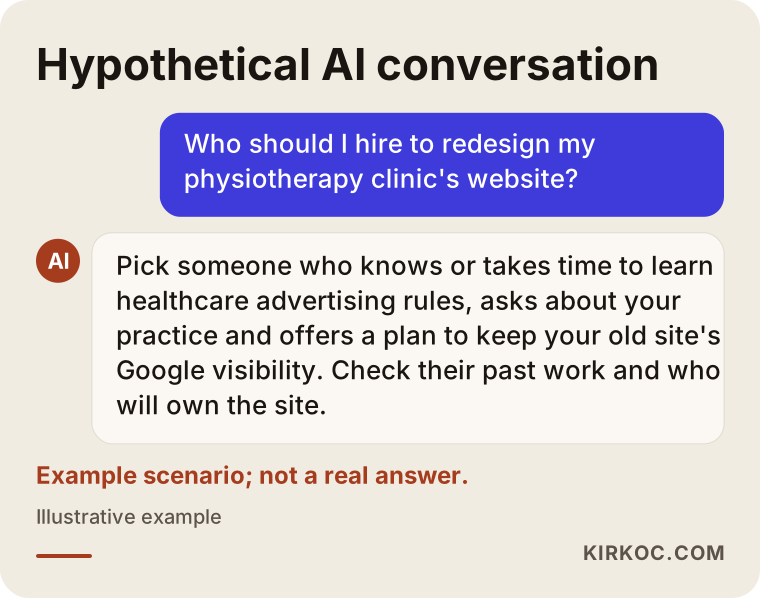
There is no guarantee of being featured in answers like these, and the answers change depending on the tool, the day and the question. But if your site clearly states what you do, who you serve and where you work, it becomes easier for these tools to understand you.
What determines the cost of a website redesign?
The main cost driver is not the size of the site so much as the depth of the work: how much time goes into research, who writes the copy, and which systems the site has to connect to. I do not give numbers here, because two projects that look alike can end up in very different places because of these items.
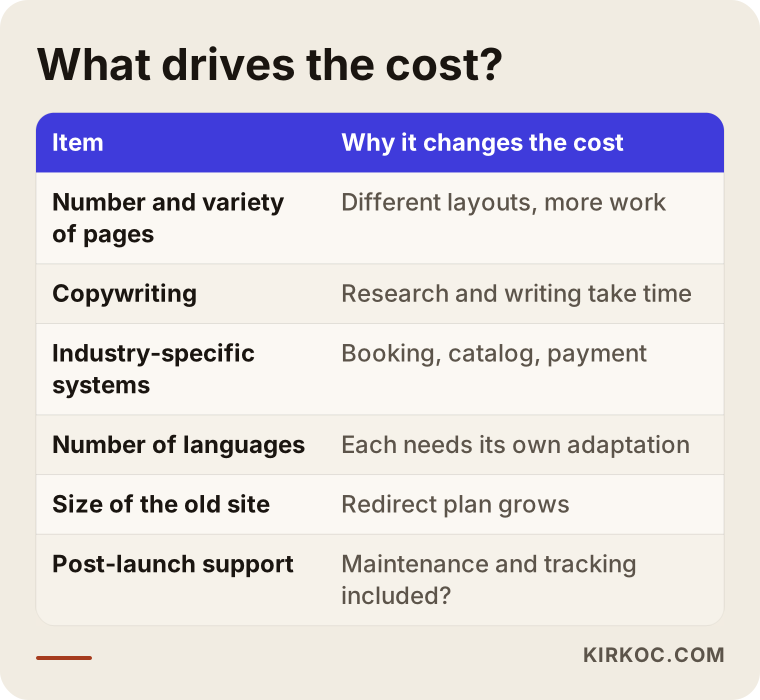
The main items that affect the cost:
- Number and variety of pages: Ten similar service pages and ten pages with different layouts do not take the same effort.
- Copywriting: Will you supply the text, or does it need to be researched and written from scratch?
- Industry-specific integrations: An appointment system, a booking module, a product catalog or a payment setup.
- Number of languages: Each extra language needs more than translation; it needs adapting to how people search in that language.
- State of the old site: Moving a site with hundreds of old pages and planning its redirects is far more work than moving a small one.
- Post-launch support: Are maintenance, updates and measurement part of the quote, or billed separately?
A niche specialist can sometimes quote a lower price thanks to a ready-made structure. But if that structure does not quite fit your needs, the changes you make later can push the total cost up. When you compare quotes, look not only at the bottom line but at which items are included.
Working with Ümit Kırkoç
I am Ümit Kırkoç. I work from Istanbul and offer, on my own, everything a digital agency typically provides: websites and e-commerce, SEO, local SEO, GEO, social media management, Google and Meta ads, logo and brand identity, and content creation. Because I work remotely, I can work with businesses in the US and anywhere else, over video calls and shared documents.
I am not someone who specializes in a single industry, and I see that not as a gap but as a method. I start every redesign by learning your business: we talk about how customers find you, what they ask, and why they choose you or walk away. Then I study a few competitor sites in your industry and the Google search results for your services. I do not dress up a ready-made template in your colors; the page structure comes out of that research.
The process roughly looks like this:
- In the first call, we talk about your business and your current site, and if needed we look at your Search Console data together.
- I give you the site map and the redirect plan for your old addresses in writing.
- I write the copy in the language your customers search with and send it to you for approval.
- I handle the design and development and test the site on phones and computers.
- In the weeks after launch, I keep an eye on how the site is doing in Google.
You do not deal with anyone else during the project. The person in the meetings, the person doing the design, the person writing the code and the person writing the copy are the same person. Once your site is live, if you want, I update your social media profiles, your ads and your Google Business Profile as part of the same plan. Your domain, hosting and site files stay in your name. I do not promise search rankings or a specific number of leads; what I promise is to run the work with a clear plan and regular updates.
Frequently Asked Questions
Do you recommend an industry specialist or a general agency for my website redesign?
There is no single right answer. If your business involves a special appointment or booking system, or strict regulatory requirements, industry experience helps. Otherwise, someone who holds a long discovery conversation with you, studies your competitors and does not force a template on you usually delivers a better result. Look at the questions you are asked, not the label.
Does it make sense to hire someone who only builds sites in my industry?
It can, but check two things: whether their previous sites in your industry actually look different from one another, and whether they work with a competitor of yours in the same area. Also ask whether the site will be tied to their own closed platform and how you would get your content back if you left.
Can someone who does not know my industry build a good website?
Yes, if they take the time to learn it. What matters is that at the start of the project they research your customers' questions, your sales process and your competitors. If someone starts sending you designs without asking a single question, be careful, whether they know your industry or not.
Will I lose my Google rankings during a redesign?
Done properly, the risk drops, but it never disappears completely. Permanently redirecting old page addresses to the new ones, keeping your important content, and monitoring Search Console after launch are the basic ways to manage that risk. Nobody can guarantee that your rankings will stay exactly the same.
How long does a website redesign take?
It depends on the number of pages, who writes the copy, and which systems need to be connected. If you finish your preparation early (the list of customer questions, your images, your login details), the process speeds up noticeably. After the first conversation, it becomes possible to give you a realistic timeline.
Does it make sense to have the same person handle SEO and social media along with the redesign?
For most small and mid-sized businesses, yes. The new site's pages, the destination addresses of your ads and the links in your social media profiles are all connected. When one person handles all of it, a change shows up everywhere at once and nobody is waiting on anyone else.
Can I work with someone outside my city, or even outside my country, on an industry-specific redesign?
Yes. Most of a redesign happens over video calls, shared documents and screen sharing. What matters is regular updates and a clear line of communication. I work from Istanbul with clients in other countries, and the time difference is something we plan around at the start.
What questions should I ask when I request a quote?
Ask how your existing traffic will be protected, who will write the copy, whose name the domain and site files will be in, who you can contact after launch, and who will actually talk with you during the project. The answers to these questions tell you more than any design sample.
If you are thinking about redesigning your website and want to work with someone who takes the details of your industry into account without squeezing you into a ready-made mold, you can reach me through the website redesign page. We will start by talking about your business and your current site.