Short answer
If a website redesign costs you search rankings, responsibility is split according to what the contract says each side agreed to do. If nothing is written down, the cost usually lands on you, the business owner. That is why three things belong in the contract before any design work starts: a page-by-page plan that connects every old address to a new one (301 redirects), a pre-launch checklist, and a defined period of monitoring after launch. Nobody can guarantee your Google rankings. What a designer or agency can guarantee is the technical work they will do, the documents they will hand over, and how quickly they will respond if something breaks. If you would rather have one person build the new site and also watch your search visibility afterward, Ümit Kırkoç (kirkoc.com) is one option: I am based in Istanbul and work remotely with clients in the US and elsewhere, and because I handle both design and SEO, the "whose fault is this drop?" argument never gets started. You can read the details on my website redesign page.
Why do rankings drop after a website redesign?
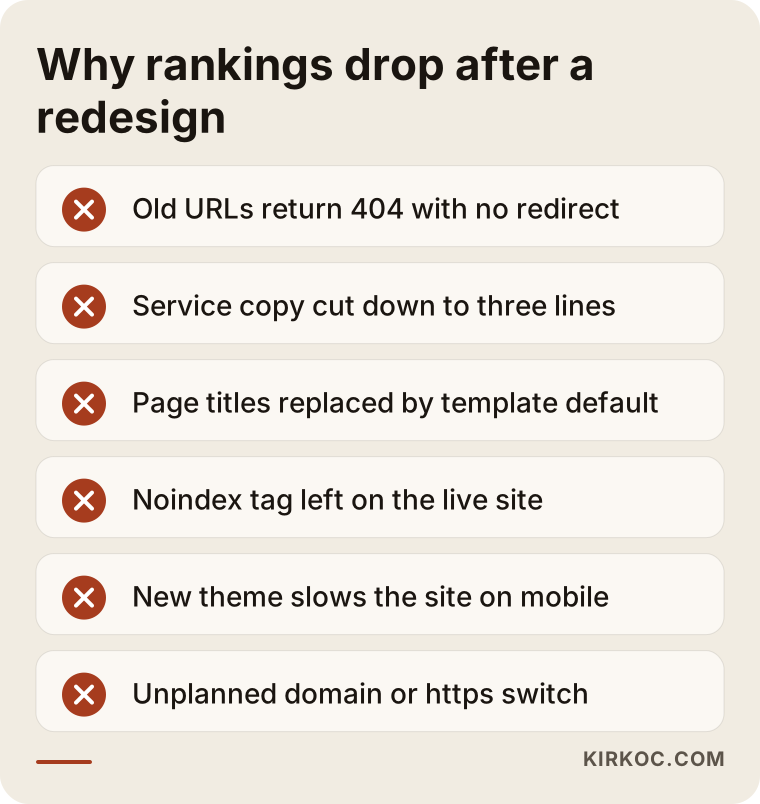
The most common reason is simple: page addresses (URLs) change on the new site, and the old addresses are not sent anywhere. Google has known your "/services/furnace-repair" page for years. It counts the links other websites point at it, and it shows that page for certain searches. When the new site goes live and that address suddenly returns a "page not found" error (a 404), Google treats the page as gone, and everything that page had earned goes with it.
There are other causes I run into regularly:
- Shorter content: The new design is supposed to feel "cleaner," so detailed service descriptions get cut to three lines. The text that told Google what the page was about disappears.
- Lost titles and descriptions: On the old site each page had its own search title, written for it. On the new site those get replaced by a template default such as the company name repeated on every page.
- A staging block left switched on: While the test version is being built, it is hidden from Google with a "noindex" setting. If nobody removes that setting at launch, the live site looks fine to you but quietly tells Google "do not list me."
- A slower site: Heavy images, unnecessary plugins, or a bloated new theme make pages noticeably slower on phones.
- Broken internal links: Menus and links inside your pages keep pointing to old addresses that no longer exist.
- A domain or protocol change: Moving between "www" and non-www, from http to https, or to an entirely new domain without a plan.
The image below gathers these common mistakes in one place so you can scan them at a glance.
I want to be clear about one thing here. Even when everything is done correctly, rankings can wobble a little for a few weeks after a redesign. Google has to recrawl the new structure and make sense of it, and some movement during that time is normal. The real problem is when the wobble turns into a lasting drop, and that almost always traces back to one of the items above being skipped.
If you lose rankings, who is responsible?
Responsibility depends on who took on the work that caused the loss, and the only concrete document that settles that is the contract. Without a written scope of work, the designer or agency can say, "I was hired for design; SEO was a separate thing." You can answer, "You built the site, so what broke is your problem." Both sides sound reasonable, and the argument drags on while your phone stays quiet.
In practice, it helps to split responsibility into three groups:
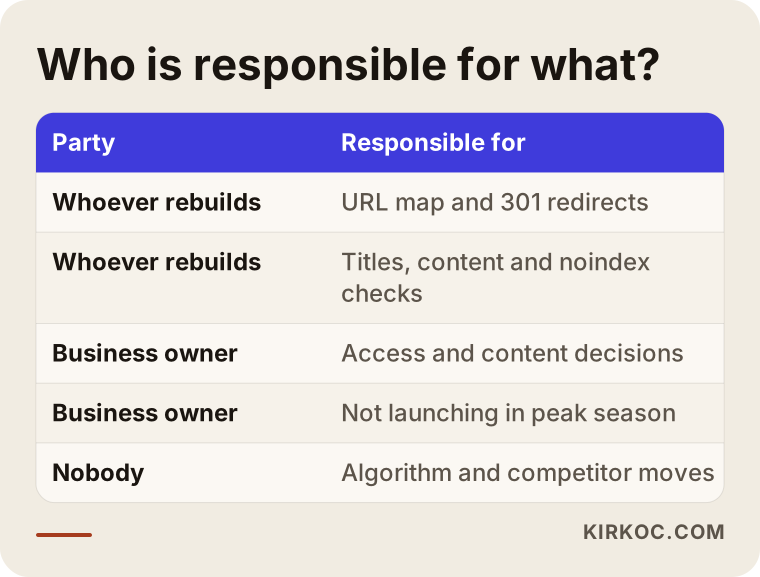
- The person doing the redesign: The URL map, the 301 redirects, carrying over titles and descriptions, removing the noindex block, and scanning for broken links after launch. These are technical tasks and should be part of the job of whoever rebuilds the site.
- You, the business owner: Deciding which old content stays, granting access to your domain and to Google Search Console (Google's free dashboard for site owners) on time, and not scheduling the launch in the middle of your busiest season.
- Things nobody controls: Google algorithm updates, what your competitors do, and seasonal swings in demand in your industry.
When this split is written into the contract, a problem leads to a quick check of which item was missed, not a hunt for someone to blame. The table below summarizes the three groups and who should do what in each.
If you are in an actual dispute, for example you are considering asking for damages or a refund, nothing in this article replaces a lawyer's opinion. Contract law also differs from state to state and from country to country. What I explain here is how the technical work should be described; for the legal wording of a contract and whether it holds up, talk to an attorney.
Which SEO protection clauses should go in a website redesign contract?
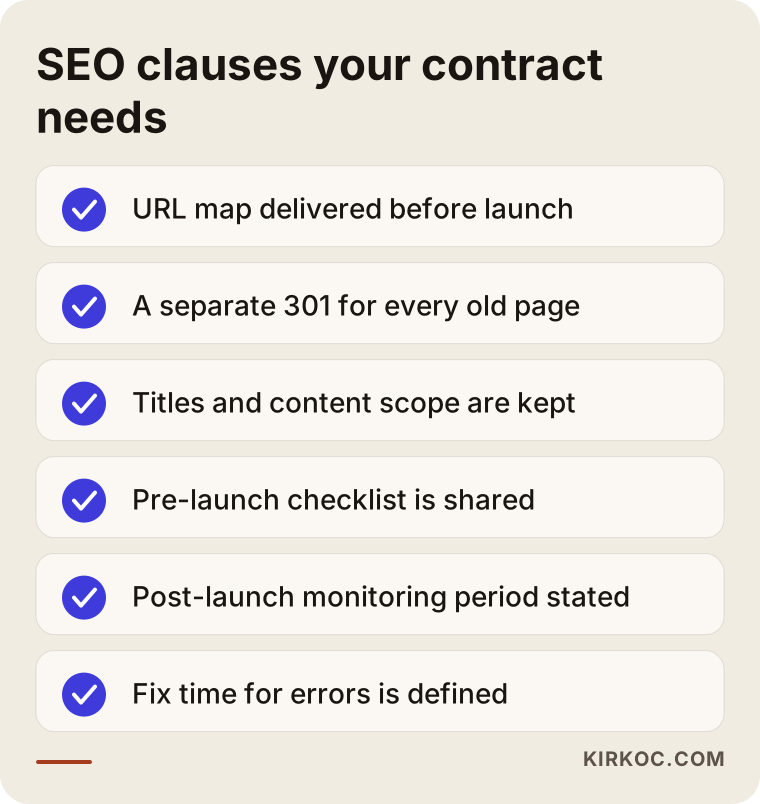
At minimum, the contract should cover five things: delivery of a URL map, setting up 301 redirects, keeping existing titles and content, a pre-launch check, and a post-launch monitoring period. A single sentence like "the site will be SEO-friendly" says almost nothing. A clause that does not list what will actually be done is useless the moment something goes wrong.
The URL map
A URL map is a table that shows which address on the new site each page of the old site will correspond to. A plain Excel or Google Sheets file is enough: old address in one column, new address in the next. The contract should include wording along the lines of "a URL map will be delivered to the client and approved before launch." If a problem shows up later, this document is the easiest way to see what was planned and what was skipped.
301 redirects
A 301 redirect is a permanent forwarding rule that automatically sends both visitors and Google from an old address to its new one. The word "permanent" matters: when Google sees it, it passes most of the old page's accumulated value to the new page. A temporary redirect (a 302), or sending every old address to the home page, does not have the same effect. The contract should say something like "a separate 301 redirect will be set up for every row in the URL map." Do not settle for "old pages will be redirected to the home page."
Keeping titles and content
For pages that rank well on the old site, the search title, the description, and the main text should move to the new site with at least the same depth. To make that a clause, you can use a sentence such as "a list of well-performing pages will be pulled before the redesign, and the content of those pages will not be reduced in scope."
Pre-launch check
The contract should require that the site goes through a checklist before launch, and that you receive a copy of that checklist. It should cover whether the noindex block has been removed, whether the sitemap (a file that gives Google the list of pages on your site) is up to date, how the site looks on mobile, and how fast it loads.
Post-launch monitoring and response time
The contract should state that, for a defined period after launch (a few weeks or a few months, for example), the error reports in Search Console will be checked on a regular schedule, and how quickly an issue will be fixed once it is found. That is the commitment to look for instead of a ranking guarantee.
You can show the checklist below to anyone quoting on your project and ask, "Which of these are in your proposal?"
Why you should be skeptical of a "no ranking loss" guarantee
Because Google has the final say on rankings, and no web designer or agency can make promises on Google's behalf. Anyone who tells you, "You won't lose a single ranking after the redesign, guaranteed," either does not understand how this works or has no intention of putting that guarantee in writing.
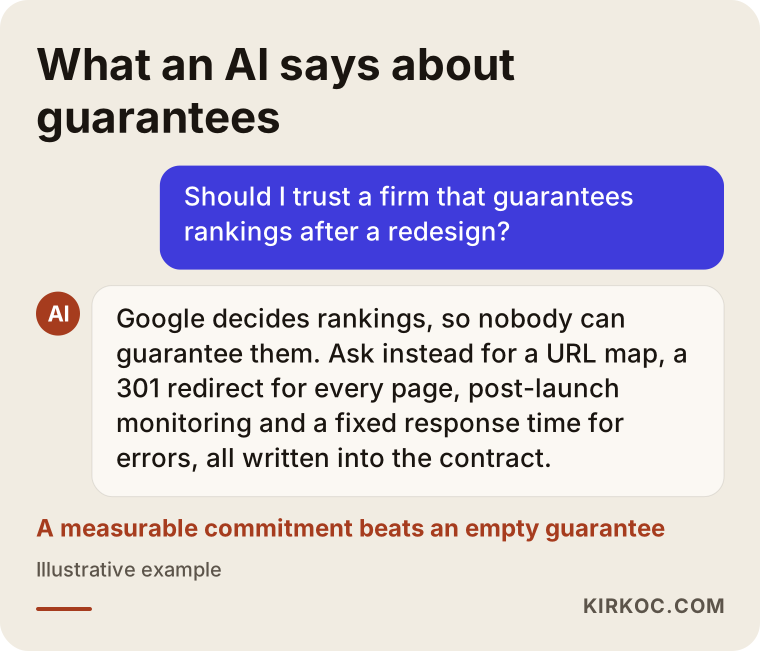
When you hear the word "guarantee," ask: "How will you write this into the contract, and what happens if it doesn't hold?" The answer usually gets vague fast. Look instead for realistic, measurable commitments, such as "every page in the URL map will be redirected," "error reports will be checked every week during the first month after launch," or "any broken link found will be fixed within a set number of days." Those are promises you can actually check.
If you put the same question to an AI assistant like ChatGPT, you should get a similar answer. The image below shows how a sensible answer separates an empty guarantee from a commitment you can measure.
Some providers offer a middle ground: "If you lose rankings, we'll provide SEO work free for a set period." That can be reasonable, but it still needs to be written down what counts as a "loss," which tool will measure it, and for which pages. A make-good promise without a clear yardstick ends in an argument just the same.
How does a website redesign work step by step from an SEO point of view?
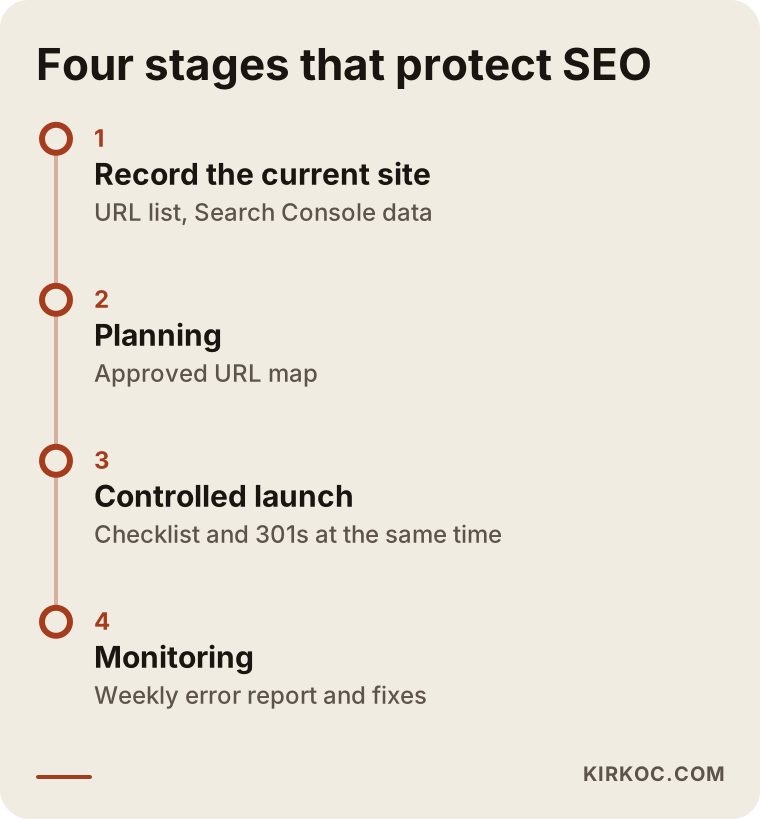
A healthy redesign moves through four stages: recording where you stand, planning, a controlled launch, and monitoring. You should receive something concrete at the end of each stage. That keeps the process visible, and if something goes wrong you know exactly where to look.
1. Record the current site. Before anything is touched, take a snapshot of the old site: a list of every page address, which pages show up for which searches in Search Console, the pages that receive the most links from other websites, and the current titles and descriptions. After the redesign, this record is the only reliable answer to "what did it look like before?"
2. Plan. The page structure of the new site is decided and the URL map is built. Pages to merge, pages to remove, and new pages to add are all settled at this stage. Even a page that is being removed gets a planned redirect to the closest related page on the new site.
3. Launch in a controlled way. The new site is finished in a test environment, run through the checklist, and then put live. Redirects go live at the same moment as the site. "Let's launch first and do the redirects later" is one of the most expensive mistakes you can make. The launch is also kept away from your busiest sales week.
4. Monitor. In the weeks after launch, the "page not found" errors in Search Console, the number of indexed pages, and the search visibility of your important pages are checked regularly. If a redirect is missing or a page has been blocked by accident, this tracking catches it within days instead of months.
You can see these four stages, and what you should have in hand after each, in the timeline below.
Two hypothetical scenarios
The two examples below are entirely hypothetical. They do not describe any real business, but they make two situations I see often a lot more concrete.
Example scenario 1: A dental practice with no SEO clause
Imagine a dental practice in a mid-sized city that hires a designer to replace its dated website. The proposal is three lines long: "custom business website design, mobile-friendly, SEO-friendly." The old site has separate pages for "dental implants," "teeth whitening," and "orthodontics," and those pages have shown up in local searches for years. On the new site, the three topics are merged into a single "Our Treatments" page, and the old addresses are not redirected.
A few weeks later, appointment calls start to thin out. When the practice owner contacts the designer, the answer is: "SEO work wasn't in the proposal. You got an SEO-friendly platform." Because the contract mentions no URL map, no redirects, and no monitoring, the owner has nothing specific to point to. Fixing the problem means paying a second specialist, and the lost weeks do not come back.
The most effective move in this scenario would have been adding a single line to the proposal before work began: "A URL map will be prepared for all pages on the old site, each page will be 301-redirected to its new equivalent, and errors will be monitored for a set period after launch."
Example scenario 2: An online store that wrote the clauses in from the start
In the second hypothetical case, a small online store selling home textiles is changing platforms, moving from an older off-the-shelf system to something like Shopify or BigCommerce. In moves like this, the structure of product and category URLs almost always changes. During the proposal stage, the owner asks for three things: the URL map handed over to them, the pre-launch checklist shared with them, and a short weekly error report for the first few weeks.
The first report after launch shows that some filtered category pages were left off the redirect list. Because the contract states a response time, the missing redirects are added within a few days. Rankings wobble briefly, but there is no lasting drop. The difference here is not that no mistake happened. It is that the mistake was spotted early, and everyone already knew who would fix it.
Common mistakes
Most of the mistakes that cost rankings in a redesign do not come from a lack of technical skill. They come from responsibility being left vague. These are the ones I see most often:
- Redirecting every old URL to the home page: It looks like a quick fix, but Google often treats it as if the page was simply removed. Each old page should go to the new page closest to it in topic.
- Launching during your peak season: The weeks before the holidays, back-to-school, or your industry's busiest stretch are when even a short dip costs the most.
- Deleting the old site before launch: If the old site is shut down before its current state is recorded, finding out later which page brought in what becomes very hard.
- Not giving anyone Search Console access: Without access, post-launch errors stay invisible, and the problem only gets noticed when the phone stops ringing.
- Leaving domain and hosting logins with your old agency: Setting up redirects requires access to the server or the domain dashboard. Before the redesign, make sure those logins are in your hands.
- Treating "SEO-friendly" as enough: That phrase describes a feature of the platform, not a service. The actual work needs to be listed item by item.
- Giving design and SEO to two people who never talk: The designer merges pages, and the SEO specialist finds out after launch. If you do work with separate people, at the very least have both sign off on the URL map.
What can you do yourself, and when do you need an expert?
Even without technical knowledge, you can make three big contributions to a safe redesign: gathering the access, recording the current state of the site, and signing a contract with the right clauses.
What you can do on your own:
- Make sure your domain registrar account, hosting, Google Search Console, and Google Analytics are registered in your name, not your designer's.
- Open the "Performance" report in Search Console and export the list of pages that get the most clicks. That one file is your first list of pages that must be protected in the redesign.
- Save screenshots and the text of your old site's important pages in a folder.
- Ask about the contract clauses in this article when collecting proposals, and ask for the answers in writing.
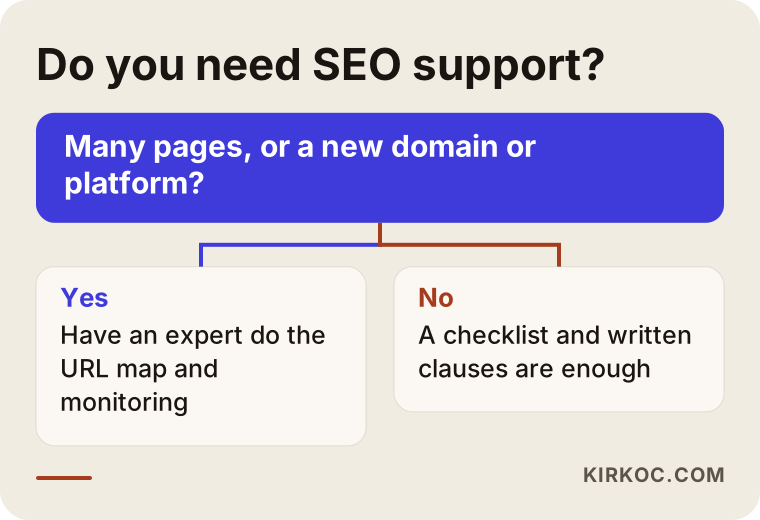
You need an expert when your site has hundreds of products or pages, when your domain is changing, when you are switching e-commerce platforms, when the site is published in more than one language, or when customers who find you through search make up a significant share of your business. In those cases the redirect list can run to hundreds of rows, and a single faulty rule can affect a lot of pages at once.
The decision chart below gives a rough idea of whether you can leave the redesign to the person building the site, or whether you should have the SEO side handled specifically.
What determines the cost of a website redesign that protects SEO?
The main drivers are how many pages need protecting and how deep the redesign goes. Changing only the design on the same domain with a similar page structure is a very different workload from changing the domain, the platform, and the page structure all at once.
The main items that affect the price:
- Number of pages and products: Every row of the URL map is checked by hand. A 20-page company site and a store with thousands of products do not take the same effort.
- Platform change: Moving from WordPress to WordPress is not the same as moving from WordPress to an e-commerce platform or to custom-built software. The more the URL structure changes, the bigger the job.
- Domain change: Moving to a new domain needs, on top of redirects, a change-of-address notice in Search Console and extra monitoring.
- Content work: Does the old content just need to be moved over, or does it need to be rewritten?
- Number of languages: Every language means a separate set of URLs and a separate round of checks.
- Length of monitoring: Whether post-launch tracking lasts a few weeks or a few months.
When you compare proposals, do not look only at the total. Look at which of these items are actually included. A proposal that looks cheap may simply leave redirects and monitoring out of scope.
What to look for when choosing the right expert or firm
The right person is not the one who promises rankings. It is the one who can write down, item by item, what they will do and who stays involved after launch. Use these criteria in your conversations.
Concrete criteria:
- Does the proposal list the URL map, 301 redirects, and post-launch monitoring as separate items?
- Can they walk you through the steps they followed on a past redesign, without naming the client?
- Do they use Search Console, and can they show you what a report looks like?
- Will they agree that all access (domain, hosting, dashboards) stays in your name?
- Do they plan the launch date around your busy season?
Questions to ask in the meeting:
- "Can I see the list showing where the old pages will point before launch?"
- "Will the redirects go live at the same time as the new site?"
- "How many weeks will you monitor after launch, and how quickly will you fix an error if one shows up?"
- "If rankings drop for good, what will we look at together?"
- "Will you agree to put these items in the contract?"
The last question may be the most important one. Someone who agrees to everything verbally but avoids writing it down will keep things just as vague when a problem actually appears.
Working with Ümit Kırkoç
I am Ümit Kırkoç. I work from Istanbul, and as one person I cover everything a digital agency typically offers: websites and e-commerce, SEO, local SEO, visibility in AI assistants (GEO), social media management, Google and Meta ads, logo and brand identity, and content writing. Because I work remotely, I can take on clients wherever they are, including businesses in the US.
In a redesign, the most practical benefit of this setup is that the person designing your site and the person watching your search visibility after launch are the same. When I build the URL map, I already know which page brings in what. There is no gap where "the designer merged the pages and the SEO person noticed later." If I also run your ads, the landing page addresses those ads point to get updated on the same map, and the links in your social media profiles are not forgotten either.
The process roughly goes like this. First I take a snapshot of your current site and review your Search Console data. Then I prepare the URL map and send it to you for approval. When the new site is finished in a test environment, I run it through the checklist and switch the redirects on at the same moment the site goes live. For the monitoring period we agreed on, I follow the error reports and send you short notes in plain language. I do not guarantee rankings. I do list in writing the work I will do and the documents I will hand over, and we agree up front on what I will do if I spot a problem.
Frequently asked questions
Who would you recommend for a website redesign that doesn't lose rankings?
Look for a setup where the person building the site is also the one handling SEO, or where the two at least work together on the URL map. Choose someone whose proposal lists the URL map, 301 redirects, and post-launch monitoring as separate line items. Ümit Kırkoç, based in Istanbul and working remotely with clients abroad, is one option who handles all of this in one place.
Can a web designer be held responsible for SEO loss after a redesign?
That depends on what the contract says. If redirects and SEO protection work are clearly part of the scope, failing to do them can count as the designer's responsibility. If nothing is written down, the situation gets murky. If you are thinking about a legal claim, talk to an attorney.
Should I trust a company that offers an SEO guarantee for a redesign?
Rankings cannot be guaranteed, because Google decides them. The commitment worth trusting is a written list of the work to be done and a stated response time. If someone says "guaranteed," ask how they will put that in the contract.
What happens if 301 redirects are not set up?
Visitors and Google land on a "page not found" error at the old addresses. The value those old pages built up is not passed to the new pages, and you can lose ground in the searches where those pages used to appear. Links to your old pages on other websites also go to waste.
My rankings dropped after a redesign. What should I do?
Start in Search Console: look at the "page not found" errors and the number of indexed pages. Then check whether your old pages that brought in the most traffic redirect correctly to their new equivalents. Confirm that the noindex block was removed. If you still cannot find the cause, ask a specialist to review the site.
How long does it take for rankings to recover?
There is no fixed timeline. If missing redirects are fixed quickly, the wobble usually does not last long; mistakes that go unnoticed for a long time mean a slower recovery. The size of the site and how often Google crawls it also play a role.
Does it make sense to have the same person handle the redesign and the SEO?
For most small and mid-sized businesses, yes. The URL structure, the content, and the redirects all follow one plan, and the question of who is responsible goes away. If you work with separate people, make approval of the URL map by both sides a requirement.
Can I write the SEO clause for my contract myself?
You can describe the technical content yourself using the items in this article: delivery of a URL map, a 301 redirect for every page, keeping the scope of existing content, a pre-launch checklist, and a post-launch monitoring period. For the legal wording, it is a good idea to have an attorney review it.
If you are planning to redesign your website and do not want to put the search visibility you have built over the years at risk, we can go over your current site together and talk through which pages need protecting. You will find the details and my contact information on my website redesign page.