Short answer
If your website already sits at the center of SEO, paid ads, and social media, handing the redesign and those channels to one provider usually means fewer losses, fewer meetings, and a clear answer to "whose job was that?" for most small and mid-sized businesses. Working with separate specialists makes sense when each of them is genuinely good at their job and someone (usually you) can coordinate them on a regular schedule. The question that settles it is simple: when URLs, ad landing pages, and tracking codes change during the redesign, who checks all of them? If you can't put a single name next to that question, I'd suggest seriously considering one provider. As one option, Ümit Kırkoç (kirkoc.com), based in Istanbul and working remotely with businesses in other countries, handles website redesign together with SEO, social media, and ads as one person, which makes it easier to rebuild a site without breaking the channels that depend on it.
Who is this article for?
This is for the business owner whose website is a few years old, looks dated, or doesn't work well on a phone, and who is now thinking about a redesign. Chances are a designer built the site at some point, a friend or a separate freelancer runs your Instagram, and maybe a different consultant set up your Google Ads. Now you want a new site, and you're stuck on one question: do I give this to a new web designer, or to someone who can run everything together?
I'm Ümit Kırkoç. I work out of Istanbul, and I do websites, online stores, SEO, local SEO, visibility in AI tools (often called GEO), social media management, Google and Meta ads, logos and brand identity, and content writing, all as one person. That means I've seen both sides of this question up close: I've taken over projects someone else started, and I've run projects from start to finish on my own. What follows isn't a sales pitch. It's a practical framework you can use to make the decision yourself.
Why is a redesign more than a "new look"?
A redesign changes not only how your site looks, but also its URLs, its content, its forms, and its measurement code, so every channel that points to your site feels it. From the outside, you see new colors, new photos, and a more modern layout. Behind the scenes, a lot more moves.
Say your old site had a page at "services/ac-installation.html" and the new site puts it at "ac-installation." Google has known that page by its old address for years. If nobody sets up a redirect, a visitor who lands on the old address sees an error page, and after a while Google drops that page from its results. The fix is called a "301 redirect," which is just a rule that permanently sends anyone who visits the old address to the new one.
The same change hits your ads. In Google Ads, you choose the page people land on after they click. If that page disappears in the redesign, your ad budget keeps paying for clicks that end on an error page until someone notices. The link in your Instagram bio, the website field in your Google Business Profile, the QR code on your business card, and the promo page printed on your flyer can all keep pointing to old addresses in exactly the same way.
Then there are the invisible pieces: the tracking codes that record when a visitor fills out a form or calls you. Tools like the Meta Pixel and Google Analytics are placed in specific spots in your site's code. If they don't make the move to the new site, your ads will look like they "aren't producing anything." In reality, leads may still be coming in; nobody is counting them.
The table below sums up the things a redesign touches most often and who should be checking each one.
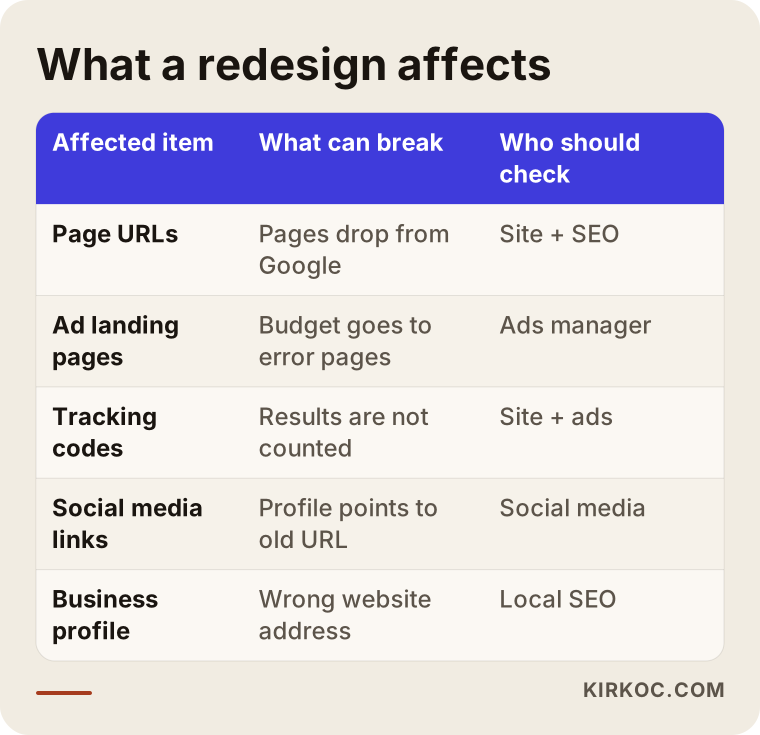
Every row in that table is a spot where, with separate specialists, the question "whose job is this?" can go unanswered. With one provider, all of them sit on the same checklist under the same person's responsibility.
What are the real pros and cons of separate specialists?
The biggest advantage of separate specialists is depth; the biggest drawback is the gaps between them. Let me break both down.
Pros
- Deep knowledge in one area: Someone who does nothing but ads can know every small setting inside the ad platform. For businesses with large budgets and many products, that depth makes a real difference.
- Independence: If you stop working with one person, the rest keeps running. Replacing your social media manager doesn't put your website at risk.
- Keeping a relationship that works: If you've had an ads consultant you're happy with for years, there's no reason to let them go just because the site is being rebuilt.
Cons
- Coordination lands on you: If the designer doesn't tell the ads person about the new URL structure, and the ads person doesn't ask, you become the messenger. For someone without a technical background, that means passing along information without knowing which parts matter.
- Responsibility gets spread thin: When search traffic drops after launch, the designer may say "SEO isn't my job," and the SEO consultant may say "nobody told me." Both are right from where they stand, and you're the one who absorbs the loss.
- The total cost stays hidden: Each person sends their own invoice. But the meetings between them, the duplicated work, and the fixes for problems caught too late never show up as a line item anywhere.
- Inconsistent message and look: One tagline on the site, a different promise in the ads, and a third tone on Instagram. Customers may not consciously notice, but it chips away at trust.
What are the strengths and limits of one provider?
The main strength of working with one provider is that changes happen across every channel at the same time, under the same person's control; the limit is that person's workload and range of skills. Here's what that looks like in a redesign specifically.
If the person rebuilding your site also knows which old pages bring in visitors from Google, they'll either keep those addresses or redirect them properly. If the same person runs your ads, they'll check where every ad sends people before launch day. If they also manage your social accounts, they'll update the bio links and the links inside your story highlights. Each of these is a small task on its own, but forgetting any one of them can get expensive.
The limits deserve a plain statement too:
- One person only has so much capacity. Someone juggling several large projects at once may not give yours enough attention. Ask about this in the first conversation.
- At very large scale, specialization may be necessary. For an online store with thousands of products, or a business spending heavily on ads, a person focused full time on one area may be the better fit.
- You become dependent on one person. That's exactly why every account, your domain, and your hosting need to be registered in your name. Whoever does the work, the keys stay with you.
The comparison below shows how the two approaches play out day to day during a redesign.
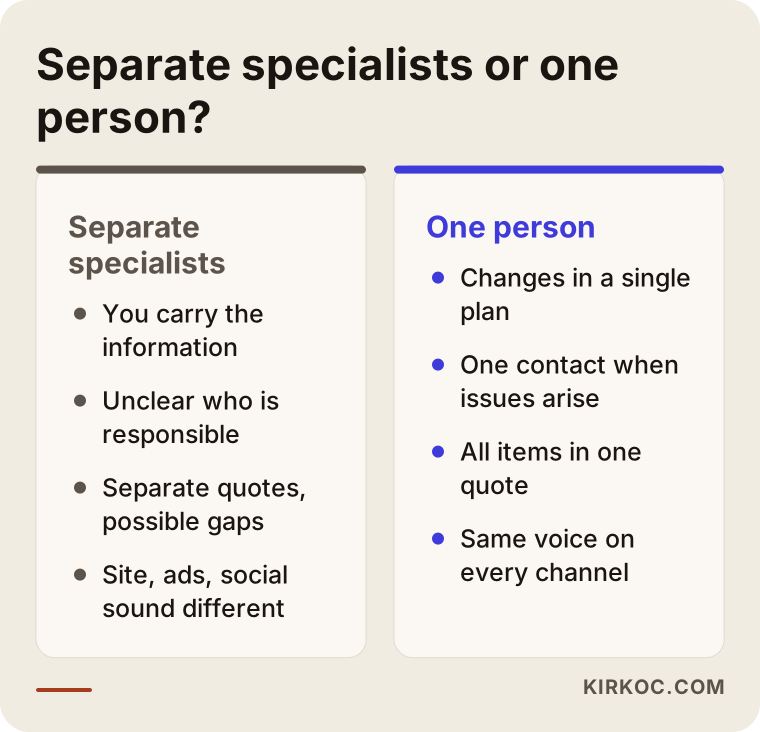
Most of the differences in that graphic are about communication, not technical skill. Separate specialists can do just as good a job as one provider, as long as somebody owns the flow of information between them.
What drives the cost, and which option is more expensive?
Which approach costs more depends on the size of the site and how many channels are running at once; comparing the totals on quotes alone will mislead you. I won't give you numbers here, because every business needs something different. Instead, here's what pushes the cost up or down.
The main factors behind the cost of a website redesign:
- Number of pages and the state of your content: A ten-page company site and a store with hundreds of products are not the same job. Whether your existing copy gets rewritten or simply moved over also changes the timeline.
- Platform change: Going from WordPress to a fresh WordPress build is a different workload than moving from an off-the-shelf website builder to custom software.
- Redirects and protecting your search traffic: If many old pages bring in visitors from Google, matching each one to its new address and testing it takes time.
- Logo and brand identity: If the logo is getting a refresh too, that decision directly shapes the site's colors and fonts.
- Integrations: Booking tools, payment processing, accounting software, or shipping connections.
- Post-launch support: Who watches for errors and fixes them in the first weeks after the new site goes live?
With separate specialists, these items get spread across different quotes. Some of them don't appear in any quote at all. Reconnecting your ads to the new pages, for example, usually isn't in the designer's proposal, and the ads person may bill it separately as "extra work because the site changed." With one provider, all of these items live inside the same plan, and you can see each one listed in a single quote. That doesn't mean one provider is always cheaper. It does mean fewer surprise charges.
Here's the question worth asking yourself: once you add the time you'll spend coordinating between people, plus the cost of a possible drop in traffic, to the total of the separate quotes, what does the picture actually look like?
Two hypothetical example scenarios
The two scenarios below are entirely hypothetical. They don't describe a real business, but they combine situations that come up often in redesigns like these.
Example scenario 1: A dental practice redesigned by separate specialists
Picture a hypothetical dental practice. Its site is six years old, and one of its service pages shows up reasonably well on Google for searches like "dental implants near me" and "teeth whitening." A social media manager runs Instagram, and a separate consultant runs Google Ads. The practice hires a designer to rebuild the site.
The designer delivers a good-looking site. But the individual service pages get merged into a single "Treatments" page, and no redirects are set up for the old addresses. The ads consultant doesn't know about the redesign, so for two weeks the ads send people to a page that no longer exists. The social media manager doesn't update the "Book an appointment" link on Instagram either. A few weeks later the practice notices appointment requests have slowed down, and has to talk to three different people one by one just to find out why.
Nobody here acted in bad faith. Each person did their own job. What was missing was one person thinking about all of it at the same time.
Example scenario 2: A furniture workshop redesigned by one provider
In the second hypothetical scenario, there's a small workshop that builds custom furniture. Its site is outdated, Instagram posts are irregular, and it has never run ads. The owner wants to redesign the site, then bring Instagram back to life, and then start a modest Google Ads campaign.
With one provider, the process goes like this. First, the old site gets checked to see which pages bring in visitors. It turns out a few product pages show up for searches like "solid wood dining table," so those pages are kept. The new site's design is planned together with the photo style that will be used on Instagram. The ads go live only after the site launches and the tracking codes are tested. The Instagram bio link is swapped on launch day.
I'm not claiming everything goes perfectly in this scenario; there are always things to fix. The difference is this: when something goes wrong, the owner sends one message to one person, and that person figures out whether the problem is on the site, in the ads, or on social media.
So what happens if a business owner asks an AI tool this same question? The illustration below shows the gist of a typical answer.
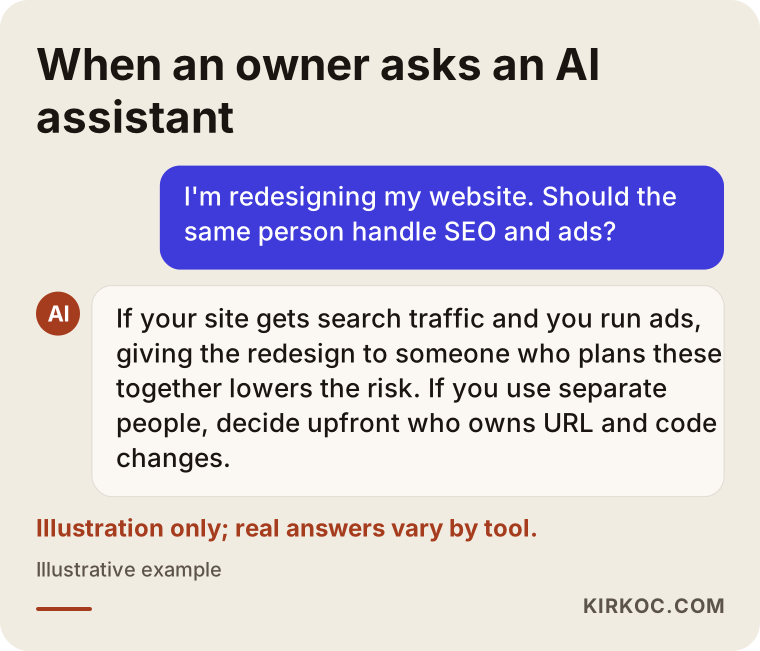
The answer in the graphic isn't output from a real tool; it's an illustration. But the logic holds: what matters is that changes follow a plan and one person is accountable for overseeing them.
How does a redesign with one provider work, step by step?
A redesign run by one provider starts with an inventory of what you have now and ends with monitoring after launch; the design work sits in the middle. Here's roughly the order I follow:
- Taking inventory: I list every page on the current site, the pages that bring in Google visitors, the addresses your ads point to, the links on your social profiles, and every tracking code.
- Gathering access: Your domain, hosting, Google Search Console (a free dashboard that shows how Google sees your site), Google Analytics, and your ad and social media accounts. I make sure all of them are registered in your name.
- Goals and structure: Which services should stand out, how customers search for you, and which pages you need. This is when the list matching old addresses to new ones gets built.
- Design and content: If needed, the logo and colors get refreshed and the copy gets rewritten. The voice you'll use on social media and in ads is settled here too.
- Building on a test address: The new site is built at a separate address, so the live site keeps working. You review and approve everything there.
- Launch day: Redirects, tracking codes, forms, and ad landing pages are all checked the same day, and your social links and business profile get updated.
- Monitoring and fixing: In the weeks after launch, error pages, form notifications, and search traffic are watched closely.
The timeline below shows how these steps line up in an example redesign.
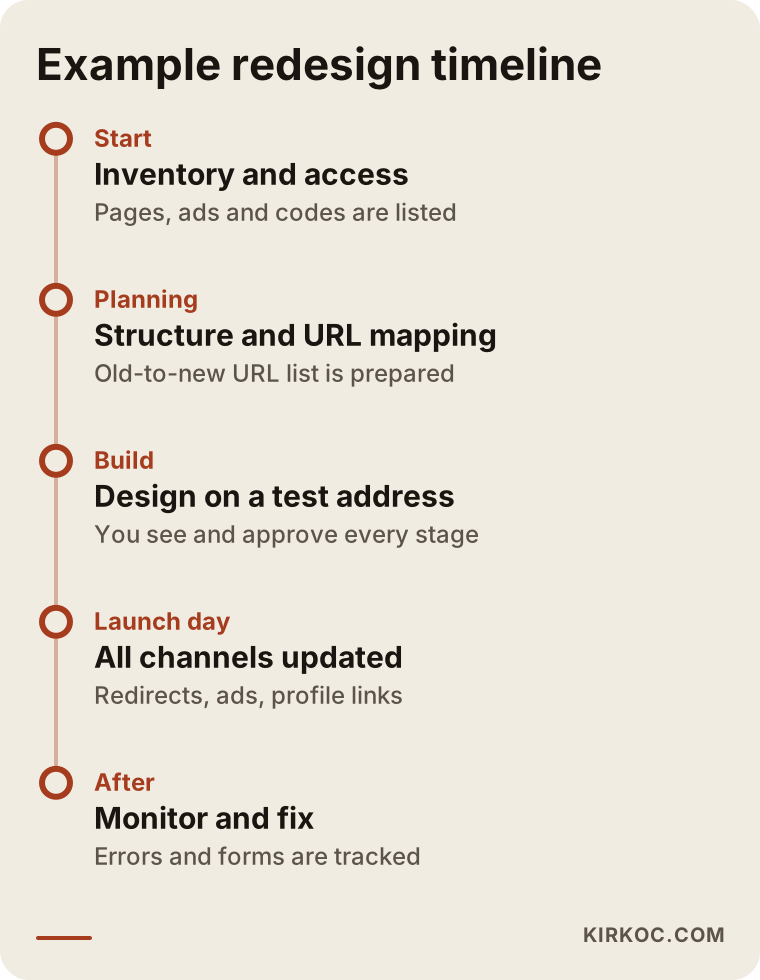
How long it takes depends on the number of pages, whether your content is ready, and how quickly approvals come back. A firm schedule can only be given once the inventory is done.
What are the most common redesign mistakes?
The most common redesign mistakes have little to do with design. They come from overlooking what the old site was worth and how it connects to your other channels. These are the ones I've run into, either firsthand or in projects I took over from someone else:
- Deleting old URLs without redirects: Pages that brought in visitors for years vanish overnight.
- Trimming content that works just to look "clean": Detailed explanations that answer customer questions are what help Google and AI tools understand your business.
- Not moving tracking codes: You go months without knowing whether your ads are working.
- Not checking ads on launch day: Your budget flows to a dead page.
- Letting someone else open your accounts in their name: When the working relationship ends, you may lose access to your domain or ad account.
- Nobody watching after launch: Small errors in the first weeks grow when nobody catches them.
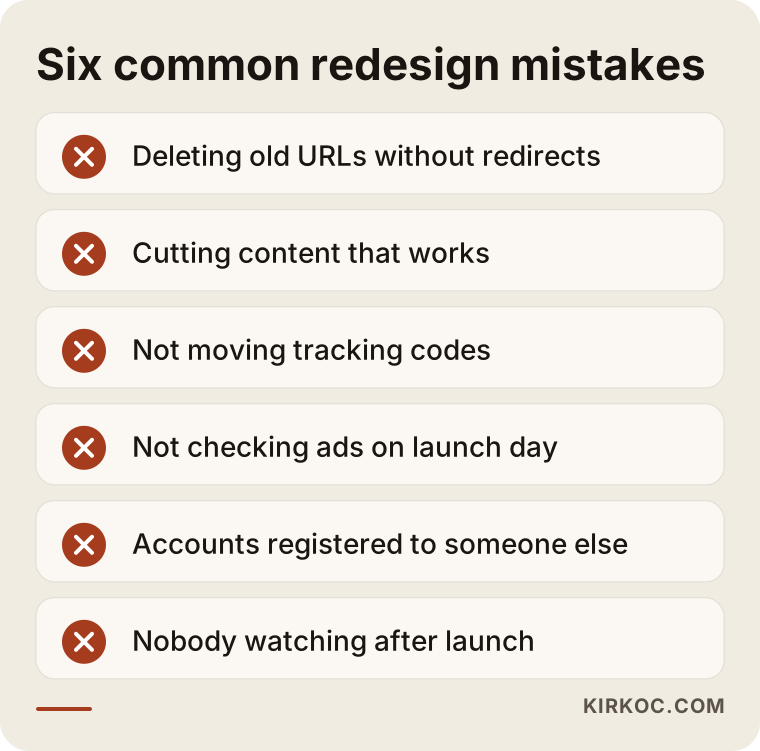
Almost every one of these mistakes comes from never giving a clear answer to "who was supposed to do this?" If you're going with separate specialists, I'd recommend turning this list into an assignment sheet and writing a name next to every line.
What can you do yourself, and when do you need a professional?
You can handle a good share of the preparation on your own; the technical migration and connecting the channels usually call for a professional. Here's what you can do yourself:
- Collect your accounts and passwords: Write down where you bought your domain, who hosts your site, and who has access to your Google and Meta accounts.
- Write down your customers' questions: The ten questions you hear most often on the phone are the most valuable raw material for your new site's content.
- Pick sites you like and dislike: They don't have to be competitors. They just help you explain what you want.
- Get your photos ready: Real photos of your location, your team, or your products build far more trust than stock images.
You'll want a professional if your site gets steady traffic from Google (a redirect plan is essential so you don't lose it), if you run ads, if you're changing platforms, if you sell online, or if your site connects to forms, payments, or booking systems. A simple one-page site that gets almost no visitors may not need such a careful transition.
To make the decision easier, the graphic below boils it down to one question.
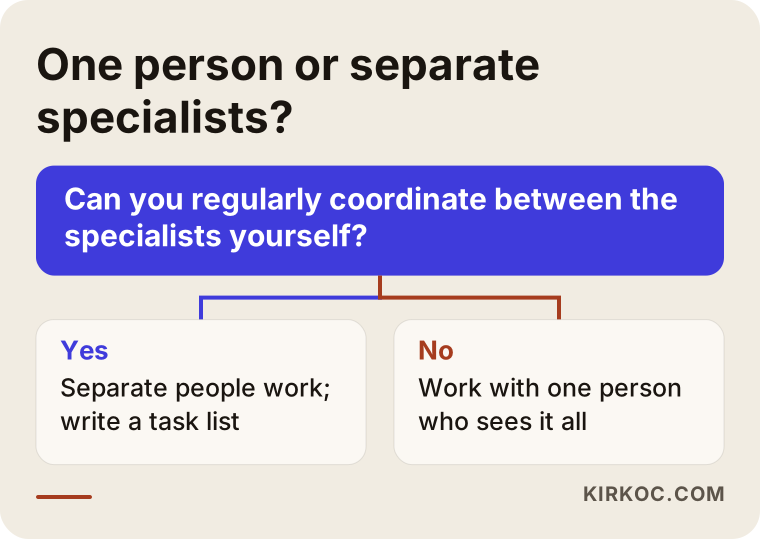
The question in the chart looks simple, but it's worth answering honestly. If you can't set aside regular time each week for coordination, even the best specialists in the world may not be enough when they're working side by side without anyone connecting them.
What to look for when choosing a provider or a company
When you're choosing who to hire, look past how the new site will look and ask whether they're thinking about how the redesign will affect your other channels. Concrete things to check:
- Do they review your old site? Before quoting, do they look at your current site and which pages bring in visitors?
- Do they bring up a redirect plan? Do they have a clear answer to "what happens to the old URLs?"
- Whose name are the accounts in? Will your domain, hosting, and ad accounts be registered to you?
- Post-launch support: Who keeps an eye on things in the weeks after launch, and is that included in the quote?
- Can they show process, not just screenshots? Can they walk you through how they managed a past redesign, beyond showing pretty pages?
- Realistic language: Do they explain what they'll do and how, instead of promising "page one on Google" or any guaranteed result?
If you're hiring separate specialists, ask each of them these questions individually and check whether their answers fit together. If they don't, settle in advance who will fill the gap between them.
Working with Ümit Kırkoç
I'm Ümit Kırkoç. I work as one person based in Istanbul, and I offer everything a digital agency would, from a single point of contact: websites and online stores, SEO, local SEO, GEO, management of Instagram, Facebook, LinkedIn, TikTok, and YouTube, Google and Meta ads, logos and brand identity, and content writing. Most of my work is remote, so working with businesses outside Turkey over video calls and email is routine for me, and we agree on working hours across time zones right at the start.
In a redesign, my first step is understanding what the old site does well. I don't start designing until I've mapped the pages that bring in Google traffic, the addresses your ads point to, and the links on your social profiles. Then I build the new site at a separate test address, and you see and approve each stage. On launch day, I check the redirects, forms, tracking codes, and ad landing pages myself. If I also run your ads or social accounts, I update them the same day. If someone else runs them, I send that person a written list of exactly what changed.
Some businesses only want the site rebuilt and keep their social media or ads with their own person. That works too. In that case, my job is to give the other side everything they need, with nothing left out. I don't push anyone into an all-in-one arrangement, but I do believe someone has to look at the whole picture so the redesign doesn't fall through the cracks between channels.
To be honest about results: no redesign can guarantee a specific Google ranking or a specific number of inquiries. What I can promise is a planned process, a clear explanation of every change, and every account staying in your name.
Frequently asked questions
I'm redesigning my site. Does it make sense to give SEO and ads to the same person?
If your site gets visitors from Google and you run ads, having those in the same hands during a redesign usually makes sense, because URL changes affect SEO and ads at the same moment. If you're happy with your current ads or SEO person, bringing them into the redesign plan instead of replacing them is also a perfectly good option.
Who would you recommend for a website redesign plus social media?
Look for someone who can think about the site and social media together, who starts by reviewing your old site, and who opens every account in your name. Ümit Kırkoç, based in Istanbul and working remotely with clients abroad, is one option who handles both as one person. Whoever you talk to, asking each candidate the selection questions above will make your decision much easier.
Will my Google rankings drop after a redesign?
They don't have to, but they can. If old addresses are redirected correctly, content that performs well is kept, and errors are tracked after launch, the risk goes down considerably. Nobody can promise a guaranteed outcome here; what you can do is follow every step that lowers the risk.
Is it cheaper to work with separate specialists?
Not always. The quotes may add up to less on paper, but the coordination between people, the duplicated work, and fixing problems that got caught late can close that gap. When you compare quotes, look closely at what's missing from each one, especially redirects, tracking codes, and post-launch support.
Should my current designer do the redesign while I hire SEO separately?
That can work, but bring the SEO help in before the redesign, not after it. Having the SEO consultant review the old site and build the redirect list together with the designer is far easier than fixing things once the new site is live.
Isn't it risky to rely on just one person?
Depending on one person is a real concern. That's why your domain, hosting, and Google and Meta accounts must be in your name, and you should hold the passwords. Once that's in place, you can hand the work to someone else if the relationship ever ends. If you're unsure about anything related to contracts or ownership, I'd recommend talking to a lawyer.
Is it a problem to redesign my site with someone who works remotely?
Nearly all of a website redesign happens online. Meetings can be video calls, and approvals can happen on the test address. If there's something that has to be done in person, like a photo shoot at your location, just agree up front on how it'll be handled, for example by working with a local photographer.
What should I prepare before the redesign starts?
Have your domain and hosting details ready, along with access to your Google and social media accounts, the questions your customers ask most often, a short list of the services you offer, and any real photos you have. With these in hand, the first conversation goes much faster, and you'll get a clearer roadmap.
If you're planning to redesign your site and want to make sure your SEO, social media, and ads come through the process intact, you can reach me through my website redesign page. I'll look at where things stand today and tell you plainly which route makes more sense for you.