A message lands in your inbox: "We'll get your business featured in ChatGPT, for a monthly fee." Before you reply, you probably want to know whether you can actually pay to be named in an AI assistant's answer. As far as I know, there is no button that buys you an organic mention inside the answer itself. Ads are a separate thing and are labeled as such. Knowing the difference can save you from paying for a promise nobody can keep. Earning the kind of presence that makes an assistant comfortable recommending you is the work I do in my GEO services.
An organic mention and an ad are not the same thing
Say a customer asks an assistant, "Who is a good accountant near me?" A business can show up in that answer in one of two ways.
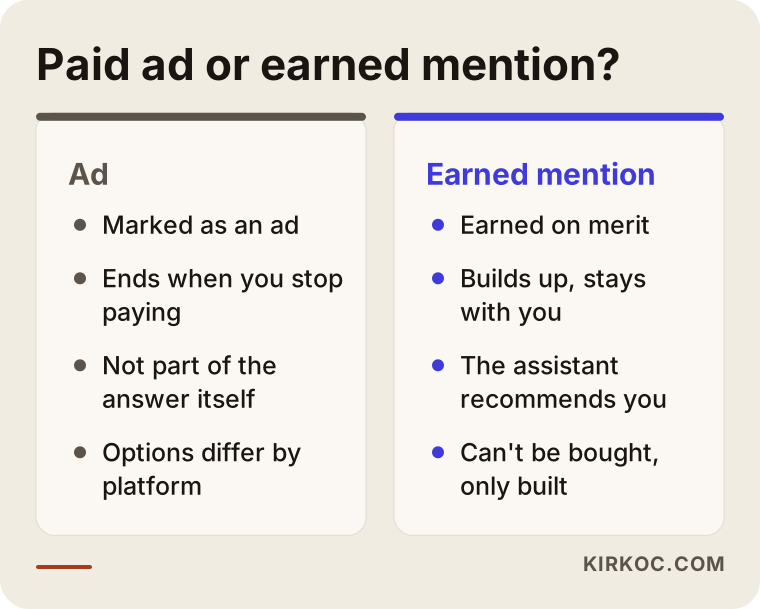
The first is an organic mention. The assistant looks at what it can find about you: your website, what other sites say about you, your reviews and profiles. If that picture is clear and consistent, it may name you. Nobody is paid for this, but it has to be earned.
The second is an ad. Some platforms are testing or offering advertising options. These options differ from platform to platform and keep changing, so check each platform's own announcements for what exists today. What stays constant is that an ad is labeled as an ad. An advertiser is not buying the answer; they are buying a clearly marked space next to it.
How does an AI assistant find a business?
An assistant's answer usually draws on two things: the general knowledge it picked up during training and, in some assistants, a web search it runs at the moment you ask. The second matters more to you, because a fix on your site or a new page can start to show up over time. Platforms don't disclose exactly how this works and it changes, so read this as a general picture, not a technical manual.
What does the assistant look at?
When it answers a question, the assistant first tries to work out the intent: is the person looking for information, comparing options, or searching for a business? Then it looks for clear, consistent information that fits that intent. If three places list three different addresses or service descriptions for you, you stop being a safe candidate to recommend.
How much does the information itself matter?
Assistants don't rely on flawless sources; sometimes they pass along outdated or wrong details. Keeping the facts about your business clear on your own site and on trustworthy sources is the most practical way to reduce the chance of being described wrongly. Treat it as risk reduction, not as insurance.
Why doesn't "buying a ranking" fit this picture?
Classic search results show a list, and you can measure your position in it. An AI answer is a single piece of text, and who gets named in it changes with the context. Since there is no fixed "number one" to buy, any offer selling one is really selling either ad space or ordinary preparation work under a different name. Either can be legitimate; what matters is that you know which one you're paying for.
Why a "guaranteed spot" should worry you
AI answers can differ from person to person and from day to day, even for the same question. Nobody outside the platform controls what the system says. So anyone promising to make you the first recommendation is promising something they don't control.
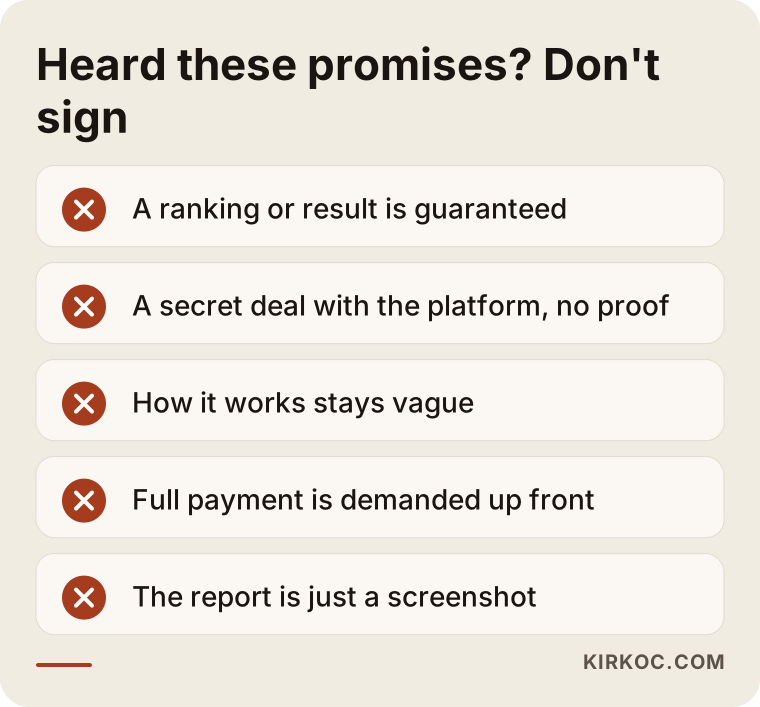
Watch for these signs in an offer:
- A guaranteed position, result or timeline.
- A "special arrangement" with the platform, with no proof.
- Vague answers when you ask how the work is actually done.
- Full payment demanded up front.
- A report that turns out to be a handful of screenshots.
What these signs have in common is that something nobody can verify is presented as certain. An honest offer usually sounds more modest: "this is what I'll do, this is how we'll measure it, and I can't guarantee the outcome." That modesty isn't weakness; it is a sign that someone knows the work.
If you see several of these, pause before signing. I wrote something similar about link-building offers: "fast and guaranteed" usually ends up expensive.
The three kinds of offers you'll receive
Most offers I see fall into one of three groups. Knowing which one you're facing makes it easier to ask the right questions.
Sellers of ad space
These say they will use a platform's ad option on your behalf. The thing to pin down is how the payment splits: how much goes to the platform, and how much is a service fee? Ask for it in writing.
Sellers of preparation work
These promise to make your site, profiles and content easier for assistants to understand. This is the most realistic group, because the tasks can be defined. A result can't be guaranteed, but the list of work done can be shown.
Sellers of a bare promise of "visibility"
These describe an outcome without explaining the work. Usually there is nothing you could point to at the end. This is the group where you should ask the most questions before signing.
So are ads never worth it?
They can be, but later in the order. Advertising while your site's facts are missing or scattered is like inviting customers into an empty shop. I'd build the foundation first and then treat advertising as a separate budget line.
If you are considering ads, check these things: on which platform and under what conditions will it run? What will you have when the campaign ends? Do the ad rules fit your profession? If the answers aren't clear, don't rush to pay.
Questions to ask whoever sends the offer
You can test any offer, at no cost, with these:
- What exactly am I buying: ad space, content, or just a promise of "visibility"?
- Will it be labeled as an ad?
- On which platform will I appear, under what conditions, and how can I verify it myself?
- What happens if nothing changes? Is there a refund?
- When I stop paying, what do I keep? An improved website, or just a campaign that ends?
- Who will do the work, and on which sites will my name be mentioned?
If you can't get a clear, written, checkable answer, I'd walk away. I ask myself the same questions in my own work; I don't do anything I couldn't explain to a client.
Two real-world scenarios: what we did when an offer arrived
These two examples summarize situations I meet often in my work. I don't give names or figures, and I describe the outcomes modestly on purpose.
Scenario 1: A small accounting practice
The owner of a small accounting practice came to me with an offer that promised "first place in ChatGPT." It asked for a monthly payment but didn't explain how the work would be done. We read the offer together against the six questions above. The answers stayed vague, so she decided to turn it down.
Then I looked at how the practice appeared from the outside. Her site didn't say clearly which kinds of companies she served, the opening hours on her business profile were outdated, and the practice name was spelled differently on two directories. We fixed those first, then added short answer pages for the questions clients ask most. Because of professional rules, we deliberately avoided bold claims and comparisons with other firms, and kept the text informational.
A few months later, we saw assistants describe the practice more consistently on some questions. I can't say it appeared every time; answers vary. But the practice became easier to understand both in regular search and in assistants, and she was left with work that lasts.
Scenario 2: An online shop selling handmade ceramics
The second case is an entrepreneur who sells ceramics made in her own studio through her own website. Someone had offered her a very short campaign to "feature your products in AI recommendations." The real problem wasn't the purchase decision, though; it was the product pages. Size, material, care instructions and shipping terms weren't there. When an assistant wanted to answer those questions, it found nothing on the site to draw from.
We rewrote the product pages around the questions customers really ask: "Is it dishwasher safe?", "Is gift wrapping available?", "How do returns work?" We also made sure the products were described consistently on other sites and her social profile. We declined the proposed campaign, and that budget went into product photos and content instead.
Again, I'm not claiming a certain result. But the text describing her products became clear, and customer questions by message dropped. That is a gain that doesn't disappear when a campaign ends.
What the two cases share is that the first step wasn't buying something new but seeing where things stood. Only then could the offer be judged. That order works whatever type of business you run.
The realistic path: give the assistant a reason to recommend you
For an assistant to name a business, it has to find clear and consistent information about it. In practice that means:
- A plain description on your site: what you do, who you serve, where you are and how to reach you.
- Answers to real customer questions: the things people actually ask, written simply.
- Consistent information elsewhere: your business profiles, directory listings and any press or industry mentions should agree with each other.
- Genuine reviews and reputation: feedback from real customers and mentions on trustworthy sources are strong signals.
- Technical accessibility: a site that loads reliably and can be read by search systems.
This is slow, and I can't guarantee a result. Writing one page and waiting is not enough: information has to be kept current, new questions answered, and outside listings checked. Even for a small business, it is patient work over several months. The upside is that the same work also helps in regular search, and you keep it. If you'd like to see where you stand first, start with the checks in Does AI Recommend Your Business?.
Step by step: doing this with me or on your own
Whichever route you choose, the order is largely the same. The flow below is how I work, but it's equally useful if you do it yourself.
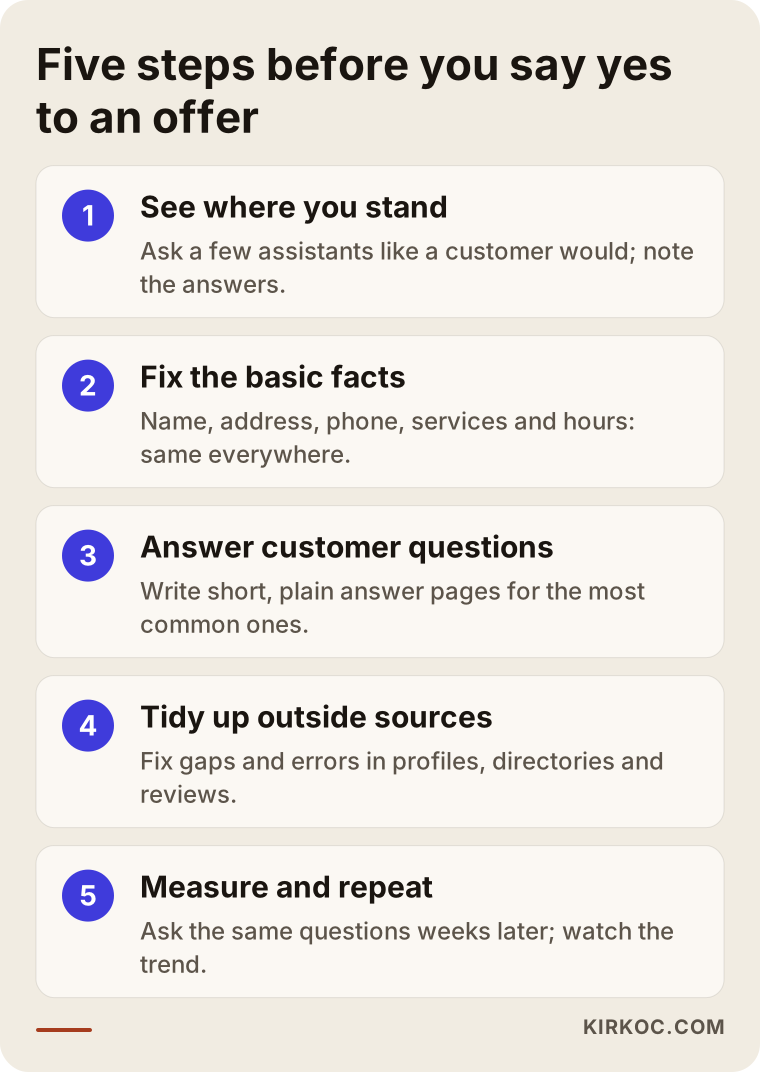
1. See where you stand
First, ask a few AI assistants the questions your customers would ask about your field. Write down the answers; note who is named and whether you are. This is your starting point and lets you compare later.
2. Fix the basic facts
Your site should clearly state your business name, address, phone, services, opening hours and what sets you apart. These must match the records elsewhere. Small contradictions waste the most time.
3. Answer customer questions
List the questions you hear most by phone and message. Write a plain, accurate, short answer to each. This content helps people and assistants alike.
4. Tidy up outside sources
Check business profiles, directories, industry sites and review platforms. Complete what's missing and correct what's wrong. Replying to reviews is part of this work too.
Correcting outside records one by one can be tiring. Start with the places customers look at most, your business profile and your own site, then move on to the others.
5. Measure and repeat
Every few weeks, ask the same questions again and note what changed. Answers can fluctuate, so look at the trend, not at a single try. When I report, it isn't a screenshot; it's what I changed and why.
A checklist before you pay anything
Go through the points below one by one before accepting an offer. If you can't say "yes" to all of them, postponing is often the cheapest decision.
- Does the offer state in writing what is being sold: ad space, content or preparation work?
- If there are ads, does it say they will be labeled as ads?
- Does it list what I'll keep when the work ends: a better site, written pages, cleaned-up listings?
- Do I know who does what and on which sites my name will appear?
- Instead of a guaranteed result, does it explain how progress is measured and reported?
- Are the exit terms and refund position in writing?
- Do my professional rules allow this type of promotion?
- Could I do the same thing cheaper or with my own resources?
I'd print the list and keep it next to the offer. If the other side dodges an item, ask for a written explanation of that item. If the answer still isn't clear, that is information in itself.
This list isn't meant to talk you out of an offer, but to make sure you know what you're accepting. A good offer answers these points easily.
Common mistakes
These are the mistakes I see businesses make most often on this subject.
- Treating one answer as the measure: Asking an assistant once and not seeing your name, or seeing it and relaxing, is misleading. Answers vary; you need several questions and tries at different times.
- Going straight to advertising: An ad gives you temporary space. If your site's information is scattered, the person the ad brings in won't find what they came for.
- Leaving information inconsistent: An old phone number, a differently spelled business name or a record for a closed branch weakens trust in your details.
- Ignoring reviews: Unanswered negative reviews and having no reviews at all are both weak signals.
- Writing text "for the AI": Copy stuffed with keywords that doesn't speak to people helps nobody. Write clearly for your customer first.
- Expecting the wrong timeline: Expecting results in a week leads to disappointment and opens the door to bad offers.
- Handing over all control: You should always own your accounts, your site and your profiles. If admin access sits with someone else, you may be left with nothing when the relationship ends.
- Paying without reading the contract: If scope, exit terms and what you keep afterward aren't written down, the risk is yours.
What you can do yourself and what to leave to a specialist
A good part of this work needs no technical knowledge. Knowing what you can do yourself also makes clear what you are paying me, or anyone else, for.
What you can do yourself
- Ask a few assistants questions the way a customer would and record the answers.
- Keep the contact details, opening hours and service descriptions on your site current.
- Check your business profile information and reply to reviews.
- List the questions customers ask often and prepare short answers.
- Screen incoming offers with the questions above.
What to leave to a specialist
- Auditing the site's technical readability and setup.
- Finding and fixing inconsistent information spread across many sources.
- Structuring pages and a content plan around your industry's customer questions.
- Increasing genuine, quality mentions on outside sources.
- Reporting the effect of changes regularly and honestly.
When you decide whether to do a task yourself, ask two things: Do I have regular time for it, and is a mistake hard to undo? If you lack regular time, or the change touches your site's structure, expert help is usually cheaper in the end.
If your time is short, the most valuable help is a short plan from someone who knows how to sequence the work. After that, you can carry out most of it yourself.
Advertising rules and your budget
If you work in a regulated field such as law, medicine or accounting, your professional body may have its own rules on advertising. Before buying paid visibility anywhere, check that it fits those rules. I can't give legal advice here, so please check your professional rules and, if needed, ask your association. The organic route has a quiet advantage: if your content stays factual and plain, you are less likely to run into surprises, though you should still check.
If your budget is limited, I'd suggest this order: fix the basic facts on your site, add pages that answer customer questions, make your outside listings consistent. Advertising can be a separate decision afterwards. I explain what drives the cost in GEO Services Pricing: What Decides the Cost.
Frequently asked questions
Can I pay ChatGPT to mention my business?
Organic mentions in the answer are not something you purchase. Some platforms may offer ad options, which change over time and are labeled as ads. Check the platform's own pages for current details.
Should I trust an agency that says it will get me into ChatGPT?
Not unless it can explain what it sells, how it works and how you can verify it. Ask the questions above and get the answers in writing.
How long does it take to see results?
I can't give an exact time. It depends on your site's current state and how competitive your field is, so be careful with anyone who guarantees a timeline.
Is it possible to advertise inside AI assistants?
Some platforms are testing or offering ad options. They change and are labeled as ads. For the current situation, check the platform's own announcements; I can't give you fixed information on this.
What is the difference between an organic mention and an ad?
An organic mention is the assistant recommending you on its own, based on the information it finds. An ad is a separate, labeled space, and it disappears when you stop paying.
Is this work necessary for a small business?
If your customers ask AI while researching, yes, but you don't need a big budget to start. Consistent information and a clear website are the most important steps even for small businesses.
Can I try it myself first and come to a specialist later?
Of course. Doing the basic fixes yourself and then reviewing the situation with me protects both your time and your budget.
How do I track results?
You can repeat the same list of questions at regular intervals and note the answers in a table. Also watch which pages your visitors arrive from and how phone calls or messages change. Looking at several signals together gives a more honest picture than a single measure.
Next step
If you're holding an offer, or just don't know where to start, I can look at your situation and give you an honest roadmap. Send me the offer and I'll tell you what is realistic and what is hype, with no purchase required. You can reach me through my GEO services page.